A 3s spin leaves 1.7s to see the loss — pause button at 0
A three-second spin leaves 1.7 seconds of dead air after the reels stop, and that gap is exactly where a pause button would do the most good
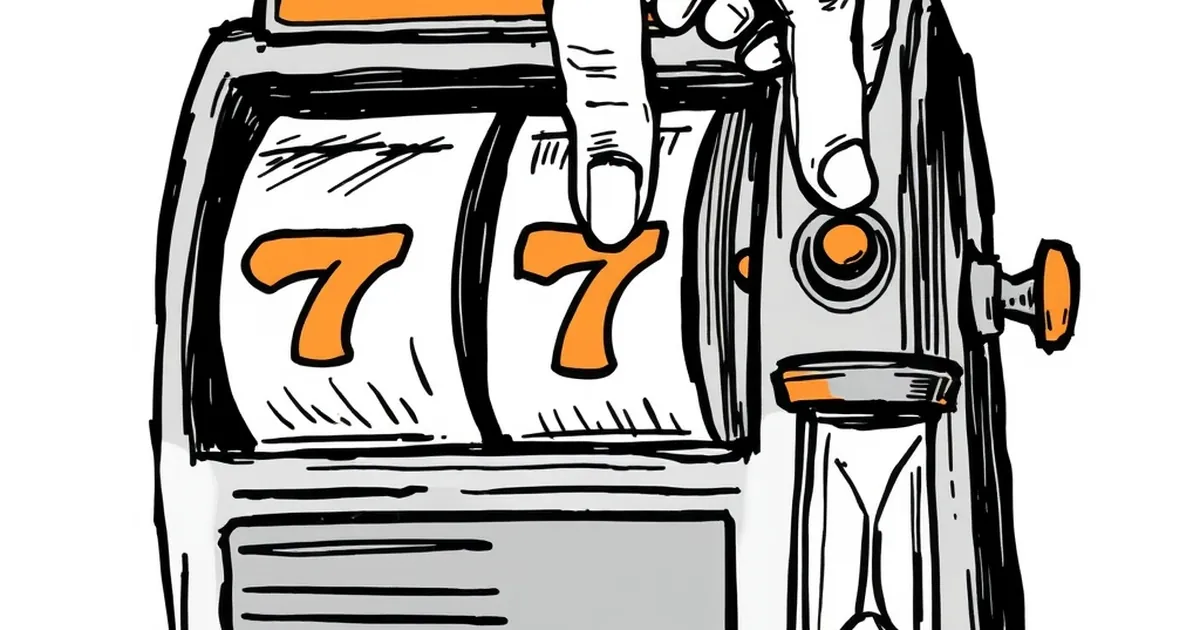
A three-second spin on a modern pokie leaves roughly 1.7 seconds of dead air after the reels stop — time in which the outcome is already locked, the win or loss is already on screen, and the machine is waiting for you to press again. That gap is not incidental. It is the exact interval where a pause button would do the most good, and almost no pokie has one. The question worth asking is why the industry treats a 1.7-second silence as sacred when it treats everything else about the session as configurable.
The maths behind that number is straightforward. A typical five-reel video pokie runs its spin animation for around 3 seconds depending on the game and the player's turbo settings. The result resolves at the end of the animation, not at the start, so the moment the last reel lands you have already won or lost. What follows is a variable hold — usually between 1.5 and 2 seconds — before the spin button re-arms. Call it 1.7 seconds as a working average. In a 600-spin session, that adds up to about 17 minutes of pure, outcome-known waiting. Not decision time. Not entertainment. Just a locked result and a thumb hovering.
Why the dead air exists at all
There is a legitimate design reason for a post-spin pause, and it is worth separating from the less legitimate ones.
The honest version: anticipation. Pokie design leans on the gap between "reels stopping" and "result confirmed" to build tension, especially on near-misses and feature triggers. That gap is part of the product. Players who enjoy the format generally enjoy the drumroll. Remove it entirely and you get the turbo-spin experience, which some players prefer and which regulators in several jurisdictions have started to look at more closely because it compresses decision time.
The less honest version: the pause keeps the spin cadence in a band that maximises handle. Too fast and players burn out or notice the losses stacking; too slow and the machine feels sluggish and they leave. That 1.5-to-2-second window is tuned. It is not an accident of animation timing.
So when someone argues for a pause button at 0 — a control that freezes the session the instant the result lands, before the next spin is even offered — they are asking the operator to give up a tuned parameter. That is why it does not exist.
What a pause at 0 would actually change
The interesting thing about a pause that triggers at the moment of resolution is that it interrupts the loop at its most vulnerable point: the instant after the loss is visible but before the reflex to re-spin fires.
Most responsible gambling tools operate at the wrong timescale for this. Session limits, deposit limits, and reality checks all work in minutes or dollars. They are useful. But a reality check that pops up after 60 minutes is not competing with a 1.7-second reflex — it is competing with roughly 2,100 of them if you are spinning at a steady clip. The tool and the behaviour are operating in different units.
A pause at 0 would be the only intervention measured in the same unit as the behaviour it targets. Press it, and the machine holds. You have to actively resume. That is a meaningfully different cognitive task from "keep spinning by default."
Worth noting: some jurisdictions already mandate something adjacent. The UK has required spin-speed minimums and autoplay restrictions for years. Australia's approach has leaned harder on pre-commitment and venue-based controls than on in-game friction. Nobody has mandated a resolution-time pause, as far as I can tell, and that is a gap worth naming.
The counterargument, taken seriously
The obvious objection is that a pause button at 0 would be ignored, the same way tilt sensors and pop-up reminders get ignored. That is a fair point and it deserves a fair answer.
The evidence on friction tools is mixed but not empty. Loss-display features — showing net loss in real time rather than net win — have measurably changed behaviour in lab and venue studies, though effect sizes vary and the industry has been slow to adopt them voluntarily. The pattern is that friction works best when it is the default, not an option buried in a settings menu. A pause button that ships off by default would do nothing. A pause that ships on by default, with an opt-out, would at least generate the data to settle the argument.
There is also a design objection: a pause at 0 breaks the rhythm that makes pokies enjoyable for the majority who play them without harm. That is real. The counter is that the rhythm can be preserved for players who want it while the default changes for everyone else — which is exactly how autoplay restrictions were handled in several markets, and the sky did not fall.
What the 1.7 seconds is really protecting
Step back and the 1.7-second gap looks less like a design flourish and more like the last unexamined part of the loop.
Everything else about a modern pokie session is negotiable. Bet size, spin speed, autoplay count, session length, deposit ceiling, reality-check interval — all configurable, all documented, all subject to regulatory minimums in mature markets. The one parameter that stays fixed is the beat between result and re-spin. It is fixed because it is the parameter that most directly drives revenue per hour, and because no regulator has yet forced the issue.
That is not a conspiracy. It is just an incentive doing what incentives do. The question is whether a market that has spent two decades adding friction everywhere else should leave the highest-frequency decision point untouched.
The open question
Here is the thing I keep coming back to. If a 3-second spin leaves 1.7 seconds to see the loss, and the result is already locked at second three, then the pause button at 0 is not asking for more time to decide. It is asking for the option to not decide at all — to let the session sit, resolved, while you think about something other than the next spin.
The industry's answer, so far, has been that players do not want that. But nobody has actually offered it at scale, so nobody knows. The next round of Australian regulatory review — whenever it lands — could settle it with a single default-on requirement and a year of data. Until then, the 1.7 seconds stays exactly where it is: unowned, unmeasured, and doing quiet work on behalf of the house.
If you are going to play, set your limits before you start rather than during the 1.7-second window, when you are least likely to be honest with yourself.