Autoplay spins 50 before you notice — the stop button sits at 3
Autoplay spins 50 before you notice, while the stop button sits at 3. Here's how interface design quietly shapes your play
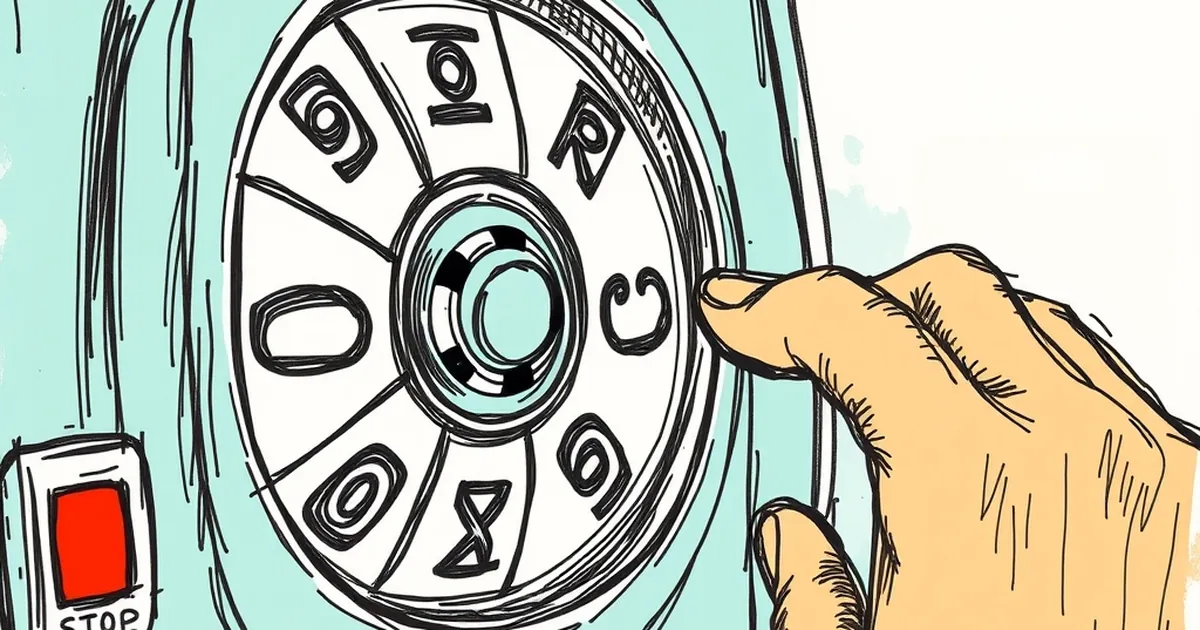
Autoplay spins 50 before you notice — the stop button sits at 3. That's the shape of the problem: the control that starts a run of spins is a big, friendly, thumb-sized target, and the control that ends it is a small grey circle tucked in the corner of the screen. On a phone in portrait mode, that stop button is often 12–14mm from the edge and about 8mm across. The spin button is more like 20mm and dead centre. Your thumb finds one of those without you thinking about it. The other one you have to look for.
That asymmetry isn't an accident. It's interface design, and it's worth understanding before you decide whether autoplay is a tool you use or a tool that uses you.
What autoplay actually does, mechanically
Autoplay on a modern pokie isn't the old "spin until you stop it" toggle from a decade ago. Most Australian-facing sites now run a version with a preset count: 10, 25, 50, 100 spins, sometimes 200. You pick a number, hit go, and the machine runs that many spins at your stake. Some versions stop on a feature trigger, some stop when your balance drops below a threshold you set, some just run to zero and ask if you want another 50.
The number matters more than people think. At 2.5 seconds per spin — a reasonable average once you account for reel animation and the pause between spins — 50 spins is a bit over two minutes. 100 spins is four and a half minutes. 200 spins is close to nine minutes of continuous play where your only active decision was made before the first spin landed.
That's the whole trick. Autoplay converts a series of decisions into a single decision. You stop saying "spin" fifty times and start saying "spin fifty times." The cognitive load drops to near zero, which is exactly why it feels relaxing and exactly why losses can accumulate faster than you'd expect from manual play.
The maths of the run
Take a mid-variance pokie at 96.2% RTP and a $1 stake. Over 50 spins you're wagering $50. The house edge of 3.8% means the expected loss is $1.90. That sounds trivial. But expected loss isn't what you feel — variance is. On a 96.2% game with typical volatility, a 50-spin run at $1 has roughly a 40% chance of finishing down more than $10, and about a 15% chance of finishing up more than $10. The distribution is wide.
Run 200 spins instead and the expected loss is $7.60, but the swing is bigger and the time spent is four times longer. The problem isn't the maths. The maths is fine and disclosed. The problem is that four and a half minutes is long enough to lose track of how many runs you've done.
Why the stop button is small
There's no conspiracy required here. The stop button is small because it doesn't need to be pressed often. It's a secondary action. Designers size buttons by frequency of use, and by that logic the spin button deserves to be big. Fine.
But frequency of use isn't the only thing that matters in a gambling interface. The stop button is the one control that exists purely to interrupt a process designed to be uninterrupted. Autoplay's value proposition is that you don't have to interact. The stop button's existence is an admission that sometimes you should. Making it small, low-contrast, and positioned away from where your thumb rests is a design choice that quietly discourages the interruption.
Some jurisdictions have pushed back. The UK Gambling Commission banned autoplay entirely on licensed sites in 2021, and the reasoning was specifically about the loss of the "reality check" moment between spins. Australia doesn't have an equivalent federal rule for offshore-facing sites, and state-based regulation of online pokies is a mess of grey areas. So the interface you get depends on where the operator is licensed, not where you are.
What a fair autoplay interface would look like
If you were designing this honestly, you'd put the stop button where the spin button is — same size, same position, swapping in place once the run starts. You'd show a persistent countdown of spins remaining in a font size you can read without squinting. You'd force a confirmation at every 50 spins. You'd make the balance display update in real time and stay visible.
Almost none of that is standard. Some sites do one or two of those things. The countdown is fairly common now. The confirmation at intervals is rare. The stop button swap is almost never done, because it would make stopping as easy as starting, and that changes the economics of the product.
The reality check that never fires
Most regulated sites have a "reality check" — a popup that appears after a set interval, usually 30 or 60 minutes, telling you how long you've been playing. It's a good idea in principle. In practice it's easy to dismiss and easy to ignore, and it fires on a timer that has nothing to do with your session's intensity.
Autoplay runs are shorter than the reality check interval. Fifty spins is two minutes. You could complete thirty autoplay runs in an hour and the reality check would fire once, at the end, when you've already made every decision. The check is calibrated to time, not to spend or spin count. That's the gap.
A more useful check would fire on cumulative stake. If you've wagered $500 in the last hour, that's worth a popup regardless of whether it took you 20 minutes or 90. Nobody builds it that way because the metric that matters to the operator is time on site, and the metric that matters to you is money out the door. Those aren't the same number.
Setting your own limits
The practical workaround is to use the deposit limit tools most sites offer — daily, weekly, monthly caps that are enforced at the account level, not the game level. A $50 daily deposit limit is more effective than any in-game stop button, because it removes the decision from the moment when you're least likely to make a good one.
Session reminders are weaker but not useless. Set one for 20 minutes if the site allows it. The point isn't that the reminder will stop you. The point is that it creates a moment where stopping is a live option, and that moment doesn't otherwise exist inside an autoplay run.
The question worth asking
The stop button sits at 3 because the product is designed around continuous play, and continuous play is more profitable than interrupted play. That's not a scandal. It's just true, and it's the thing to hold in your head when you tap the big button.
The open question is whether regulators will ever treat interface design as a form of harm reduction rather than a matter of taste. The UK answered yes in 2021 and killed autoplay outright. Australia hasn't answered at all. In the meantime, the honest move is to assume the interface is not on your side, and to build your own stops — deposit limits, session reminders, a hard rule about how many autoplay runs you'll do before you close the tab — somewhere the operator can't shrink them to 8mm and grey them out.
If you're going to use autoplay, use it with a number you chose before you sat down, not one you picked because 100 looked better than 50 in the moment. And if you're ever unsure whether it's still fun, that's usually the answer.