Bonus wheel lands at 20 — the terms cap it at 5
Bonus wheel promos advertise 20x multipliers while terms quietly cap payouts at 5x your deposit, revealing how Australian-facing offers mask their real value
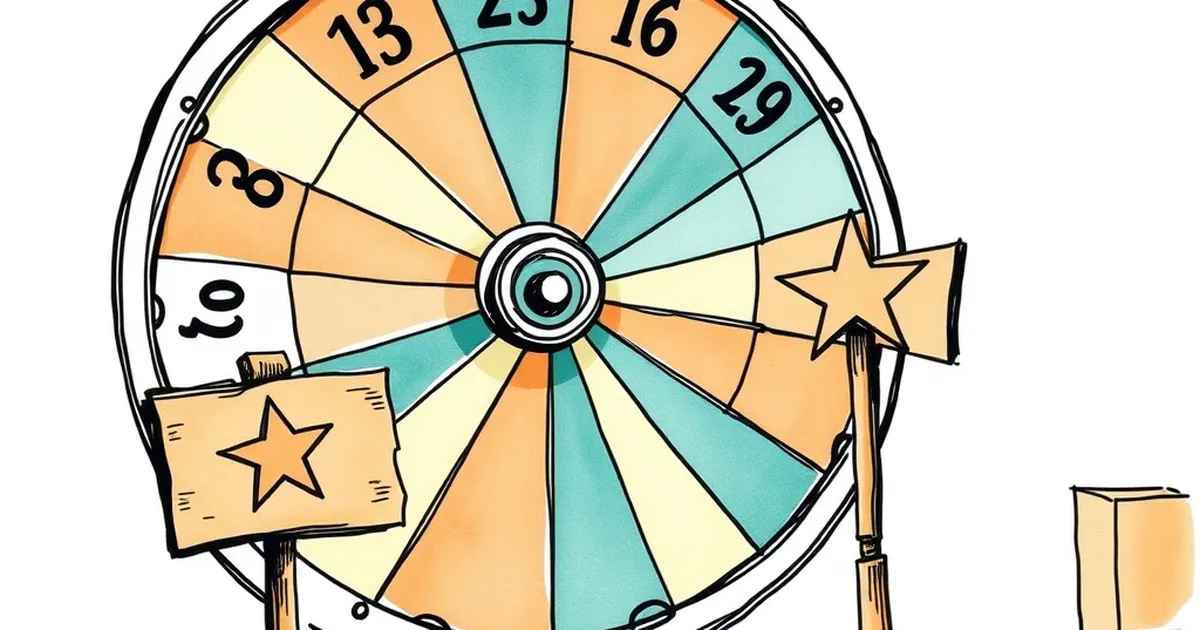
A bonus wheel that lands on the 20x multiplier sounds like a win until you read the fine print and find the payout capped at 5x your deposit. That gap isn't a rounding error or a display glitch — it's written into the terms, and it's showing up across a growing number of Australian-facing promos. The headline number is bait; the cap is the actual offer.
I've been pulling apart these mechanics for a while, and the pattern is consistent enough now that it's worth walking through properly, because the average punter sees "20x" and does the maths on a $100 deposit, not a $500 ceiling.
How the wheel actually works
Most bonus wheels run on a weighted random draw. You get a spin — usually from a qualifying deposit, sometimes from a loyalty tier — and the wheel resolves to one of maybe eight to twelve segments. Those segments typically include free spins, bonus cash, a multiplier, and a "better luck next time" slot that does nothing.
The multiplier segment is the one that gets plastered over the promo banner. Land on 20x and you've "won" twenty times your qualifying deposit in bonus funds. On a $50 deposit, that reads as $1,000. On a $100 deposit, $2,000.
Except it doesn't. Because buried in clause 4.7 or thereabouts, you'll find something like: "The maximum bonus amount claimable from any wheel multiplier is capped at 5x the qualifying deposit, or $500, whichever is lower."
So the 20x segment is real in the sense that the wheel does land on it. It's just that the payout is truncated the moment it exceeds the cap. You didn't win 20x. You won 5x, dressed up as 20x.
Why the weighting matters more than the segments
Here's the part that rarely gets explained. The segments on the wheel aren't equally likely. A wheel with twelve visible segments might have the 20x multiplier weighted at 0.4% and the 1x free spins segment weighted at 35%. The visual is symmetrical; the maths isn't.
I've seen promo documentation (usually in the operator's own T&Cs, occasionally in affiliate disclosures) that lists the actual probability per segment. When it's published, the 20x segment almost always sits below 1%. When it isn't published — which is most of the time — you're left guessing, and the guess is usually wrong.
This isn't unique to wheels. It's the same logic as a scratch card where the top prize has a 1-in-250,000 chance. The difference is that a wheel feels more transparent because you can see the segments. You can't see the weights.
The cap is the product
Strip away the theatre and the bonus wheel is a lead-generation tool with a fixed liability ceiling. The operator knows, with reasonable precision, what the average claim will be. They've modelled the weighted probabilities. They've set the cap to keep the expected payout per spin within a range they're comfortable with.
A 5x cap on a $100 deposit means a maximum bonus of $500. But the expected bonus — accounting for the weighting — might be closer to $12 or $15 per qualifying spin. That's the number that matters to the operator's finance team.
For the player, the cap does something subtler. It makes the 20x segment functionally identical to a 5x segment, which means the top of the wheel is decorative. You're not playing for 20x. You're playing for the cap, and the cap is 5x.
What the cap does to wagering
This is where it gets genuinely annoying. Bonus funds typically carry a wagering requirement — say 30x the bonus amount. If you land on the 20x segment and the cap reduces your bonus to 5x, does the wagering requirement apply to the capped amount or the nominal amount?
Legally, it should apply to what you actually received. In practice, I've seen terms that are ambiguous enough to cause disputes. One operator's T&Cs, reviewed in early 2024, stated that wagering applies to "the bonus amount credited," which sounds fine — until you notice the bonus is credited at the capped value but the promotional material still advertises the 20x figure.
If you receive $500 and need to wager it 30x, that's $15,000 in turnover before you can withdraw. On a slot with 96.2% RTP, the expected loss across that turnover is roughly $570. You're wagering $15,000 to unlock $500 that was advertised as $2,000. The maths doesn't collapse, but it's tight enough that variance will decide most outcomes.
The Australian angle
Australia's regulatory environment complicates this further. The Interactive Gambling Act 2001 prohibits online casino operators from offering services to Australian residents, which means most of the sites running these wheels are offshore and technically not supposed to be accessible here. That doesn't stop them, and it doesn't stop Australian players from signing up.
What it does mean is that when a dispute arises over a capped bonus, you have no domestic recourse. The operator is licensed in Curaçao or Malta or Anjouan, and the complaint mechanisms are correspondingly distant. The Australian Communications and Media Authority can block access to a site, but it can't adjudicate a wagering dispute on your behalf.
So the cap isn't just a term — it's a term you can't effectively challenge. That asymmetry is the real story.
The "5x or $500, whichever is lower" problem
The dual cap is worth flagging separately. "5x your deposit or $500, whichever is lower" means high rollers get proportionally worse treatment. Deposit $200 and your 5x cap gives you $1,000 — except the $500 ceiling kicks in first. You've deposited double, and your maximum bonus has gone from $500 to $500.
The cap doesn't scale. It's a flat ceiling dressed as a multiplier. If you're depositing more than $100, the effective multiplier on your bonus is less than 5x, and it keeps shrinking as your deposit grows.
What to actually check before you spin
If you're going to engage with these promos — and plenty of people do — the terms that matter are:
- The maximum bonus cap, expressed in both multiplier and dollar terms
- The segment weighting, if published (and if it isn't, treat the top segments as decorative)
- Whether wagering applies to the nominal or capped bonus amount
- The game contribution rates (slots usually 100%, table games often 10% or excluded)
- The expiry window on the bonus funds
That last one catches people. A 7-day expiry on a $500 bonus with a 30x wagering requirement means you need to turn over $15,000 in a week. At an average bet of $1 per spin and 600 spins per hour, that's 25 hours of play. Doable, but not casual.
Five of those six items are usually in the T&Cs. The one that's most often missing is the segment weighting — and it's arguably the most important, because it tells you whether the 20x segment is a genuine possibility or a rounding error in the marketing department.
The open question
The bonus wheel isn't going away. It's cheap to build, it photographs well in a promo email, and it generates the kind of engagement metrics that affiliate managers love. The question is whether regulators — or the operators themselves — will ever be forced to publish segment weightings alongside the multiplier figures.
If they did, the 20x segment would probably disappear from the banners within a month. Because a wheel that lands on 20x but caps at 5x isn't a wheel with a top prize. It's a wheel with a 5x prize and a decorative top. And once you see it that way, the whole thing looks less like a game and more like a disclosure problem.