Bonus wheel shows 20 spins — the terms cap them at 5
Bonus wheel animations often promise 20 free spins while the terms cap them at 5, revealing how marketing and contract figures diverge in AU offers
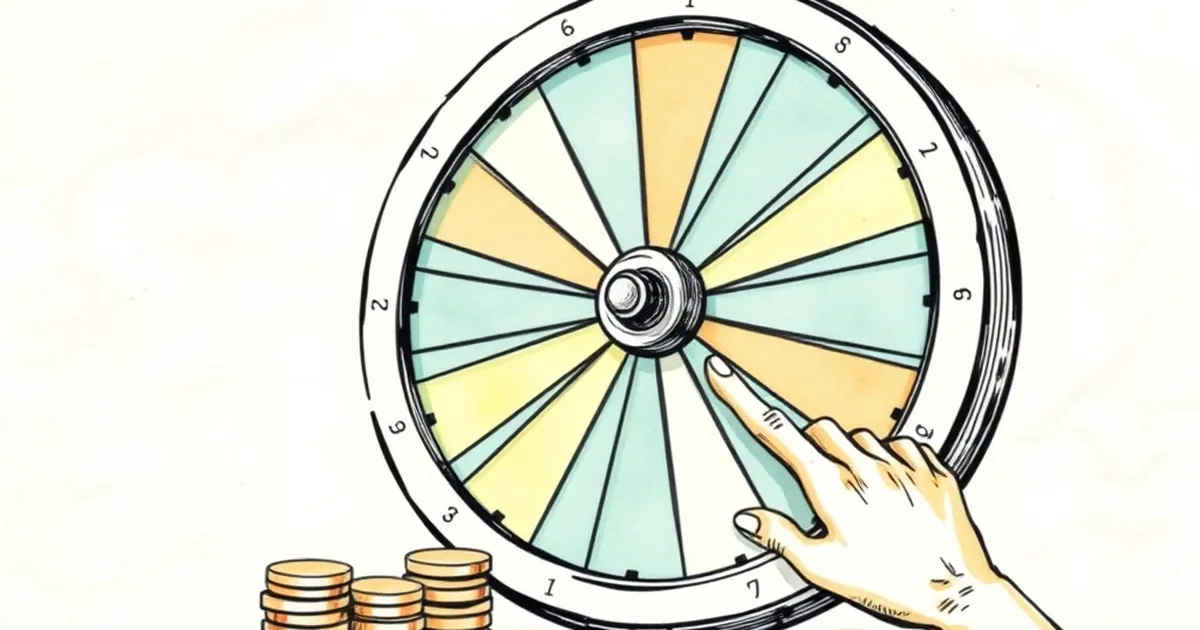
A bonus wheel animation that lands on "20 free spins" is one of the most common mismatches in Australian-facing casino promotions, and the gap is rarely a glitch. The wheel is marketing. The terms are the contract. And in a lot of the offers that circulate through AU-facing sites, the number on the wheel and the number you can actually withdraw against are two different figures entirely — often 20 on the screen, 5 in clause 4.3. If you've ever spun a wheel, seen the confetti, then read the fine print and felt like you were bait-and-switched, you weren't imagining it. You were reading two documents that were never meant to agree.
Why the wheel and the terms diverge
The bonus wheel isn't a random number generator in the way a slot is. On most of these promotions it's a piece of front-end theatre — a GIF or a short animation that plays after you click, weighted toward the outcome the operator has already assigned you. The "20 spins" segment might be the biggest, brightest slice on the wheel precisely because it's the least likely to be the actual prize, or because it's the headline figure and the terms quietly reduce it.
Here's the structural reason this keeps happening. Promotions get built by a marketing team chasing click-through, then handed to a compliance and CRM team who write the terms to protect margin. The wheel is designed by the first group. The cap is designed by the second. Nobody's job is to make them match, and in a lot of cases the mismatch is the point — 20 spins converts better than 5, and the terms page is where the operator claws the difference back.
The Australian angle matters here. Under the Interactive Gambling Act 2001, most online casino play isn't legal to offer to people physically in Australia, which pushes a lot of this activity toward offshore operators licensed in places like Curaçao, Malta, or the Kahnawake territory. Those jurisdictions have their own advertising and bonus rules, and enforcement against an offshore site targeting AU players is patchy at best. So the wheel-versus-terms gap is exactly the kind of thing that thrives in a grey market: nobody with real teeth is checking whether the animation tells the truth.
What "20 spins" usually turns into
Read enough of these terms and the same five or six mechanisms show up. The number on the wheel is almost never the number you get to keep.
The cap clause
The most direct version: the wheel says 20, and a term buried in the promotion page says the maximum award is 5 spins. Sometimes it's phrased as "spins are awarded in increments of 5" or "the displayed figure represents the total value of the prize pool, not your individual award." That last one is a genuine sentence from real terms, and it means the 20 you saw was never yours. It was the sum of what four people might get.
The split award
You land on 20, and the terms say spins are credited as 4 per day over 5 days. You get 20 eventually — if you log in every day for a week and don't miss one. Miss day three and the remaining 12 evaporate. The wheel showed a single number; the terms turned it into a streak you have to maintain.
The wagering trap
This is the one that does the real damage. Say you get your 20 spins and win $40 from them. The terms attach a 40x wagering requirement to that $40, which means you need to turn over $1,600 before you can withdraw a cent. At a typical slot contribution of 100% and a house edge around 4%, you're looking at an expected loss of roughly $64 on that turnover — more than the $40 you won. The spins were real. The prize was real. The ability to keep it was the fiction.
The max-win ceiling
Plenty of these offers cap the total win from free spins at something like $100 or $200, regardless of how much the spins actually produce. Land a 500x hit on spin 6 of your 20 and the terms convert it to a fixed $100. The wheel said 20 spins. The terms said your ceiling is a number you'd have to be very lucky to hit anyway — which is the trick. The cap looks generous until you realise it's doing the work of a loss limit.
The numbers that actually matter
When you're staring at a bonus wheel, the number on it is the least useful figure on the page. The ones worth finding are:
- The wagering multiplier. Anything at or above 40x on a free-spin win is close to unkeepable at typical slot RTP. At 97.3% RTP over a long run, a 40x rollover on a $40 win leaves you grinding $1,600 of turnover for a theoretical return of about $1,556 — you're expected to lose money chasing a prize you already "won."
- The max cashout. Often $50–$200 on these promotions. If the cap is $100 and the wagering is 40x, you're risking $1,600 of turnover to cap out at $100.
- The expiry window. Seven days is common. Three days shows up too. Your 20 spins might be 5 spins a day for 4 days, and if you miss a day, they're gone.
- The game weighting. Free spins are frequently locked to a single low-RTP title. A 94.2% RTP slot is a very different proposition from the 97%+ games you'd pick yourself.
If you add those up, the "20 spins" on the wheel is often worth somewhere between $2 and $6 in expected value once the terms have done their work. The animation cost more to render.
How to read a wheel offer in 90 seconds
Skip the wheel. Go straight to the terms and find four things: the word "maximum" next to the spin count, the wagering multiplier, the max cashout, and the expiry. If you can't find all four in the first two minutes of reading, that's your answer — the offer isn't designed to be understood, it's designed to be clicked.
There's a practical test worth running. Take the headline spin count, multiply it by the average win per spin (call it $0.20 on a typical $0.10–$0.20 spin value), then subtract the expected loss from the wagering requirement. If the result is negative — and it usually is — you're not being offered a bonus. You're being offered a reason to deposit.
This isn't a reason to avoid bonuses entirely. A 10-spin offer with 20x wagering and no max cashout is genuinely better than a 20-spin offer with 40x and a $100 ceiling, even though the first number is smaller. The wheel is built to make you compare the wrong figures.
The question worth asking
The real issue isn't that a wheel showed 20 and the terms said 5. It's that there's no mechanism forcing them to agree. Offshore operators targeting Australian players answer to regulators with limited reach, and the affiliate sites that host these promotions get paid per deposit, not per accurate disclosure. So the mismatch persists because nothing punishes it.
Which raises the uncomfortable question: if the headline number on a promotion can be decorative, what else on the page is? The wagering figure is a term, so it's probably real. The RTP is a term, so it's probably real. But the thing you actually clicked on — the number that made you deposit — sits in a space between marketing and contract where nobody's checking. Worth remembering the next time the wheel slows down on 20 and the confetti drops. The confetti is free. The spins might not be what you think. And if you're going to play, set a limit before you spin, not after — because the terms won't do it for you.