Cart recovery emails fire at hour 1—checkout completes at 3
Cart recovery emails typically send at one hour while checkouts complete at three, revealing a timing mismatch worth reconsidering
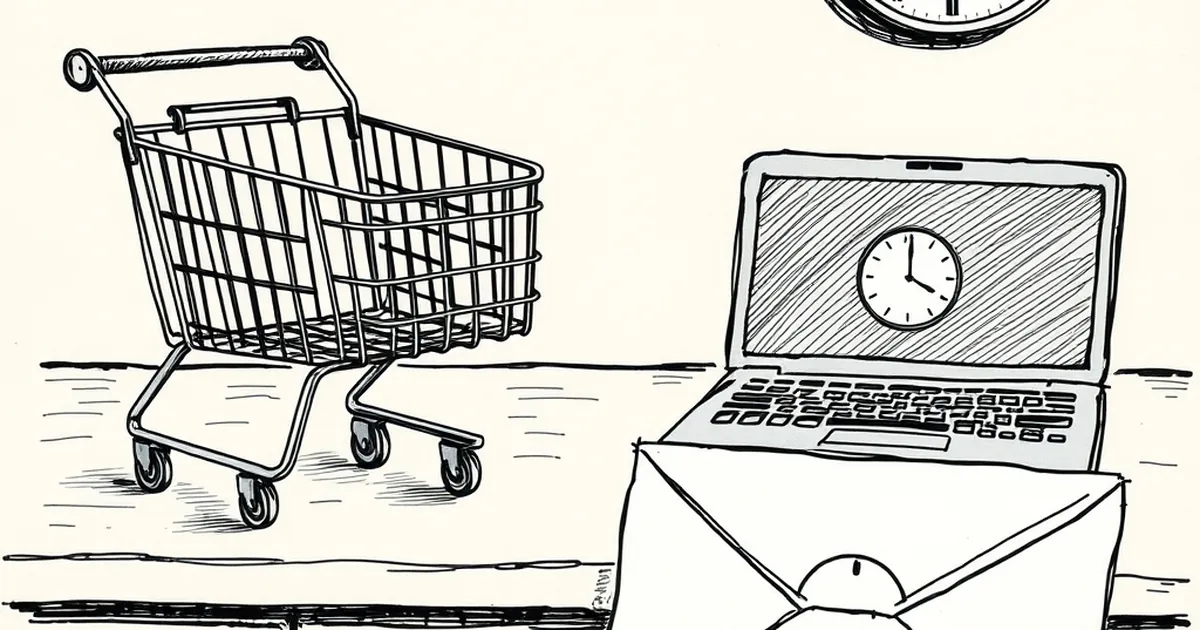
There's a number that floats around ecommerce circles like a half-remembered proverb: most cart recovery emails go out about an hour after someone abandons checkout, and most checkouts that eventually complete happen around the three-hour mark. If both of those are roughly true, we've built a timing system that's optimised for the wrong moment. So the question worth sitting with is this — are we sending the nudge when the customer is ready to hear it, or just when our automation happens to be free?
Why the one-hour default feels right (and probably isn't)
The one-hour send exists because it's easy to defend in a meeting. It's fast enough to feel responsive, slow enough to seem non-desperate, and it slots neatly into a drip sequence that someone can draw on a whiteboard. It also satisfies a very human itch among marketers: the desire to do something while the lead is still warm.
But warm to whom? The customer who bailed at the payment step is often not hesitating over the product. They're hesitating over a card that's in the other room, a phone that rang, a toddler who woke up, or a nagging feeling that the shipping cost was a bit rich. None of those resolve in sixty minutes. Some of them resolve over a cup of tea and a second look at the budget that evening.
This is where behavioural economics earns its keep. Kahneman and Tversky's work on loss aversion tells us that a near-miss — "I almost bought it" — carries a particular sting. The abandoned cart sits in that uncomfortable zone between intention and commitment. A message that arrives too early can read as pressure applied to a wound that's still open. A message that arrives after the sting has faded, when the person has had a chance to reframe the purchase as a decision rather than a lapse, lands very differently.
The three-hour completion cluster is a clue, not a coincidence
If your analytics genuinely show a cluster of completions around the three-hour mark, that's worth treating as data rather than noise. Three hours is roughly the length of an afternoon, a work block, a commute plus dinner. It's long enough for the initial friction to clear and short enough that the intent hasn't fully evaporated.
There's a useful parallel in the psychology of decision-making under uncertainty. People don't resolve ambiguity in a single instant; they oscillate. They open the tab, close it, open it again. Each return visit is a small act of re-commitment. What the customer often needs isn't a reminder that the cart exists — they know — but a reason to stop oscillating. That reason is usually logistical: a clearer delivery window, a payment option that suits them, a nudge that the item is genuinely low in stock (if it is).
The variable-ratio trap
Here's where a lot of cart recovery programs go wrong. They borrow the mechanics of variable-ratio reinforcement — unpredictable rewards that keep people checking back — and apply it to transactional email. A discount that appears sometimes but not always, at intervals nobody can predict, trains customers to abandon on purpose and wait. You've turned your checkout into a slot machine where the payout is a 10% code.
That's not persuasion. That's teaching a behaviour you'll spend the next two years paying for. The fix is boring but effective: make the recovery sequence predictable in its timing and honest in its content. If there's a discount, say so upfront at checkout. If there isn't, don't invent one at hour four because the sequence says so.
What the timing data actually lets you do
The gap between hour one and hour three is an opportunity to stop treating cart recovery as a single email and start treating it as a small decision architecture. A few practical moves:
Split the sequence by abandonment point. Someone who bailed on the product page has a different question than someone who got as far as entering a card number. The first needs reassurance about the product; the second needs reassurance about the transaction. Sending both the same "still thinking about it?" email at hour one is a wasted touch.
Use the first hour for friction removal, not persuasion. A short message that says "your cart's saved, and here's the delivery estimate to your postcode" does more than a discount. It answers the question they were actually stuck on.
Let the three-hour mark carry the emotional weight. By then, the customer has had time to reframe. This is where a well-placed reminder about what they chose — the specific item, the reason it caught their eye — outperforms generic urgency.
Test against your own data, not the industry average. The hour-one/three-hour pattern is a starting hypothesis. Your audience might cluster at ninety minutes, or at eleven hours. The only way to know is to segment your completion timestamps and look.
A concrete example worth knowing
Baymard Institute's long-running checkout research has repeatedly found that a large share of abandonments are driven by friction — forced account creation, unclear costs, too many form fields — rather than genuine indecision. That matters here because it reframes the whole exercise. If the abandonment was friction, the recovery email isn't competing with the customer's doubt; it's competing with your own checkout design. The best-timed email in the world can't outrun a form that asked for a fax number.
Designing for the three-hour mind
The forward-looking move isn't to shift your send time from one hour to three and call it optimisation. It's to build recovery around the actual shape of a decision: friction first, reassurance second, gentle re-commitment third. That means instrumenting your checkout to know where people left, not just that they left. It means writing emails that sound like a helpful shop assistant rather than a countdown timer. And it means accepting that some carts should never be recovered, because the customer was never really buying — they were browsing, and that's allowed.
The interesting work is in the middle of that curve, where intent is real but fragile, and where a well-timed, honest message can tip a decision that was already leaning your way. Build for that person. They're the ones the three-hour cluster is made of.