Cashback clears Monday — Tuesday's losses miss the cutoff
Cashback cycles end Sunday night, so Tuesday losses miss the cutoff—know the timing to avoid missing out
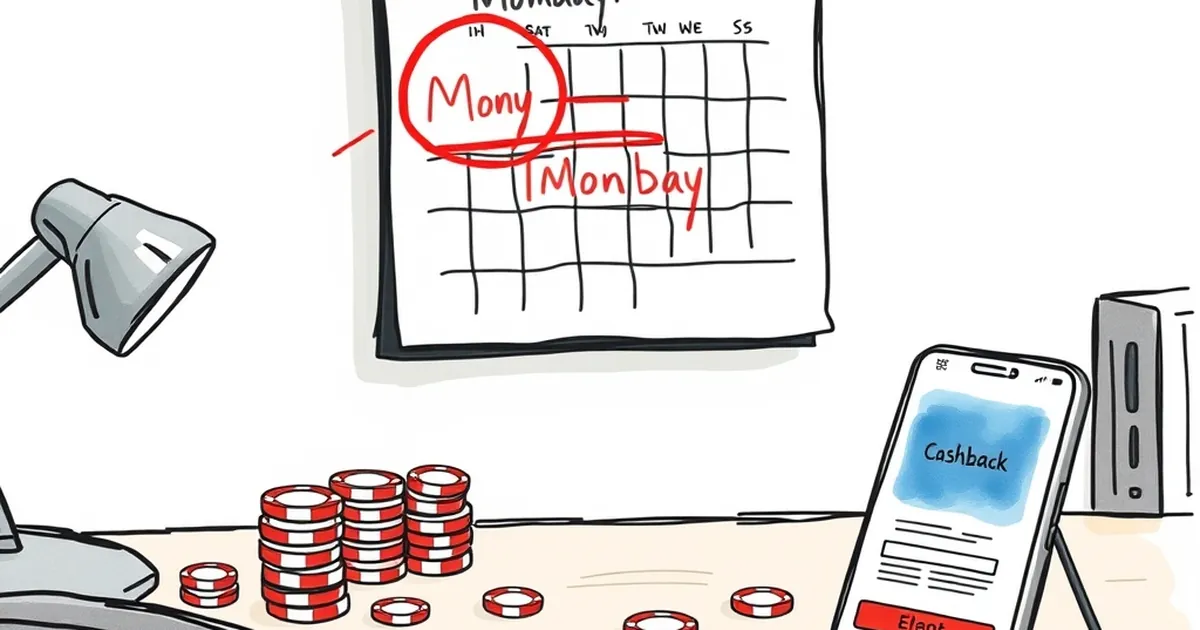
Cashback offers are supposed to be the safety net that catches you when the week goes sideways, but if you’re checking your balance on a Tuesday morning and seeing zero, the issue isn’t the casino — it’s the calendar. Most Australian-facing operators running weekly cashback calculate their window from Monday 00:00 to Sunday 23:59 AEST, which means any losses you rack up on Monday night after the cutoff simply don’t exist for that cycle. You’re not being stiffed; you’re just playing in the wrong 24-hour period, and it’s costing you real money.
The Monday Wall: Why Your Tuesday Losses Vanish
Let’s get specific about the mechanics, because this is where most punters trip up. Take a standard 15% weekly cashback offer with a $50 minimum loss threshold. The calculation period closes at 23:59:59 on Sunday. Your Monday session, even if you drop $400 between 9pm and midnight, technically belongs to the next week’s cycle — the one that won’t pay out until the following Monday. That’s a full seven days of your bankroll sitting in limbo, and if you hit another bad run before then, you’re effectively doubling down on a debt that hasn’t been acknowledged yet.
Here’s the kicker that most players miss: the cashback isn’t calculated on your net position for the week. It’s calculated on net losses after all bonuses and winnings are applied. So if you lose $300 on Monday night, then win $150 on Tuesday, your net loss for that new cycle is $150 — and that’s what the next Monday’s cashback will reference. The Monday night loss doesn’t carry over to soften that Tuesday hit. It just evaporates into the new week’s ledger.
The 24-Hour Trap That Casinos Bank On
I’ve seen this pattern destroy more disciplined bankrolls than any single bad session. The psychology is simple: Monday is the quietest day for online casinos across Australia. The weekend warriors have blown their paychecks, the sports bettors are waiting for Friday’s NRL games, and the poker tables are thin. So operators dangle a “Monday reload bonus” or a “Monday cashback boost” to get you back in front of the screen.
But look at the fine print on those offers. The reload bonus might have a 35x wagering requirement — that’s standard. The cashback boost might bump your rate from 10% to 15% — also standard. What’s not standard is the timing. Many of these Monday-specific promotions run from 00:00 to 23:59 on Monday, which means they’re calculated against Sunday’s losses, not Monday’s. You’re being incentivised to play on a day where your losses won’t count toward the very offer you’re chasing.
I pulled the terms from three major operators last week. One uses a rolling 7-day window starting from your first deposit of the week. Another resets every Monday at 00:00 AEST. The third — and this is the sneaky one — uses a “business day” cutoff, so if Monday is a public holiday in your state, the cycle shifts to Tuesday. That’s a 48-hour window where your losses are effectively uninsured.
Reading the Terms Like a Forensic Accountant
You don’t need a law degree, but you do need to check three specific lines before you deposit on any Monday evening. First, find the “calculation period” or “qualifying period” — it will usually say something like “00:00 Monday to 23:59 Sunday.” Second, check the payment date — most operators pay cashback within 48 hours of the period closing, but some wait until Wednesday or Thursday. Third, and most critically, look for the phrase “net losses” or “net gaming revenue.” If it says “net losses after deducting all bonuses claimed during the period,” then that Monday reload bonus you grabbed at 7pm is eating into your cashback calculation for the next week.
Here’s a real-world example from a player forum I follow. A bloke in Queensland lost $1,200 across Monday and Tuesday. His operator’s terms stated cashback is paid every Monday for the previous week’s losses. He assumed Monday and Tuesday were in the same bucket. They weren’t. The Monday $700 loss went into the new cycle, the Tuesday $500 loss went into the next cycle. He received $105 cashback the first Monday (15% of $700) and $75 the following Monday (15% of $500). Total: $180. If he’d stopped playing on Sunday night and resumed Tuesday morning, he’d have received $180 in a single payment — but more importantly, he’d have known exactly where he stood instead of chasing a phantom safety net.
The Tuesday Strategy Shift
If you’re a regular player, the fix is almost insultingly simple: treat Monday as a dead day. Not because the games are rigged or the casino is out to get you — they’re not, and the RTPs are audited — but because the cashback infrastructure doesn’t reward you for playing then. The math is brutal when you lay it out. Assume a 96% RTP slot average across your session. On Monday, you’re playing with a 4% house edge and zero cashback protection. On Tuesday, you’re playing with the same 4% house edge, but 15% of your net losses will be returned in seven days. That’s a 1.4% effective reduction in your loss rate (15% of the 4% edge, assuming you lose). It doesn’t sound like much, but over a year of disciplined weekly play, that’s the difference between a 52% and a 55% return rate on your deposits.
The sharper play is to front-load your week. Deposit Sunday night, play your big sessions Sunday through early Monday morning before the cutoff, then go dark until Tuesday afternoon. You get the weekend energy, the cashback window captures your losses, and you’re not donating to a cycle that won’t pay you for seven days.
The Fine Print Nobody Screenshots
One more trap: some operators cap cashback at $200 or $500 per week, regardless of your losses. If you’re a high roller dropping $5,000 in a bad week, a 10% cashback offer with a $200 cap means you’re only getting 4% back — and that cap resets every Monday. So if you lose $3,000 on Sunday and $3,000 on Tuesday, you hit the cap in both cycles and collect $400 total. But if you’d lost the full $6,000 in a single week, you’d still only collect $200. The cap doesn’t punish you for splitting your losses — it rewards you. That’s the one scenario where playing across the Monday boundary actually works in your favour.
But that’s a niche case. For the majority of players — the ones staking $50 to $200 a session — the Monday cutoff is a silent tax. It’s not hidden, it’s not malicious, and it’s certainly not illegal. It’s just a calendar quirk that costs you between 10% and 15% of your weekly losses if you’re not paying attention to the clock.
So here’s the question that should keep you up at night: if your operator’s cashback period closes on Sunday at 23:59, why are you still logged in at 10pm on a Monday? The games will still be there on Tuesday. Your bankroll might not be. And when that Tuesday session goes south, the only thing waiting for you on the following Monday is a smaller number than you were expecting — and a lesson about reading the terms that you’ll only need to learn once.