Casino chips stack differently once your balance hits six digits
Six-figure balances change how you bet—and not for the better. Here’s where the real risk begins
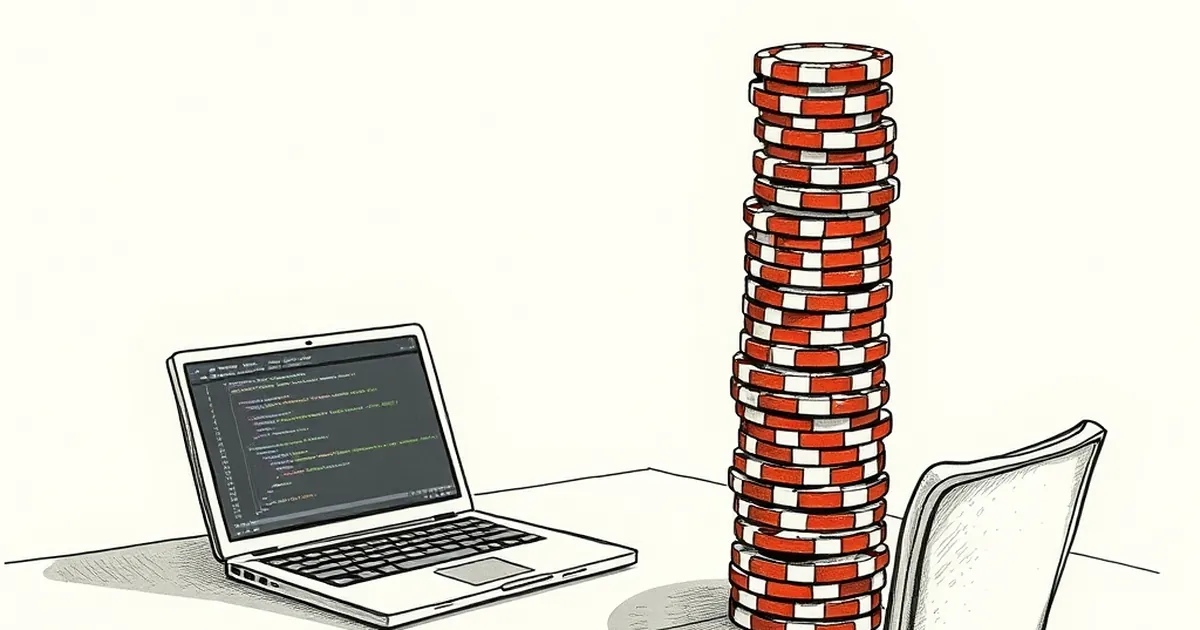
The moment your balance ticks over into six figures, the game changes. It’s not a psychological trick, and it’s not about being a high roller with a private jet. It’s about the math of your own behaviour. When you’re playing with $1,200, a $50 bet feels like a calculated risk. When you’re playing with $120,000, that same $50 bet becomes noise — and that’s precisely when the real damage starts.
The shift isn’t in the house edge. It’s in your decision-making frequency, your tolerance for variance, and the way you suddenly treat $500 spins like they’re pocket change. I’ve watched it happen to friends, and I’ve felt it myself. Here’s what actually changes, and why it’s not the win rate that gets you.
The $50 Bet Paradox
Let’s anchor this with a concrete number: at 100 spins per hour on a 96.2% RTP slot, a $50 bet carries an expected loss of $190 per hour. When your bankroll is $5,000, that’s a 3.8% hourly bleed — noticeable, uncomfortable, enough to make you drop the bet size. When your bankroll is $150,000, that same $190 hourly loss is 0.13% of your stack. It’s invisible. So you don’t drop the bet size. You raise it.
That’s the trap. The percentage feels irrelevant, so you start playing at $200 or $500 a spin to “feel something.” Now your expected hourly loss is $760 to $1,900. Still under 1.3% of your balance, so it feels manageable. But here’s the kicker: the variance swings at that level are brutal. A 200-spin dry spell at $500 a spin is a $100,000 drawdown. You’re not losing 1% of your bankroll anymore — you’re losing two-thirds of it in a single session, and the only thing that stopped you from walking away was that the percentage looked small.
The Bankroll Management Fallacy
Every guide you’ve ever read says the same thing: bet 1-2% of your bankroll per spin. That’s sound advice at $1,000. At $100,000, it means $1,000 to $2,000 a spin. That’s not a strategy — that’s a demolition plan. The problem is that the rule scales linearly, but your emotional tolerance doesn’t.
Here’s what actually happens when your balance hits six figures:
- You stop checking the bet size against your total. You check it against your last win instead. Won $4,000 on a bonus round? A $300 spin feels conservative now.
- You start chasing “meaningful” wins. A $10,000 win on a $50 bet feels like nothing. So you need $500 bets to make a win feel real, which means you need $50,000 swings to feel excited.
- You forget the session limit. When you’re playing with $150,000, a $5,000 loss doesn’t trigger the “stop” reflex. It’s 3.3%. You tell yourself you’ll win it back. That’s how a $5,000 loss becomes a $40,000 loss.
The numbers don’t change. The house edge doesn’t change. What changes is your internal calibration of what “a lot” means. And that calibration is what actually determines your long-term outcome.
The Real High Roller Edge: Table Limits and Bonus Caps
Here’s a practical difference nobody talks about: when your balance hits six figures, the game itself changes. Not because the casino treats you differently — though they might — but because table limits become relevant.
At $50 a hand, you can play blackjack for hours with basic strategy and a 0.5% house edge. Your expected loss is $25 per 100 hands. At $1,000 a hand, you’re now hitting table limits on most Aussie-facing tables. You’re forced into either multiple seats (which changes your variance profile) or into games with worse rules — like the 6:5 blackjack tables that carry a 1.4% house edge — because the higher-limit tables often have worse payout ratios.
Same story with slots. A $100,000 balance on a game with a $5 max bet is pointless. You’re playing with $5 bets on a 96% RTP game, and your expected loss is $20 per 100 spins. That’s not gambling — that’s waiting. So you seek out high-limit slots, and suddenly you’re playing games with 94.5% RTP instead of 96.2%. The edge just got 1.7% worse, and you barely noticed because the bet size feels right.
That’s the six-figure tax. It’s not a fee. It’s the slow drift toward worse games, worse rules, and worse decisions because the stakes you’re comfortable with don’t align with the games available.
The Psychological Shift Nobody Warns You About
I’m not a psychologist, but I’ve logged enough hours at tables and in front of screens to recognise the pattern. When your balance crosses $100,000, you stop playing to win money. You start playing to not lose status.
- You won’t cash out $20,000 because that “ruins” the round number.
- You won’t drop to lower stakes because that “feels like a downgrade.”
- You won’t walk away after a $15,000 win because “that’s not enough to matter.”
This is the exact opposite of how you played at $5,000. At $5,000, a $1,500 win was a massive victory. You’d cash out, celebrate, and come back tomorrow. At $150,000, that same relative win — $45,000 — feels like a failure if you don’t push for $50,000.
The responsible gambling angle here isn’t about addiction. It’s about rationality. The tools you used to protect yourself at lower balances — session limits, loss limits, bet caps — stop working because the numbers no longer feel like they apply. You need to rebuild those guardrails from scratch, but this time against a much larger backdrop.
The Real Question: What’s the Number You’re Protecting?
Here’s the practical takeaway. If your balance ever hits six figures — whether through a lucky tournament, a sports betting parlay that somehow landed, or years of disciplined grinding — the first thing you should do is set a new floor. Not a percentage. A hard dollar amount.
Say you’re at $120,000. Decide that $95,000 is your absolute floor. If you hit it, you walk away for 48 hours. That’s a 20.8% drawdown allowance. That sounds huge, but it’s actually the only number that matters, because it’s absolute. It doesn’t scale with your mood. It doesn’t shrink because you’re winning.
The second thing is to cap your bet size at 0.25% of your balance — not the 1-2% you used at lower stakes. At $120,000, that’s $300. That’s still a big bet. It’s just not a life-changing one. And that’s the point: at six figures, your goal isn’t to double up. It’s to keep the number above the floor for as long as possible.
The third thing — and this is the one nobody does — is to set a withdrawal trigger that’s not based on a round number. Not “I’ll cash out at $150,000.” That’s a fantasy. Instead, “If I’m up 15% on the day, I take out half the profit, no matter what.” That’s $18,000 on a $120,000 balance. It’s not glamorous. It’s not a story you’ll tell your mates. But it’s the difference between a six-figure balance that lasts and one that evaporates in a single Tuesday afternoon.
So here’s the open question: when you hit that number, will you still be playing the same game — or will you have already decided what the number is actually for? Because the chips don’t care how you feel about them. They only care about how many you’re willing to push across the line.