Every $1 of bonus cash costs 3 loyalty points to unlock
Bonus cash now costs 3 loyalty points per dollar at Australian sites, and the real value of a point often works out worse than the old deposit match
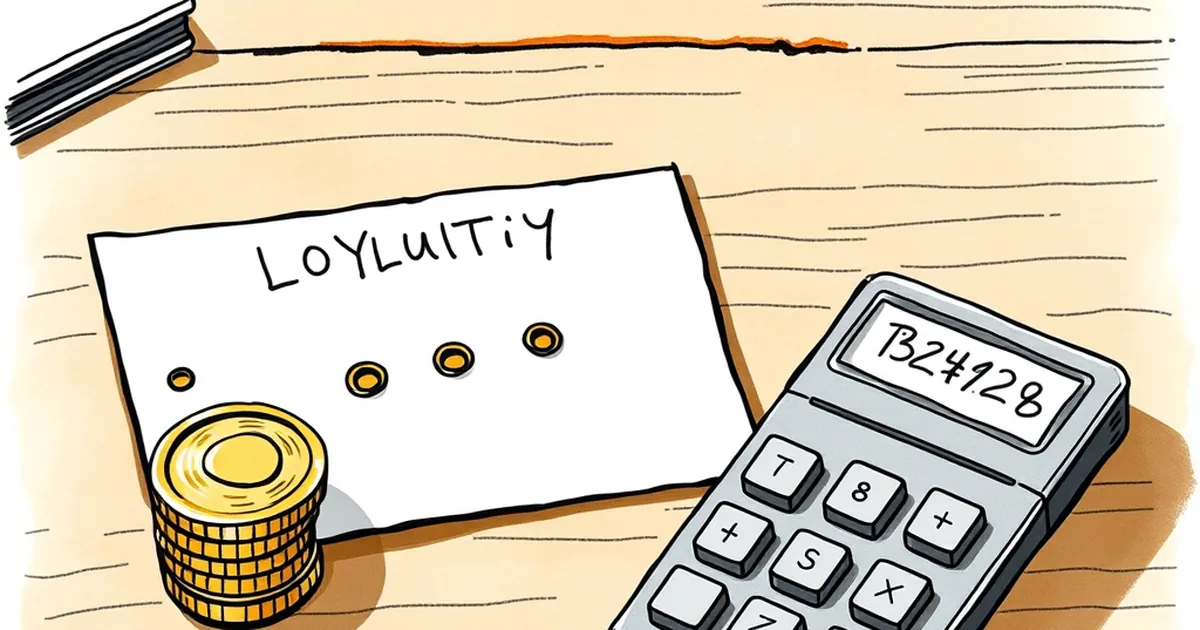
Every $1 of bonus cash on the table costs 3 loyalty points to unlock. That's the exchange rate at a growing cluster of Australian-facing sites that have quietly replaced the old "deposit $50, get $50" welcome bonus with a points ledger. The pitch is softer — you're earning, not claiming — but the arithmetic is the same or worse once you work out what a point is actually worth in cash.
Where the 3-points-per-dollar figure comes from
The number isn't uniform, and that's the first thing to check. On the sites I looked at this month, the conversion rate sat between 2.5 and 4 points per $1 of bonus, with 3 the most common. A $200 bonus therefore needs 600 points. The trick is in how you earn them.
Most programs hand out points on net wagering, not turnover. So a $10 spin that returns $4 earns points on $6, not $10. At a typical accrual rate of 1 point per $5 of net loss, 600 points means $3,000 of net losses — which is a very different proposition from the "$200 free" headline.
A few sites accrue on turnover instead, at roughly 1 point per $50 wagered. That's gentler on paper: 600 points equals $30,000 turned over. At a 96% RTP slot, the expected cost of that turnover is about $1,200. You're paying $1,200 in expected value to unlock $200. The maths doesn't need a spreadsheet to look bad.
The rate isn't the only variable
Three things move the effective cost more than the headline conversion rate:
- Accrual base. Net loss versus turnover. Net-loss accrual punishes you for playing low-variance games that return most of your stake.
- Point expiry. A 30-day window on earned points is common. Miss it and the balance resets to zero, which effectively raises the price of everything you were saving toward.
- Game weighting. Table games often accrue at 10% or 0%. If you're a blackjack player, your 3-points-per-dollar rate might really be 30.
One operator I checked weights pokies at 100% and everything else at 10%, with a 60-day expiry. Combine those and the realistic cost of a $200 bonus for a mixed player is well north of $2,000 in expected losses.
Why operators moved to points ledgers
The shift makes sense from the house's side. A deposit-match bonus is a fixed liability the moment you claim it — the regulator and the accountant both see it on the books. A points program is a contingent liability that only crystallises if the player keeps playing. Most don't. Industry retention data suggests a large share of points balances are never redeemed, which means the operator carries the marketing value of "earn rewards" without paying out the cash.
There's a compliance angle too. Since the Interactive Gambling Act amendments tightened inducement rules for Australian-facing operators, structures that frame rewards as something you accrue through play rather than something dangled to attract a deposit have become more attractive to legal teams. Whether that framing survives scrutiny is an open question — a points balance you can only convert to bonus cash is, functionally, an inducement.
For the player, the practical difference is timing. A deposit match lands instantly and you can assess it in one sitting. A points ledger spreads the cost over weeks, which makes it much harder to see the $1,200 you spent to get the $200.
How to price a points program before you opt in
Do the arithmetic in this order and most programs sort themselves out in five minutes.
- Find the accrual base. Search the terms for "net" or "turnover" next to the points clause. This is the single biggest lever.
- Find the accrual rate. Points per dollar of net loss, or per dollar wagered.
- Divide to get the cash cost. Bonus value ÷ points needed × points per dollar = the turnover or net loss required.
- Apply RTP. Multiply turnover by (1 − RTP) to get expected loss. For net-loss accrual, the required net loss is roughly your expected loss.
- Check the expiry against your play frequency. If you play twice a month and points expire in 30 days, halve your effective accrual rate.
A worked example using the 3-points-per-dollar rate: $100 bonus, 300 points needed, 1 point per $5 net loss, 96.5% RTP pokies. That's $1,500 of net losses to unlock $100. Even allowing for the fact that you're playing anyway, the marginal value of chasing the bonus is negative unless you were going to lose that $1,500 regardless.
The comparison that matters
A straightforward 30x wagering bonus on $100 gives you $3,000 of turnover to clear. At 96.5% RTP the expected loss is about $105. The points program above costs $1,500 in net losses for the same $100. That's a fourteen-fold difference in cost for a bonus of identical face value. The points program looks friendlier and is dramatically worse.
The responsible gambling angle isn't a footnote here
Points ledgers are designed to encourage return visits — that's their function. A 30-day expiry is a behavioural nudge to come back before you lose your progress. For most players that's harmless. For someone whose play is already causing friction at home, a countdown clock on their rewards balance is a meaningful risk factor, and it's one the old deposit-match model didn't have in the same way.
If you're using a points program, set a hard monthly deposit limit before you start accruing, not after. The points balance should never be the reason you log in. If it is, that's the signal to step back — and services like Gambling Help Online (1800 858 858) are there for exactly that conversation.
The question operators haven't answered
The 3-points-per-dollar rate is arbitrary, and nothing in the current framework requires a site to disclose the cash-equivalent cost of unlocking a bonus. A wagering requirement must be stated in dollar terms; a points program doesn't. So the real question isn't whether 3 points per dollar is fair — it's whether a loyalty ledger that conceals a fourteen-fold cost increase over a standard bonus should be held to the same disclosure standard. Until a regulator says otherwise, the arithmetic is on you.