Free spins expire before the wagering they were meant to cover
Free spin expiry windows and wagering requirements run on mismatched clocks, and understanding why reveals how the mechanic is designed to work
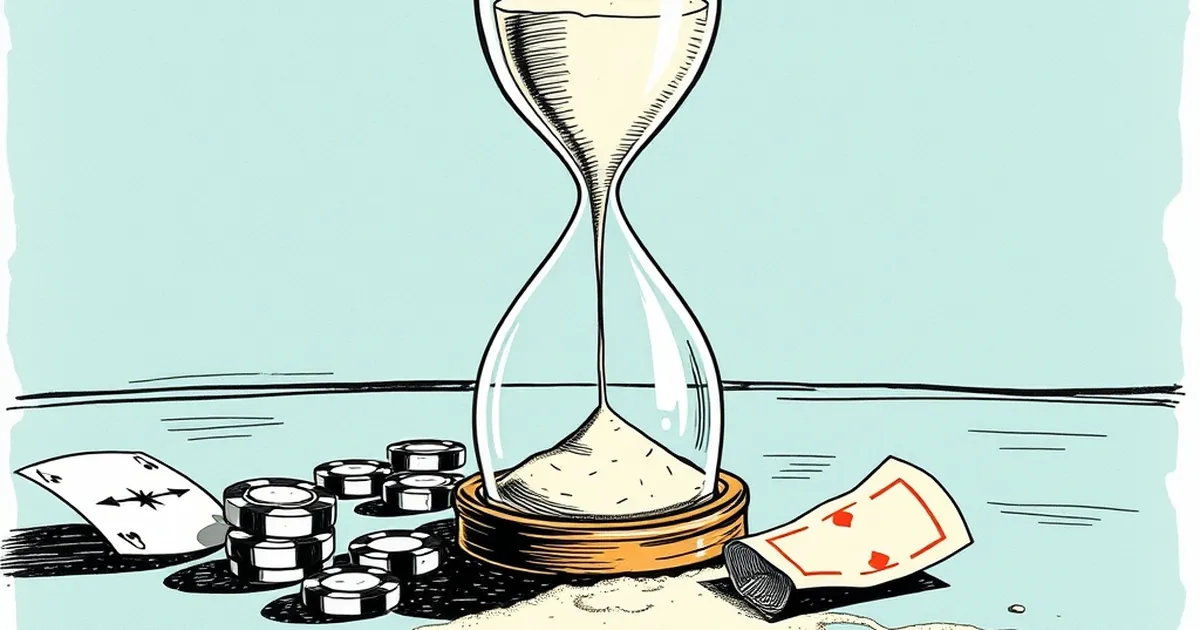
Most free spin offers in Australia expire inside 72 hours, while the wagering requirement attached to whatever you win from them typically needs a fortnight of normal play to clear. The expiry clock and the wagering clock are running at completely different speeds, and only one of them is designed to be beaten. That mismatch isn't an accident — it's the mechanic doing its job.
The two clocks
A free spin offer usually comes with a short fuse. Seven days is generous. Three days is common. Twenty-four hours shows up more than you'd think, especially on "daily" spin drops tied to a deposit the day before.
The wagering requirement attached to the winnings is a different animal. Say you get 100 spins at $0.20, they land you $14 in bonus cash, and the terms say 40x. That's $560 you need to turn over before anything is withdrawable. On pokies contributing 100%, at a realistic $1 per spin, that's 560 spins. At 500 spins an hour — which is quick, and assumes no bonus rounds slowing you down — you're looking at a bit over an hour of pure grinding.
That sounds fine until you remember you're not spinning in a vacuum. You're playing a game with variance, you're probably not betting exactly $1 every spin, and if you're on a table game the contribution rate might be 10% or even 0%. Drop the contribution to 10% and that same $560 requirement becomes $5,600 of turnover. Now you're not looking at an hour. You're looking at a weekend.
So the offer gives you three days to claim, and the maths quietly asks for something closer to ten or twelve days of casual play. The expiry doesn't cover the wagering. It covers the claiming window, and those are not the same thing.
Why the clock is short on purpose
There's a straightforward commercial reason for the tight expiry. An unclaimed spin is a spin that never converts into a depositing player. Operators know that the longer a bonus sits in an account, the more likely it is to be forgotten, ignored, or — worse from their side — used by someone who reads the terms carefully and plays it optimally.
A 48-hour expiry pushes you toward claiming immediately, which pushes you toward playing immediately, which usually means playing without a plan. That's the point. The expiry isn't there to protect the operator from liability. It's there to compress your decision-making window.
What actually happens when the clock runs out
Here's the part that catches people. When free spins expire, you don't just lose the spins. You lose the entire bonus balance that came from them, and any winnings still sitting in that bonus wallet. If you've been grinding toward a $560 requirement and you're at $400 with two hours left, the expiry wipes the lot.
Some operators are cleaner about this than others. A few will convert remaining bonus to cash if you've met the requirement before expiry, which is the fair version. Many won't. The terms will say something like "any unused free spins and associated winnings will be removed from your account upon expiry," and that's that.
The nastier version: you've already made real-money deposits to fund the play that generated those winnings, and the expiry claws back the bonus portion while leaving your deposits spent. You're not just out the bonus. You're out the cash you put in chasing it.
The contribution rate trap
If you're playing anything other than pokies, the maths gets ugly fast. A 40x requirement on $14 is $560 at 100% contribution. At 20% contribution — common for video poker and some table games — it's $2,800. At 10%, $5,600. At 0%, which some operators apply to live dealer and certain blackjack variants, the requirement never moves no matter how long you play.
Combine that with a 72-hour expiry and you've got an offer that is, mathematically, close to impossible to clear unless you're betting large and running hot. The expiry and the contribution rate aren't independent terms. They multiply.
The numbers that matter
Rough rule of thumb: if the expiry window in days, multiplied by your realistic daily turnover, is less than the total wagering requirement, the offer is designed to expire before you can clear it. That's not a bug. It's the intended outcome for the majority of players.
For a $14 bonus at 40x with 100% pokies contribution, you need $560 turnover. At $200 a day — which is a reasonable casual player's turnover — that's 2.8 days. A 72-hour expiry gives you three days. It's tight but theoretically doable if you play every day and don't hit a cold streak. A 48-hour expiry makes it a coin flip. A 24-hour expiry makes it a lottery ticket.
The operators who offer 7-day or 14-day expiries on the same 40x requirement are the ones actually giving you a chance. That's the tell. Expiry length is a better indicator of whether an offer is genuine than the headline spin count or the bonus dollar value.
Read the expiry before the spin count
Most players scan the spin count and the wagering multiplier. The expiry sits further down the terms, usually in a section headed something like "Bonus Validity" or "Time Limits," and it's the term that decides whether the rest of the offer is real.
If the expiry is under 72 hours and the wagering is 40x or higher, treat the offer as entertainment rather than value. Play it if you were going to play anyway. Don't deposit specifically to claim it, because the clock is already against you.
Where this leaves the whole model
The free spin offer has always been a customer acquisition tool dressed up as a reward. That's fine — it's a business, and nobody's pretending otherwise. The problem is the expiry mechanic has drifted so far from the wagering mechanic that the two no longer describe the same offer. One says "here's a chance to win something." The other says "here's a chance to win something, but only if you can turn over $560 in 48 hours, which most of you can't."
The obvious fix would be to align them — set the expiry to match the realistic clearing time, or drop the wagering on small spin wins entirely. Some operators have moved that way, particularly in markets where regulators have pushed back on bonus terms. Others have gone the opposite direction, shortening expiries to 24 hours and calling it "urgency."
Which raises the question worth asking: if an offer's expiry is calibrated so that the average player can't clear the wagering in time, is it still a bonus, or is it just a deposit prompt with extra steps? And if the answer is the second one, how long before players stop scanning the spin count and start checking the calendar first?
If you're playing through any bonus, set a hard limit on what you're willing to deposit to chase it, and treat the expiry as a stop signal rather than a challenge. Gambling shouldn't cost more than you planned, and a bonus that expires before you can use it was never really yours. Support is available through Gambling Help Online on 1800 858 858 if the chase stops being fun.