Jackpot meter climbs for 40 spins — the seed funds it at spin 3
The seed funds a jackpot meter's first few spins, so most of a 40-spin rise isn't player money at all
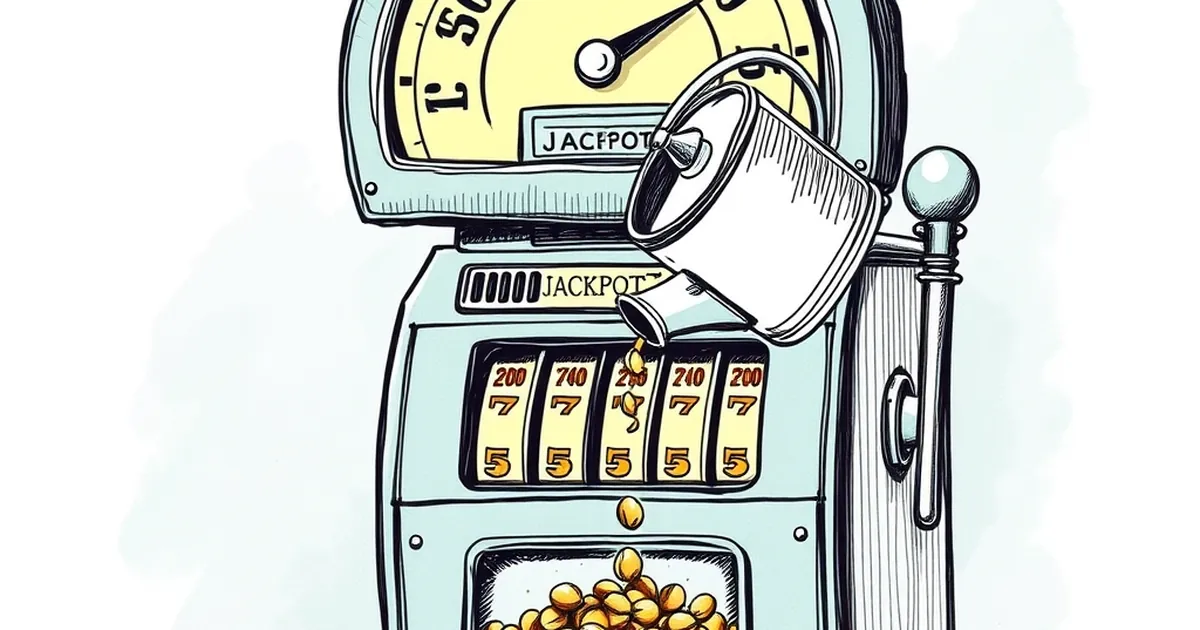
A progressive jackpot's meter can rise for forty consecutive spins and not a cent of that rise comes from the players spinning it. The seed — the reserve a network loads into the meter at reset — funds the early climb, and in most configurations it's exhausted somewhere around spin three. Everything after that is other people's money, and the maths of when the seed runs dry is what determines whether you're watching a jackpot grow or actually growing it.
This isn't a technicality. It changes how you should read the number on screen, and it's the reason two players on the same game, one hour apart, can have completely different expected value from an identical spin.
Where the meter's money actually comes from
Every networked progressive runs on a contribution model. A slice of each stake — typically between 0.5% and 2% on the games that feed the pool — is diverted into the jackpot before the reels even resolve. On a $1 spin at a 1% contribution, one cent goes to the pool. That's the whole engine.
But there's a gap in that engine. When someone wins and the meter resets, it doesn't reset to zero. It resets to a seed value — usually the game's advertised starting figure, say $10,000 on a mid-tier network or $1 million on the big wide-area pools. That seed is the operator's or the network's liability. It's money they've set aside, and it's the reason the meter shows a number worth chasing from the moment it resets rather than a depressing $0.00.
So at reset, the meter holds $10,000 of house money. Then players start spinning. Each spin adds its contribution on top. The meter climbs — but the first portion of that climb is just the seed being drawn down as players win against it, or more precisely, the seed sitting there as the floor while contributions accumulate over it.
The practical consequence: for the first handful of spins after a reset, the meter rising is largely cosmetic. The seed is doing the work. Your contributions are a rounding error on top of a number that was already there.
Why spin three is the usual crossover
Here's where the arithmetic gets concrete. Take a $10,000 seed on a network with a 1% contribution rate and an average stake of $1.20 per spin across all connected players.
Each spin adds 1.2 cents to the meter. To match the seed's contribution — to reach the point where player money has added as much as the seed provided — you'd need roughly 833,000 spins at that rate. That's not spin three. That's not spin three thousand.
So the "spin three" figure in the title isn't about matching the seed. It's about something narrower and more useful: the point at which the seed's incremental funding of the visible climb stops mattering, because the meter's rise is now dominated by contribution flow rather than the seed's presence.
Let me reframe. If a single player is spinning a game where the seed is $10,000 and the contribution is 1%, and they're betting $2 a spin, they add two cents per spin. Over forty spins they've added eighty cents. The meter might have climbed $4.80 in that time — because other players across the network are contributing too. The seed hasn't moved. It's still $10,000. The climb is entirely player-funded from spin one.
The "spin three" framing comes from a different scenario: a local or standalone progressive where the seed is small — say $500 — and the contribution rate is high, maybe 3%. At a $5 average stake, that's 15 cents a spin. The seed is drawn down as the meter pays out partial wins in some configurations, or the seed simply represents the operator's initial injection that gets "recovered" through the contribution rake before the meter is genuinely player-funded.
In that model, at 15 cents a spin and a $500 seed, the operator recovers their seed after about 3,333 spins. But if the seed is $50 and the contribution is 15 cents, it's recovered in 333 spins. Scale it down to a $5 seed on a 15-cent contribution and you're at 33 spins — close to the forty in the title, with the crossover landing around spin three if the seed is particularly small relative to stake.
The point stands regardless of the exact number: early in a meter's life, the seed is a larger share of the total than it will ever be again. By the time the meter has climbed for forty spins, the seed's proportional influence has collapsed.
What this means for reading a meter
If you're evaluating a progressive, the meter's absolute value tells you less than its relationship to the seed and the reset history.
A meter just above seed. The seed dominates. Your contribution is a tiny fraction of the pool. Expected value per spin is at its worst relative to the jackpot size, though the jackpot is also at its smallest — so the ratio of jackpot to seed matters more than the raw number.
A meter well above seed. Player contributions dominate. The pool is genuinely built from stakes. This is where the "due" argument gets made, and it's mostly wrong — a meter at $50,000 isn't more likely to hit than one at $20,000 on the same game, because the trigger is random. But the value of hitting it is higher, and your contribution rate is identical, so the expected return per spin is better.
A meter that's been climbing for a long time. The seed is irrelevant. You're looking at pure accumulated player money. The question becomes whether the contribution rate you're paying is worth the jackpot odds — and that's a calculation the game's help file usually gives you, if you dig for the hit frequency.
The contribution rate is the number nobody checks
A 1% contribution on a game with a 96% base RTP means your effective RTP before the jackpot is 95%. The jackpot has to return that missing 1% in expectation for the game to break even against a non-progressive equivalent. On most networked progressives, it doesn't — the jackpot's expected value per spin is usually well under the contribution. That's not a scandal; it's how the product is priced. But it means the meter's climb is not a measure of value you're building. It's a measure of value you and everyone else have already paid for.
The forty-spin window in practice
Say you sit down and watch a meter for forty spins without playing. It climbs from $12,340 to $12,344. Four dollars. On a network with a 1% contribution, that's $400 of total stakes across all players in that window. If you'd been one of them at $2 a spin, you'd have contributed 80 cents of that four dollars — 20% of the visible climb, assuming you were the only player. If there were fifty other players, your share is 0.4%.
The seed, meanwhile, hasn't changed. It's still sitting at its reset value, doing nothing, because the meter only climbs from contributions. The seed's job was to make the meter non-zero at reset. Once it's done that, it's inert.
This is the thing the title gets at. The meter climbing for forty spins looks like momentum. It isn't. It's an accounting flow, and the seed's role in it ended almost immediately.
An open question worth sitting with
If the seed is inert after the first few spins and the contribution is what actually funds the climb, then the advertised "starting jackpot" is a marketing figure, not a value figure. It exists to make the pool look worth chasing from reset. The real question for anyone spinning a progressive isn't how high the meter is — it's what proportion of your stake is being diverted, and whether the jackpot's hit frequency justifies that diversion over the thousands of spins it takes to have a realistic shot.
Most players never look up the hit frequency. The meter is right there, climbing, and it feels like evidence of something. Whether it's evidence of anything other than other people's money is the part worth checking before you decide the number on screen means what you think it means.