Live dealer chat floods at 30 messages—the tell hides in 3
Live dealer chat gets unreadable past 30 messages a minute, but the real tell usually hides in a short three-line cluster worth learning to spot
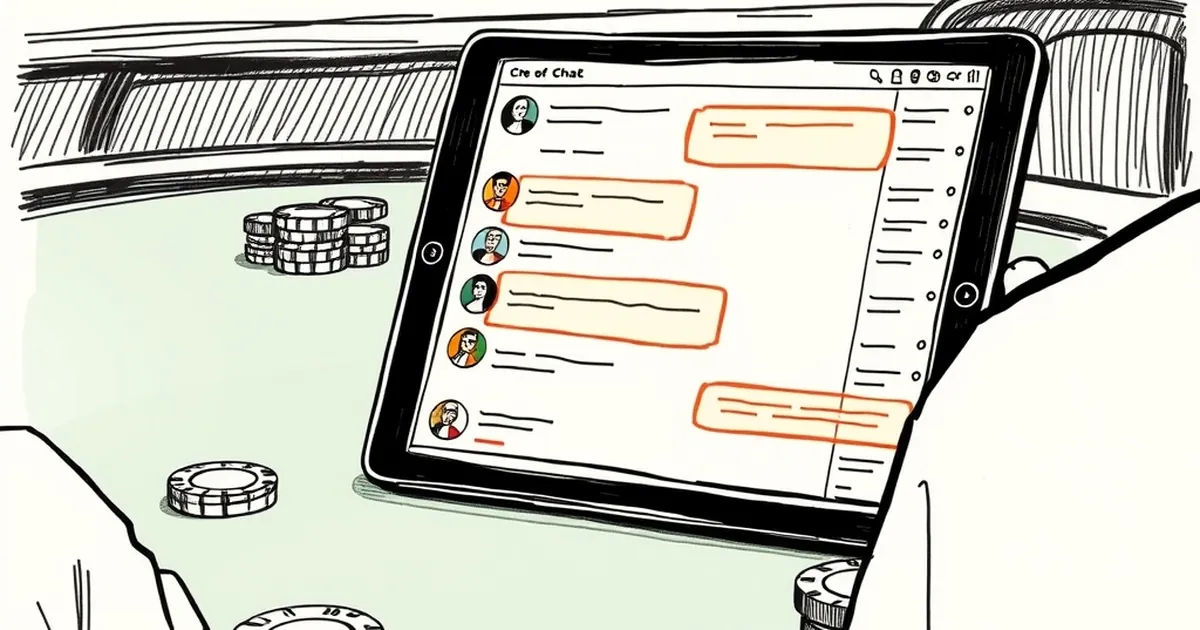
Live dealer tables start to feel different once the chat box passes about 30 messages a minute. The scroll stops being readable and starts being a texture—usernames, emojis, the same three greetings bouncing off each other. And somewhere in that blur, usually buried in a short cluster of no more than three lines, is the thing worth noticing: a tell, a pattern, or a scripted bit of theatre that the operator or a sharper player is running on the room. If you can train yourself to ignore the flood and read the three, you get a much cleaner picture of what's actually happening at the table.
That's the claim, and it's testable in a modest way. On a busy Evolution or Pragmatic Play blackjack table during Australian evening hours—roughly 7pm to 11pm AEST—the chat velocity regularly clears 30 messages per minute. The three-message tell is the exception inside that noise, and it's where the real information sits.
Why 30 messages a minute is the threshold, not a guess
Chat doesn't scale linearly with attention. Below roughly 20 messages a minute, most people can follow the thread and still track the cards. Between 20 and 30, attention starts splitting. Past 30, the room crosses into what you might call ambient noise: individuals stop being distinguishable and the chat becomes a single moving object.
That matters because the human eye is bad at tracking a moving object and good at catching a break in one. A dealer who pauses, a username that repeats a phrase verbatim, a sudden three-line burst that doesn't match the tone of the preceding 30 messages—these register precisely because they break the texture. The flood isn't the problem. The flood is the camouflage, and the three-line break is the thing the camouflage exists to hide.
There's an operator-side version of this too. Studios running multiple tables will often seed chat with what are politely called "engagement accounts"—usernames that greet newcomers, ask rhetorical questions ("anyone hitting on 16 here?"), and keep the room warm. These accounts tend to post in short bursts of two or three lines, then go quiet for a minute or more. Once you know the rhythm, they're not hard to spot. They also tend to use the same handful of phrasings across tables, which is the giveaway.
The three-message tell in practice
The greeting cluster
Watch for three consecutive messages within about eight seconds that all welcome a new username. On a genuine table, one regular might say hello. Three in a row, from accounts that haven't spoken in ten minutes, is a scripted pattern. It's not illegal and it's not even particularly deceptive—it's just marketing—but it tells you the room is being managed, which changes how you read everything else in the chat.
The "lucky" run
The more interesting version is player-side. Someone posts three short lines—"wow", "again", "unreal"—right after a dealer bust. If those three lines appear within four seconds and the same account does it three times in a session, you're likely looking at either a bot or a player running a side channel (a stream, a group chat) and reacting to it rather than to the table. Neither is your problem directly, but both distort the room's mood, which is exactly what live dealer games are selling.
The dealer's own tells
Dealers are trained, and good ones don't give much away. But three-message clusters in the chat often coincide with a dealer's procedural pause—a re-shuffle, a card change, a supervisor stepping in. If you see a burst of chat right as the shoe is being swapped, that's the room covering a gap. It's not a scam; it's just the machinery showing.
What the flood actually costs you
The practical cost of a 30-message-a-minute room isn't confusion. It's decision speed. Live blackjack and baccarat move at roughly 40 to 60 hands an hour on a busy table, and if you're reading chat between decisions you'll miss the betting window more often than you'd think. A missed window on a $25 hand is a $25 swing in tempo, not bankroll—but over a two-hour session that's a lot of decisions made on autopilot.
The other cost is emotional. Live dealer games are designed to feel social, and a fast chat creates a sense of momentum that has nothing to do with the cards. That's the actual product. The RNG version of the same game doesn't have it, which is why live tables can feel more "real" and also more expensive.
Worth keeping in mind: Australian players accessing offshore live dealer sites are doing so outside the licensed framework, which means no local dispute resolution if a session goes sideways. That's not a reason to avoid the format entirely—it's a reason to keep sessions short and stakes boring, and to treat the chat as scenery rather than company.
Reading the room without reading every message
The skill isn't following the chat. It's sampling it. Glance at the box once every ten hands or so and look only for breaks in the pattern: three-line bursts, repeated phrasings, accounts that appear across multiple tables with the same opener. Everything else is noise, and noise is fine as long as you're not paying attention to it.
If you want a concrete habit: set a soft time limit of 45 minutes per live session and a per-hand cap you'd be comfortable losing 20 times in a row. Those two numbers do more for your session than any amount of chat-reading. The tell is interesting. The bankroll is what actually matters.
The open question is whether operators will keep letting chat run this hot. Regulators in several markets have started looking at "social features" in live dealer products as a form of engagement design rather than a neutral add-on, and a cap on message velocity—say, 15 per minute per table—would change the texture of these rooms entirely. Whether that happens in Australia, and whether it makes the games better or just quieter, is genuinely unclear.