Live dealer tables cap at 7 seats — the waitlist clears at 40
Live dealer tables cap at seven seats with waitlists clearing near 40, revealing the real arithmetic behind peak-hour queues at Australian blackjack and bacc...
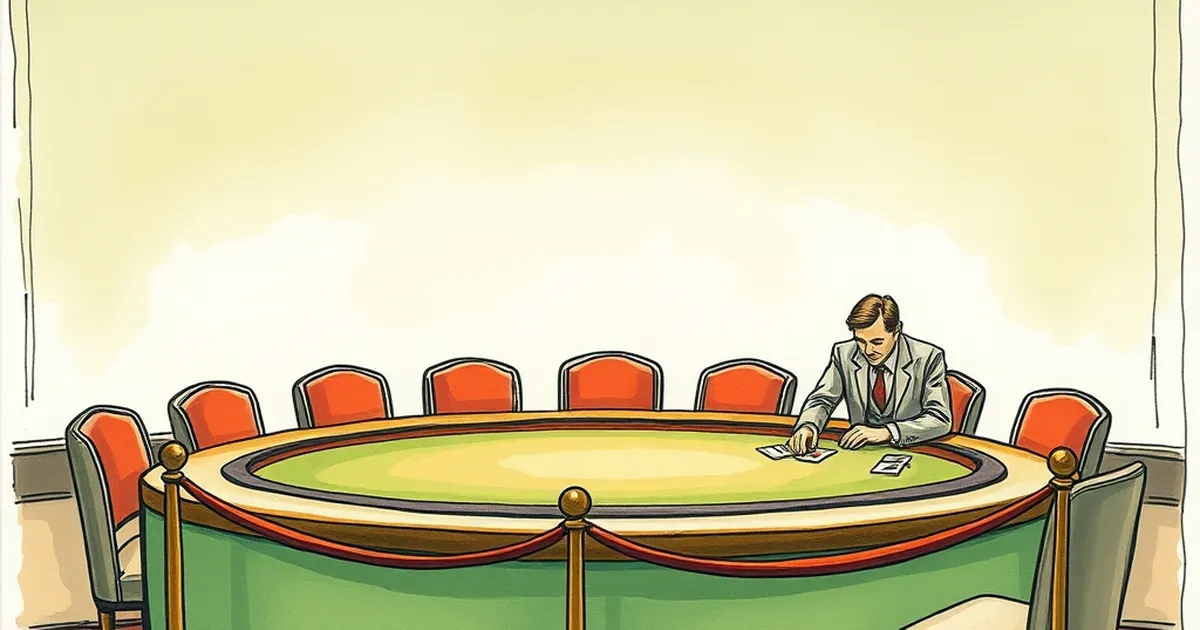
Live dealer tables cap at seven seats, and the waitlist clears at about 40. That's the practical arithmetic behind the "full table" message you'll see on blackjack and baccarat lobbies at peak Australian hours — roughly 5.7 punters queued for every seat. The number isn't a marketing figure. It falls out of how studios schedule tables, how long a hand actually takes, and how many seats the software will let a dealer manage at once.
Why seven seats is the ceiling, not a choice
A live blackjack table could physically seat more. The limit is operational. Seven is where the dealer's card handling, chip work and eye contact stay inside the time budget for a hand, and where the camera framing still lets every player read their own cards on a phone screen.
Push to eight and something gives. Either hands slow down — which crushes hands per hour and therefore the house edge maths the table is built around — or the studio widens the shot and the card details get soft on a small display. Most operators have tested eight. Most have gone back to seven.
Baccarat sits at the same cap for a different reason: the betting window. With seven players the interface fits a single screen without a scroll on a 6-inch phone, and the dealer can read the board and settle without the squeeze that causes misdeals. Roulette is the exception in the other direction — some studios run 8 or even 12 seats on immersive wheels, because the dealer isn't dealing to individuals. The seven-seat rule is really a cards-and-chips rule.
The hands-per-hour maths
A live blackjack hand runs about 55 to 70 seconds with a full table, depending on how many players hit, split or ask questions. Call it 60. That's 60 hands an hour at best. A seven-seat table turning over 60 hands serves 420 player-hands per hour. An eight-seat table at the same speed serves 480 — but only if the dealer doesn't slow down, and in practice the eighth seat costs you 5 to 8 seconds a hand. At 52 hands an hour, eight seats delivers 416 player-hands. You've added a chair and lost throughput.
That's the whole argument in one line: seven seats is the throughput maximum, not a compromise.
What "waitlist clears at 40" actually means
Forty is the point where the queue stops behaving like a queue. Below roughly 40 waiting players, a seat frees up within a hand or two and the waitlist is invisible — you tap, you sit. Above 40, the wait becomes a visible product feature: a countdown, a "next available" estimate, a nudge toward a different table.
The 40 figure comes from the churn rate. At a busy table, seats turn over at roughly one every 90 seconds during peak — someone busts out, someone leaves for dinner, someone's phone rings. That's about 40 seat changes an hour per table. So a waitlist of 40 is, very roughly, one hour of turnover. That's the threshold where an operator can honestly say "you'll get a seat this session" rather than "you'll get a seat eventually."
Peak hours in Australia
The queue is worst between 7pm and 10pm AEST, when the local studios are at full staffing and the European rooms are opening. A Tuesday night blackjack lobby might show four or five tables at 40-plus waiting. A Sunday morning shows none. If you're the sort of player who cares about table selection, the timing matters more than the operator.
The seat cap changes how you should pick a table
If you're choosing between two blackjack tables with identical rules and a 0.5% house edge, the one with the shorter waitlist is worth more than the one with the prettier studio. Time spent waiting is time not played, and if you're working through a wagering requirement, waiting is dead time that doesn't contribute.
Three things to check before you queue:
- Seat count. Seven-seat tables move faster than five-seat tables at the same dealer speed. More seats, more hands, more chances to catch a good run.
- Bet limits and table minimums. A $5 minimum table with a 40-deep waitlist is a bad trade. A $25 table with six waiting is often the better session, even if the minimum stings.
- Side bet clutter. Tables offering Perfect Pairs and 21+3 slow the dealer down. Every side bet is another decision point and another payout to settle. A plain seven-seat table will out-pace a cluttered one by 10 to 15%.
For baccarat, the seat cap matters less — you can often bet on a full table via the "back bet" positions without a seat at all. That's the quiet workaround most players miss. If the waitlist is 40 deep and you just want to back Banker, you don't need a chair.
The 40 threshold as a signal
Treat a 40-plus waitlist as information. It usually means one of three things: the studio is under-staffed for the hour, the table has a genuinely good rule set that's drawn a crowd, or the operator is funnelling traffic to a single table to make the lobby look busy. The first is bad luck. The second is worth waiting for. The third is worth leaving.
Where the cap hurts: high-stakes and niche tables
The seven-seat ceiling is fine for a $10 blackjack table with a queue. It's a problem for anything niche. A $500-minimum blackjack table with seven seats and a 40-deep waitlist is effectively closed to anyone who isn't already sitting. Same for double-exposure variants, Spanish 21, and any table with a specific rule set a player actually wants.
Studios have partly solved this with private tables and "reserved seat" features, but those tend to carry a higher minimum or a session fee. The result is a two-tier live casino: mass-market tables where the queue is the product, and premium tables where the price of entry is the queue-skip.
Poker is the outlier worth noting. Live dealer poker variants — Casino Hold'em, Caribbean Stud — run the same seven-seat cap, but the waitlist clears faster because hands resolve quicker and players churn harder. A 40-deep waitlist on Casino Hold'em clears in about 25 minutes, not an hour.
What the cap does to bonus clearing
If you're clearing a wagering requirement on live tables — and plenty of Australian-facing sites now contribute live dealer play at 10% to 20% of the standard rate — the seat cap is a direct tax on your time. A $200 bonus with a 30x requirement is $6,000 of turnover. At 60 hands an hour and a $10 average bet, that's 10 hours of play. Add a 40-deep waitlist twice a session and you've added an hour or more of dead time that doesn't count toward anything.
The practical fix is to play off-peak or pick a table with a shorter queue even at a slightly worse rule set. A 0.6% house edge table you can actually sit at beats a 0.4% table you queue for. And set a time limit before you start — the waitlist has a way of making a 90-minute session feel like three hours, which is exactly when the bets get sloppy.
The open question
The seven-seat cap has held for a decade because the dealer is still a person dealing physical cards to a camera. The moment studios move to hybrid tables — a dealer overseeing six or eight automated seats with digital card display — the cap becomes a software setting rather than a physical constraint. Some Asian-facing studios are already trialling 10-seat automated blackjack. If that spreads, the 40-deep waitlist disappears, and with it the whole ritual of queuing for a seat. The question is whether players actually want that, or whether the wait is part of what makes a live table feel live.