Live dealer tables drop to 4 seats at 11 p.m.—the math shifts
Late-night live dealer tables drop to four seats as operators recalculate costs, quietly shifting your effective return and hands per hour
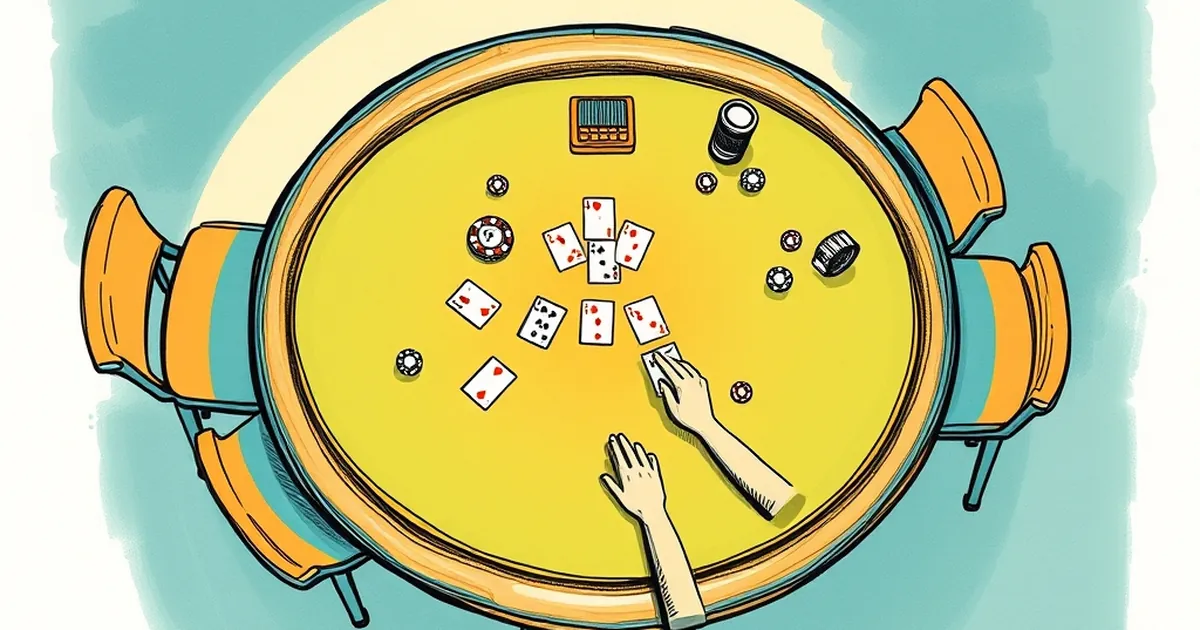
If you play live blackjack or roulette between 11 p.m. and roughly 2 a.m. AEST, you'll notice a pattern that isn't in any marketing copy: tables that ran seven seats at 8 p.m. are running four. The studio hasn't shrunk. The dealer hasn't moved. What changed is the operator's cost-per-hour calculation, and it flows straight through to your effective return, your hands per hour, and how much a "low stakes" table actually costs you. Most players read the four-seat layout as a cosmetic downgrade. It's a pricing decision.
Why the seat count moves at all
Live dealer economics are weird. Unlike RNG blackjack, where the marginal cost of a seat is essentially zero, every live seat consumes dealer time, camera framing, and — critically — a share of the table's theoretical win rate. A seven-seat table at 8 p.m. with a full deck of recreational players generates more total handle than a four-seat table, even if per-player stakes are lower. The operator wants bodies.
At 11 p.m., the demand curve inverts. The recreational crowd in Sydney and Melbourne has thinned out. What's left is a mix of night-shift players, Europeans awake at lunchtime, and a smaller pool of higher-stakes regulars. Filling seven seats becomes harder, so the operator does the arithmetic: a half-empty seven-seat table ties up a dealer and a studio bay for the same fixed cost as a full four-seat table, but the four-seat table concentrates the handle.
There's a second lever. Many studios run shared dealer pools. When concurrent table count drops after peak, the operator can either keep seven-seat tables open and accept idle seats, or consolidate into fewer, fuller four-seat tables. The second option usually wins on labour utilisation. The seat reduction you see isn't a downgrade — it's consolidation.
The fixed-cost floor
A live dealer bay costs the operator somewhere in the region of $8–$14 per hour in dealer wages alone, before studio rent, camera infrastructure, compliance staff, and the streaming backbone. That number doesn't care whether one player or seven are seated. At 11 p.m., with lower seat occupancy, the operator needs each occupied seat to carry more of that fixed cost. One way to do that is raise the minimum bet. The other is to reduce seat count so the remaining seats fill faster and the table's theoretical win per hour stays viable.
What four seats does to your hands per hour
Here's the part players feel but rarely quantify. Blackjack hands per hour depend on seat count, dealer speed, and how many players are actually sitting. A seven-seat table with four players seated runs slower than you'd think — the dealer waits for decisions across a wider layout, and the shuffle and cut-card sequence is the same regardless. A four-seat table with four players seated runs faster per seat because there's less dead time scanning empty positions and less ambiguity about whose turn it is.
The catch is variance. Fewer seats means fewer hands per shoe, and fewer hands per shoe means your session sample is smaller. If you're grinding a 0.5% house edge game and you're used to 70 hands an hour, dropping to 55 hands an hour doesn't change your expected loss per hand — but it does change how long it takes to reach the long run, and it stretches the variance window where you're either up or down by more than the edge would suggest.
Run the numbers. At $25 a hand, 70 hands an hour, 0.5% edge: expected loss is $8.75 an hour. At 55 hands an hour, same stake and edge: $6.88 an hour. The four-seat table looks cheaper. But your standard deviation per hour also drops, which cuts both ways — fewer hands means your results cluster less tightly around expectation, so a single hot or cold hour swings wider relative to the smaller number of hands played. The edge is the same. The ride is not.
Roulette is a different animal
Roulette doesn't care about seat count in the same way. The wheel spins on a fixed cycle. Whether four or seven players are betting, the number of spins per hour is largely set by the dealer's pace and the ball's travel. Four seats just means fewer people sharing the same spins. Your hands — spins — per hour barely move. What moves is table minimum, which operators often nudge up on consolidated late-night tables to compensate for lower occupancy. That's the real cost to you: not fewer spins, but a higher entry point for the same game.
The minimum bet creep
This is where the seat math hits your bankroll directly. When a table drops from seven seats to four, the operator frequently raises the minimum from, say, $10 to $25, or $25 to $50. The logic is straightforward: fewer seats need to generate the same revenue per hour, so each seat has to carry more. For a player who was comfortable at $10 a hand, the 11 p.m. table is now a $25 table. That's a 150% increase in stake for the same game, same rules, same RTP.
If you're bankroll-managed at 1% of a $2,000 roll per hand — $20 — a $25 minimum puts you over your own limit. You either move up in stake against your plan, drop to a lower-variance game, or stop. None of those are what you sat down for. The seat reduction didn't change the rules. It changed the price of admission.
Check the rules, not just the seats
Late-night consolidated tables sometimes also tighten rules to protect the operator's margin. Common shifts: blackjack paying 6:5 instead of 3:2, dealer standing on soft 17 instead of hitting, or no double-after-split. A 6:5 payout on blackjack adds roughly 1.4% to the house edge compared to 3:2 — on a 0.5% base game, that's a near-tripling of the edge. Always check the payout and rule card before you buy in, especially on a table that looks newly consolidated. The seat count is the visible change. The rule card is the one that costs you.
What to do with this
If you're a late-night player, the practical move is to know your own numbers before 11 p.m. arrives. Work out your hands per hour at both seat counts, your expected loss at the minimum stake on offer, and whether the late table still fits your bankroll plan. If the minimum has jumped and the rules have tightened, the four-seat table isn't the same game you played at 8 p.m. — it's a different product wearing the same layout.
The open question is whether operators will keep pushing consolidation as studio costs rise and late-night demand stays soft. If four seats at 11 p.m. becomes the norm, does the seven-seat table survive at all outside peak hours — and if it doesn't, what happens to the recreational player who can't meet a $50 minimum at midnight? The studios have run the math. The players haven't yet.
If gambling stops being fun, take a break. Support is available through Gambling Help Online or on 1800 858 858, any hour.