Poker tells sharpen at $2/$4 blinds — then vanish
Physical poker tells peak at $2/$4 blinds, then vanish at higher stakes where players broadcast nothing but white noise
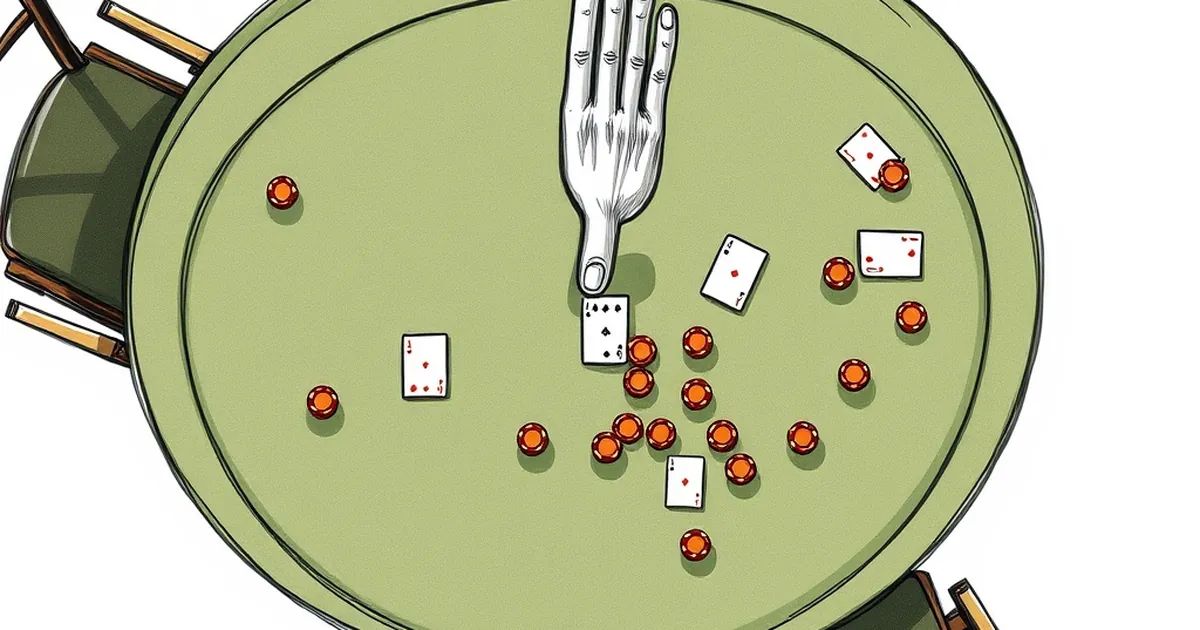
There’s a sweet spot in live poker where physical tells actually mean something, and it’s not where most recreational players think. At $2/$4 blinds — the staple of Australian pub poker and low-stakes casino rooms — opponents are loose enough to give off readable behavioural cues, but skilled enough that those cues carry real weight. Push past $5/$10 and the dynamic flips: the regulars have seen every twitch, every fake sigh, and they’ve trained themselves to broadcast nothing but white noise.
The $2/$4 Tell Window
Let’s be precise about what makes this stake so special. At $2/$4, the average pot sits somewhere between $30 and $80 in a typical live game. That’s a number that matters for two reasons. First, it’s high enough that players care about the outcome — nobody’s shrugging off a $60 loss as pocket change, especially over a four-hour session. Second, it’s low enough that the player pool hasn’t been filtered down to pure professionals. You’re facing shift workers, retired tradies, and weekend warriors who’ve watched a few poker YouTube videos but haven’t drilled the robotic discipline required to suppress natural reactions.
The result is a beautiful, exploitable middle ground. I’ve sat in these games at the Crown in Perth and the Star in Sydney, and the pattern repeats like clockwork. A player checks their cards, then their hand drifts toward their chips before they’ve decided to bet. That’s a classic strength tell — the body moves toward the action it wants to take. At $2/$4, that hand movement happens maybe 70% of the time when a player holds top pair or better. At $5/$10, that same player has learned to keep their hands flat on the table or use a consistent pre-action ritual.
The tells that work at $2/$4 aren’t subtle. They’re the obvious ones: the quick double-take at the flop, the sudden stillness when the river completes a flush draw, the way a player’s breathing shallowly when they’ve flopped a set. These aren’t advanced reads — they’re just observations that most players at this level haven’t learned to mask.
Why the Tells Vanish at Higher Stakes
Here’s the kicker: the same players who are transparent at $2/$4 become stone-cold at $10/$20. It’s not that they’ve suddenly developed superhuman control. It’s that the stakes themselves change the physical calculus.
At $2/$4, a bad bluff costs you maybe $60. The emotional stakes are real but survivable. Your body reacts honestly because you haven’t yet conditioned yourself to treat that money as irrelevant. At $10/$20, a failed bluff costs $300 or more, and that’s when the fear response kicks in — but not the kind you can read. Experienced players at this level have been burned enough times that they’ve built a muscular memory of not reacting. They’ve learned to breathe evenly, to count their chips in a fixed rhythm, to look at the flop with the same neutral gaze whether they’ve hit quads or complete air.
I’ve watched this transition happen in real time with regulars who move up in stakes. A guy I played with at $2/$4 for two years was the most readable player in the room — he’d drum his fingers when he was bluffing and go completely still when he had the nuts. He moved up to $5/$10 and within three months, the finger-drumming was gone. Not because he’d consciously practiced suppressing it, but because the higher variance forced him to focus on his own decision-making so intensely that his body stopped broadcasting his emotional state. The tells didn’t get hidden — they got overridden by cognitive load.
The Numerical Anchor: 100 Hands of Observation
Here’s a concrete number that helps calibrate your expectations. In a live $2/$4 game, you’ll see roughly 25 to 30 hands per hour. Over a four-hour session, that’s about 100 hands. If you’re paying attention, you’ll get a reliable read on at least three or four opponents within those 100 hands — enough to make a meaningful adjustment to your win rate.
Now, let’s compare that to a $10/$20 game. Same 100 hands, but now you’re dealing with players who’ve seen 10,000+ hours of live poker. The tells you might pick up are so marginal — a slight hesitation before a river call, a half-second faster bet when they’ve got a monster — that they require statistical tracking over multiple sessions to become actionable. You’re not going to spot a reliable pattern in 100 hands. You need 500 or more, and by then, the player has likely adjusted anyway.
This is why the $2/$4 game is the last place where live tells — as opposed to betting pattern analysis — actually move the needle. The signal-to-noise ratio is favourable enough that a decent observer can profit purely from physical reads. At higher stakes, the only reliable edge comes from understanding ranges and bet-sizing logic, because the physical channel has been effectively shut down.
The One Tell That Survives
There’s a single exception worth noting. Across every stake level I’ve played, from $1/$2 home games to $20/$40 mixed games, one physical tell persists: the speed of the check. Players who check quickly with a weak hand, then check slowly when they’re trapping — that rhythm differential never fully disappears. It’s the last tell to go because it’s not something players consciously control. It’s tied to how quickly their brain processes the board texture relative to their hand strength.
At $2/$4, this tell is almost comically obvious. A player who checks in under a second on a coordinated board almost always has nothing. At $10/$20, the same player might take two seconds to check with air and three seconds with a monster — a difference you can only catch if you’re timing every action with your phone. But it’s still there. It’s just moved from a sledgehammer to a scalpel.
The Australian Pub Poker Angle
There’s a local twist that makes this particularly relevant for Australian players. The pub poker circuit — those $50 buy-in tournaments with $2/$4 cash games running alongside — is arguably the best training ground for live tells in the country. The player pool is a rotating cast of amateurs who play twice a month, which means you’re constantly seeing fresh faces with unrefined tells. But here’s the catch: the games are so soft that most regulars never bother learning to read anyone. They just play their own two cards and hope for the best.
If you’re willing to actually watch opponents instead of your phone between hands, you can build a tell-based edge that translates directly to the casino cash games. The skill ceiling for physical reads is lower at pub poker, but the volume of readable opponents is higher. I’ve seen players crush $2/$4 at the casino purely by applying the observational habits they developed in Wednesday night pub games.
The flip side is that this skill has a shelf life. The moment you move to a game where the average opponent has played 5,000+ live hours, your tell-reading edge shrinks to almost nothing. You’re left with the same tools as everyone else: position, range analysis, and the discipline to fold when the math says fold.
So Where Does That Leave You?
The uncomfortable truth is that the $2/$4 game is a developmental sweet spot that most players either outgrow too quickly or never learn to exploit properly. If you’re grinding at $2/$4 and relying purely on mathematical strategy, you’re leaving money on the table — the physical reads are right there, waiting to be taken. But if you’re planning to move up, you need to accept that the skills that made you money at $2/$4 will become nearly useless at $5/$10 and above.
The question that keeps me up at night is this: are today’s online-first players — who learned poker staring at a screen with no physical component — actually better equipped for higher-stakes live games because they never developed a reliance on tells in the first place? Or are they missing a fundamental layer of human psychology that no amount of GTO study can replace? I genuinely don’t know the answer. But the next time you sit at a $2/$4 table, watch the player across from you who’s drumming his fingers on his stack. He’s telling you exactly what he has. The only question is whether you’ll still be able to read him when the blinds go up.