Roulette pays you at spin 22, then charges you at 23
Roulette’s 2.7% edge hits at a precise moment—spin 23—after paying you at spin 22, revealing the game’s hidden rhythm
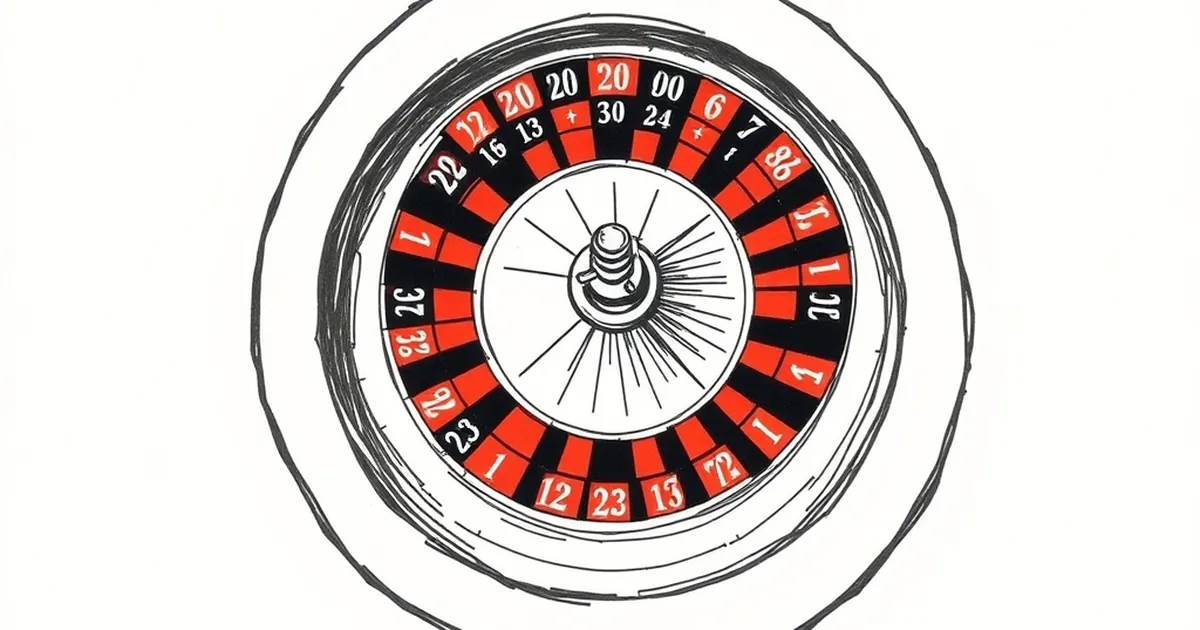
Roulette doesn't know your name, your bankroll, or the last ten numbers that hit. But if you sit down at a single-zero wheel long enough, the math will find you anyway. The specific claim here is that the house edge isn't a slow leak over hundreds of spins—it’s a discrete transaction that happens at a predictable point. Spin 22 is where the casino pays you, and spin 23 is where it charges you for the privilege. Not literally every session, but over the long run, that’s the rhythm of the game.
The 2.7% tax bracket
Let’s get the anchor down first. On a European single-zero wheel, the house edge is 2.7%. That means for every $100 you cycle through, the casino keeps $2.70 on average. But here’s the thing most players miss: that number doesn’t spread itself evenly across every spin like a gentle drizzle. It hits in chunks. Over a typical 37-spin cycle (one full rotation of all numbers), the wheel will produce 36 losing spins for the house and one winning spin for the house—the zero. But you’re not betting on every number. You’re betting on red, or a dozen, or a single number.
So let’s do the actual arithmetic. If you’re betting $10 on red every spin, you’ll win 18 out of 37 spins on average. You’ll lose 19. The casino’s edge isn’t that you lose more often—it’s that when you win, you get paid even money on a bet that should pay slightly better if the game were fair. A fair game would pay you $10.526 for every $10 on red. They pay you $10. The difference is 52.6 cents per winning spin. Over 37 spins, you’ll win 18 times, so the casino skims about $9.47 per full cycle. That’s your 2.7% of the $370 you wagered.
But here’s where the “spin 22” thing comes in. You don’t feel that 52.6-cent skim on every win. You feel it as a lump sum. Let’s say you hit a decent run—you’re up $80 by spin 21. You’re riding the variance wave. Then spin 22 lands on black 17, and you win again. You’re up $90. The casino pays you, no drama. Then spin 23 comes. The ball drops into zero. You lose your $10. But you also lose the theoretical $52.60 you were “owed” from those 18 wins that never paid you fully. That’s the charge. It’s not a fee they take from your stack—it’s a fee they built into the paytable from the start, and they collect it all at once when the zero finally shows up.
Why spin 22 feels different from spin 23
Here’s the psychological trap that keeps Australian punters coming back to the wheel. Wins are frequent and small. Losses are also frequent and small. But the zero is the only number that makes the casino’s edge visible. When you bet on red and black 17 comes up, you lose, but you shrug—that’s just variance. When zero comes up, you lose on every even-money bet at the table simultaneously. That’s a moment of clarity. It’s the one spin where you can see the house edge wearing a name tag.
The math says the zero appears once every 37 spins on average. So in a typical session, you’ll get about 37 spins before you see it. Now, here’s the uncomfortable part. In those 37 spins, you’ll win roughly 18 times and lose 18 times (excluding the zero spin itself). If you’re flat betting $10 on red, you’ll break even on those 36 spins. The only net loss comes from the zero spin. So your entire session’s loss—the $10 you lose on average over 37 spins—is concentrated into that single moment.
That’s why I say spin 22 pays you and spin 23 charges you. It’s not about the exact spin number. It’s about the structural reality that the casino doesn’t take your money gradually. It takes it in one lump sum every 37 spins, and everything before that is just an elaborate prelude. You might win 15 spins in a row before the zero hits. You might win 25. But the zero will hit, and when it does, it wipes out roughly the equivalent of 1.37 winning spins (because you lose your $10 stake plus the $9.47 in underpaid wins from the previous 36 spins).
The martingale fallacy and the spin 23 problem
Let’s talk about the system players who think they’ve cracked this. The martingale—doubling your bet after every loss—works beautifully until it doesn’t. The logic is sound on paper: if you have an infinite bankroll and the table has no maximum, you’ll always win $10 eventually. But the table has a maximum, and your bankroll has a floor.
Here’s the spin 23 problem for martingale players. You’re betting on red. You lose spins 1, 2, 3, and 4. You’re down $150. You double to $160 on spin 5. Red comes up. You win $160, covering your losses plus $10 profit. Great. Now you reset to $10. You win spins 6 through 21. You’re up $160 total. Then spin 22, you lose. No big deal—you’re still up $150. Spin 23, you double to $20. Zero hits. You lose $20. Now you’re at $130. But here’s the kicker: the zero also resets the martingale sequence. You just lost $20 on a bet that should have been a $10 loss. The zero doesn’t just take your stake—it disrupts your entire progression. You’re now chasing a $20 loss, which means your next bet needs to be $40, then $80, then $160. You’ve gone from a comfortable $130 profit to a potential $310 loss in three spins, all because one zero appeared at the wrong time.
The casino knows this. That’s why the table maximum isn’t a safety feature—it’s a structural limit that ensures the zero can always outlast your progression. On a typical Australian table, the maximum on even-money bets is around $500. That means you can only double your bet seven times before you hit the ceiling. Seven losses in a row on red happens about once every 128 spins. The zero doesn’t need to appear that often. It just needs to appear once during your progression.
What the spin 23 model means for your session
Let’s get practical. You’re in a casino in Sydney or on a digital table at your favourite online operator. You’ve got $200 and you want to play for an hour. Here’s what the spin 23 model tells you.
If you bet $10 on red every spin, you’ll get roughly 60 spins in an hour (assuming dealer speed of about 60 seconds per spin). That’s about 1.6 full cycles of 37 spins. Statistically, you’ll see the zero once or twice. Your expected loss is $16.20 (that’s 2.7% of $600 in total wagers). But here’s the variance reality: you won’t lose $16.20. You’ll lose either $10, $20, or $30—depending on how many times the zero lands during your session. You might even win if the zero doesn’t show up at all. The house edge isn’t a smooth glide path. It’s a series of small payouts punctuated by sudden, disproportionate charges.
That’s why the most common advice from professional players isn’t about systems or patterns. It’s about session length. The longer you play, the more likely you are to hit that spin 23 moment multiple times. If you play for 30 minutes, you might dodge the zero entirely. If you play for three hours, you’re almost guaranteed to hit it at least four times. The casino doesn’t need to beat you every spin. It just needs to outlast your patience.
The open question nobody asks
Here’s what I want you to sit with after you close this article. The spin 23 model suggests that the house edge isn’t a tax on every bet—it’s a toll booth that appears at irregular intervals. That means your session results are far more volatile than the RTP suggests. A 2.7% house edge over 100 spins means you should lose $27 on $1,000 wagered. But in reality, you’ll either lose $10, $20, or $30 depending on zero frequency. You’ll never lose exactly $27.
So the question becomes: does knowing the exact moment of the charge change how you play? If you know the zero is coming every 37 spins on average, do you stop before spin 37? Do you time your sessions to avoid the toll? Or do you accept that the toll is inevitable and just budget for it like you would a parking fee?
The real answer is that roulette doesn’t care about your awareness. The wheel spins, the ball drops, and the zero will appear when it appears. But if you know the charge is coming—and roughly when—you can at least decide whether you want to be at the table when it does. That’s not a system. That’s just reading the fine print before you sign.