Roulette's 2.7% edge rides 37 pockets — the last one pays 35
Roulette’s 2.7% house edge comes from pure arithmetic: 37 pockets, 36-to-1 true odds, and a 35-to-1 payout that quietly keeps one unit on every spin
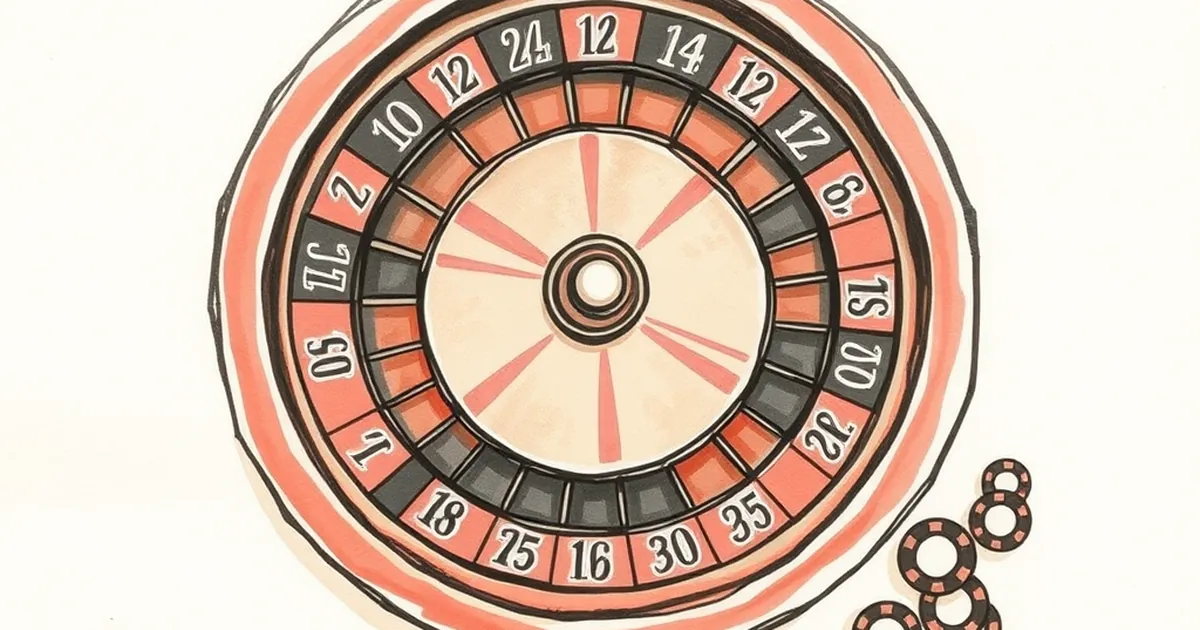
Roulette's house edge isn't a fee, a rake, or a hidden charge. It's arithmetic baked into the payout structure: 37 pockets on a European wheel, 36-to-1 true odds against any single number, and a payout of 35-to-1. That missing unit is the entire 2.7%, and it shows up every time the ball lands — not once, not sometimes, but on every spin you're paid on.
The 37th pocket is the whole story
Put $10 on a single number. The true odds of hitting are 1 in 37. A fair payout, one with no edge either way, would return $370 on a win — $360 profit plus your $10 back. The actual payout is 35-to-1, so you collect $350 profit plus your stake, or $360 total. The $10 difference is the house's cut, and it's carved out of the payout rather than deducted from your account.
Scale that up. Over 37 spins at $10 a number, you'd stake $370 and expect one win. You'd get back $360. The house keeps $10, which is 2.70% of $370. That's not a simulation artefact — it's the definition of the edge on a single-number bet, and it holds for every bet on the European layout once you do the same division. Straight-up, split, street, corner, column, red/black: the payout ratios are all set so the expected loss lands on the same 2.7%.
The reason it feels different bet to bet is variance, not edge. A $10 straight-up bet has a 1-in-37 chance of returning $360 and a 36-in-37 chance of returning nothing. A $10 red/black bet wins 18 times out of 37 and pays even money. Same expected loss per dollar staked, wildly different ride.
Why 35-to-1 and not 36-to-1
Because 36-to-1 would be a fair game. If the casino paid true odds on a 37-pocket wheel, expected value would be zero and roulette would be a coin-flip with extra steps. The 35-to-1 payout is the mechanism by which the 37th pocket — the one that isn't yours — gets funded. Every other bet type on the layout is just a different packaging of that same shortfall.
American roulette doubles the shortfall
Add a double-zero pocket and the maths shifts. The American wheel has 38 pockets, pays the same 35-to-1 on a straight-up number, and the edge jumps to 5.26%. That's nearly double the European figure for the same bet with the same payout. The extra pocket is doing all the work.
Australian players will mostly encounter the European single-zero layout online, and often the French variant with la partage (half your even-money bet returned when zero hits) or en prison (your even-money bet held for the next spin). La partage cuts the edge on even-money bets to 1.35%; en prison does the same in expectation. Neither touches the straight-up bet, which stays at 2.7%. If a table offers either rule, the even-money bets become meaningfully cheaper than the inside bets — a detail worth checking before you default to red/black for "safety."
What 2.7% actually costs per hour
The edge is per dollar staked, not per session. That distinction matters more than the percentage itself.
Say you play 40 spins an hour at $5 a spin on red/black. That's $200 staked per hour, and the expected loss is $5.40. Play $25 a spin for the same 40 spins and you're staking $1,000 an hour with an expected loss of $27. The edge didn't change. Your exposure did.
Now compare that to a 97.3% RTP pokie. Sounds close to roulette's 97.3% return on the European wheel — and it is, on paper. But a pokie at 97.3% RTP with 600 spins an hour at $1 a spin turns over $600 an hour with an expected loss of $16.20. Roulette's edge and a pokie's edge are the same number expressed two ways: 2.7% house edge equals 97.3% RTP. What differs is how fast you cycle money through it. Roulette is slow by comparison, which is why the hourly cost often looks gentler than the headline percentage suggests.
That's also why the "play longer to win it back" instinct is backwards. Every spin is an independent 2.7% tax on the stake. Time in the chair doesn't improve your position; it just multiplies the number of times the tax applies. The variance is what makes a session feel winnable — and sometimes it is, over 50 spins. Over 5,000 spins, the 2.7% has a lot more chances to assert itself.
The strategies that don't move the number
Martingale, Labouchere, D'Alembert, the "sector" systems sold in PDFs for $47 — none of them change the expected value per dollar staked. They change the shape of the outcome distribution. Martingale in particular converts a high probability of a small win into a low probability of a catastrophic loss, and on a table with a betting limit it fails by design. A $5 minimum and a $500 maximum gives you seven doublings before you're capped. Eight losses in a row on red/black happens roughly once in 256 sequences — frequent enough to matter over a few hundred spins.
The only things that genuinely alter the edge are rule changes: single-zero instead of double-zero, la partage or en prison on even-money bets, and in some jurisdictions a "surrender" rule that halves the loss on a split bet when zero hits. Those are worth hunting for. Betting patterns aren't.
Where the 2.7% leaves you
The edge is small enough that a session can go either way, and large enough that it never goes away. That's the honest tension in roulette: it's one of the cheapest table games in the building per dollar staked, and it's still a game where the long-run expectation is a slow, steady drain at 2.7 cents per dollar.
Which raises the question worth asking before you sit down: if the payout structure guarantees the house 2.7% on every bet, what are you actually buying with your stake? Entertainment, mostly — and the price of that entertainment is set per spin, not per session. Set a loss limit in dollar terms rather than time, treat the 37th pocket as a cost of admission rather than a design flaw, and the number stops being something that happens to you and becomes something you've priced in. If it stops feeling like entertainment, the maths won't bail you out — and that's the point at which a break, or a call to Gambling Help Online on 1800 858 858, is worth more than any system.