Same-game multi pays 4x — the correlation eats 30%
Same-game multis advertise up to 4x, but correlation between legs quietly strips around 30% of the true value, and some combinations lose far more
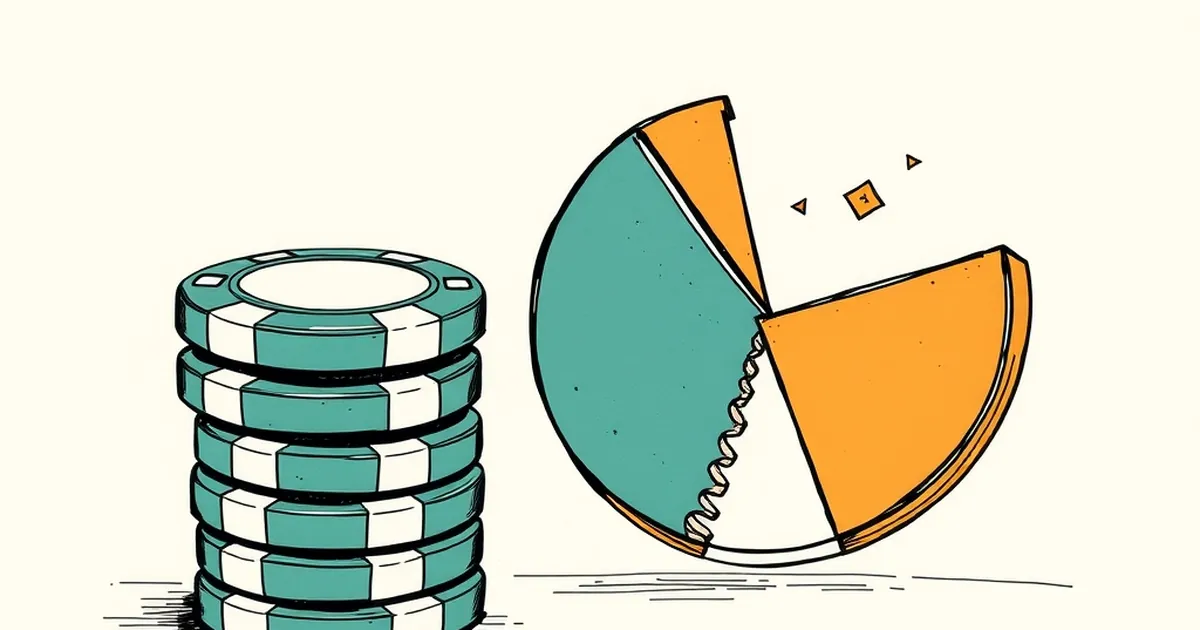
Same-game multis advertise a headline price and pay a different one. When a bookmaker quotes "up to 4x" on a same-game multi, that multiplier is calculated as if each leg were an independent event — but legs in the same match are almost never independent. The correlation between them quietly removes somewhere around 30% of the true value, and on some combinations of legs it removes far more. The 4x is real in the sense that you'll see it on the bet slip. It's just not worth 4x.
This isn't a knock on multis as a product. They're popular for a reason: a small stake on a handful of related outcomes is a cheap way to make a dead rubber interesting, and the top-line multiplier is genuinely fun to look at. But if you're going to bet them regularly, it's worth understanding where the money actually goes, because the gap between the advertised multiplier and the fair one is the whole game.
Where the 30% goes
A same-game multi prices each leg at its own odds, multiplies them together, and then applies a bonus multiplier on top — that's the "up to 4x" you see. The bonus exists to compensate you for taking on all the legs at once. The problem is that the legs aren't independent, and the pricing treats them as if they are.
Take a simple NRL example. You back a team to win head-to-head at $1.60, and you back the same team to win by 13+ at $3.20. Individually, the implied probability of the first is 62.5% and the second is 31.25%. Multiply them as independent events and you get 19.5% — implied odds of about $5.12. But the second outcome is a strict subset of the first: every 13+ win is also a head-to-head win. The true probability of both landing is just the probability of the 13+ win, 31.25%, or $3.20. The bookmaker has priced a $3.20 chance at $5.12, and then applied a multi bonus on top of that inflated number.
That's an extreme case — most books won't let you combine those two legs precisely because the correlation is too obvious. But subtler versions of the same problem are everywhere. A soccer same-game multi with "over 2.5 goals" and "both teams to score" is heavily correlated: most high-scoring games have both teams on the sheet. "Team A to win" and "Team A -1 handicap" overlap substantially. "First goalscorer" and "anytime goalscorer" for the same player is the NRL example in a different shirt.
The 30% figure is a rough average across typical same-game multi constructions. On genuinely independent legs — a first-half result and a total corners line, say — the correlation penalty is close to zero, and the multi bonus is close to free money. On tightly linked legs it can exceed 50%. The bookmaker's pricing engine knows this, which is why the bonus multiplier is capped and why some leg combinations are blocked outright. The 4x headline is the best case, not the typical case.
The pricing engine isn't hiding it
It's worth being clear that none of this is deceptive in a legal sense. Same-game multi pricing is disclosed in the sense that the odds are on the screen before you bet. What isn't disclosed is the correlation adjustment — the amount by which the true joint probability differs from the product of the individual probabilities. That number is buried in the bookmaker's model and you won't see it.
What you will see is the bonus multiplier tier. Most Australian books structure same-game multis so the bonus scales with the number of legs: two legs might get 1.1x, three legs 1.25x, four legs 1.5x, and the advertised maximum — often 4x or 5x — only kicks in at five or six legs, and usually only on selected markets or selected matches. The more legs you add, the higher the bonus, but also the more correlation you're likely to be stacking. The two effects move in opposite directions, and at some point the correlation penalty overtakes the bonus.
There's a rough rule of thumb worth carrying around: the bonus multiplier is roughly fair when the legs are close to independent, and it's a losing proposition when the legs describe the same passage of play. A same-game multi on a single team's attacking output — say, a striker to score, his team to win, and over 2.5 goals — is three expressions of the same underlying event. The bookmaker will happily take that bet, price it at 4x, and sleep well.
What the bonus is actually for
Here's the part that gets lost in the marketing. The multi bonus isn't a gift. It's compensation for the fact that you're accepting a higher-variance bet with a lower expected return per dollar than a single. A same-game multi with a 4x bonus on correlated legs typically carries an effective house edge well above the single-bet margin — often in the 15–25% range rather than the 5–8% you'd see on a head-to-head.
That's not a scandal. It's the price of the product. The question is whether you're getting the experience you want for that price. If you're betting $5 on a Saturday afternoon for the sake of having a stake on the game, a 20% house edge on a $5 bet is a dollar. Nobody cares. If you're betting $50 or $100 a week on same-game multis because the multipliers look attractive, the correlation penalty is a meaningful annual cost — and it's a cost that's invisible on the bet slip.
The sensible framing is to treat same-game multis as entertainment spending rather than value betting. They're a legitimate way to engage with a match, and the bonus tiers do make them more interesting than a straight multi on unrelated games. But the 4x is a marketing number, not an expected-value number. The expected value is whatever's left after the correlation takes its cut.
The open question
The interesting question isn't whether same-game multis are bad value — on correlated legs, they clearly are, and on independent legs they're roughly fine. The interesting question is whether the pricing will get more transparent. Some jurisdictions have started pushing for disclosure of correlation adjustments on same-game products, on the grounds that the headline multiplier is misleading if the true joint probability is materially lower than the product of the legs. Australia hasn't moved on this yet, and the bookmakers have an obvious incentive not to volunteer the number.
In the meantime, the practical move is to think about what your legs have in common before you add the fourth one. If two legs describe the same event from different angles, the bonus isn't compensating you for anything — it's just a nicer-looking number on a worse bet. If they're genuinely unrelated, the 4x is closer to what it claims to be. The multiplier tells you how many legs you've stacked. It doesn't tell you how much of the price the correlation has already eaten.