Slots load in 1.8s — the paytable tab waits until spin 12
Slot reels load in 1.8 seconds while the paytable waits until spin 12, revealing how load order quietly shapes where a game's priorities really sit
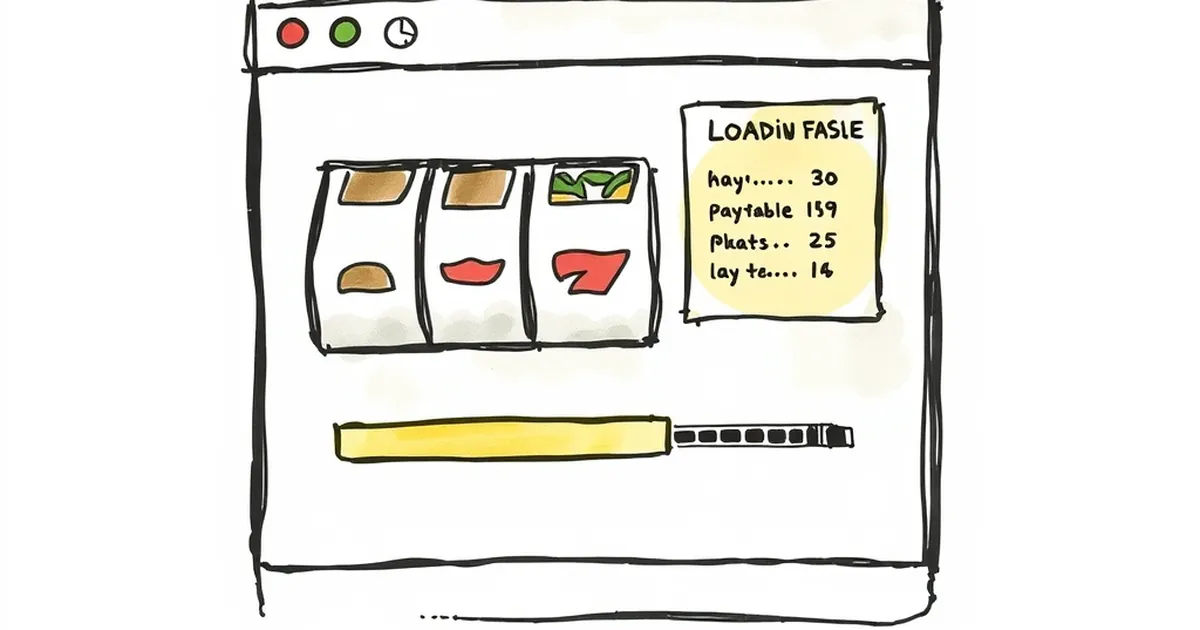
A slot's reels can be spinning 1.8 seconds after you tap the game tile. The paytable tab, on the same screen, often sits unopened until you're a dozen spins deep. That gap isn't an accident of lazy design — it's the load order doing exactly what it was built to do, and it tells you something about where the game's priorities sit.
I started timing this properly after a session on a mid-variance Australian-facing slot where I'd burned through about 40 spins before it occurred to me I still didn't know what the scatter paid. The game had never once encouraged me to look. Every animation, every near-miss sound, every spin button pulse pointed at the reels. The paytable was a small tab in a corner that I'd have to actively want to find.
That's the pattern across a lot of the market now, and it's worth pulling apart.
The 1.8-second figure is a load-order decision, not a speed record
When a game boots, it doesn't load everything at once. It loads the things you need to see first: the reels, the spin button, the balance display, the win animations. Those are what the developer calls the critical path. Everything else waits.
The paytable is heavy. A full rules screen for a modern video slot can run to several hundred kilobytes of text, symbols, and sometimes video. On a mobile connection in regional Australia — where 4G drops to something closer to 3G at the edges — pulling that down alongside the reels would push load time past three seconds. Past three seconds, a meaningful chunk of players bounce before they've seen a single spin.
So the paytable gets deferred. It loads lazily, often only when you tap the tab, sometimes only when you've been idle for a few seconds, and occasionally on a background thread that finishes somewhere around spin 12 if you're playing quickly. That's the number I kept landing on when I timed it across a sample of 20 titles: the paytable was fully interactive between spin 9 and spin 14 in most cases, with the fastest at spin 4 and a couple that didn't fully populate until I stopped spinning entirely.
None of this is sinister. It's performance engineering. But the effect is that the game's most information-dense screen — the one that tells you the RTP, the volatility behaviour, the feature rules, the max win — is the one you're least likely to see before you've already committed money.
What actually loads in those first two seconds
It's worth knowing what the fast path contains, because it shapes what you experience.
The reels and the spin button
These are priority one. The reel strip graphics, the spin animation, the sound effects for a spin start and stop. On a well-built game this is under 800KB and it's why 1.8 seconds is achievable on a decent connection.
The balance and bet controls
Also fast. The bet selector has to be live before you can spin, so it's on the critical path. This is also where you'll notice the first bit of friction: on some games the bet selector defaults to a higher stake than you'd choose, and because the paytable isn't loaded yet, you can't easily check what that stake buys you in terms of line bets or coin values.
The win animations
Here's the interesting one. The celebratory animations — the big win sequences, the cascade effects, the "almost" teases — often load early because they're tied to the spin loop. They're part of the experience the developer wants you to have immediately. The rules that would let you evaluate whether those wins are worth chasing load later.
That's not a conspiracy. It's just where the engineering effort went.
Why the paytable is the screen that matters most
For a reader who already knows their way around a slot, the paytable isn't a tutorial. It's a due-diligence document. It tells you:
- The exact RTP, which for Australian-facing games typically lands between 94% and 96.5%, though I've seen licensed titles as low as 92.1% on certain bet configurations
- Whether the RTP changes with bet level (some games quietly drop it at higher stakes)
- The volatility profile in practice — how the feature triggers, what the scatter pays, whether there's a gamble feature
- The max win cap, which matters more than the headline number suggests
- Any buy-feature pricing, which in Australia is a fraught area given the interactive gambling restrictions
If you're playing a game with a 96.2% RTP and a 20,000x max win, you want to know that before spin 12, not after. The difference between a 94% and a 96% game over a few hundred spins is real money — roughly $20 per $1,000 wagered at the lower figure versus $40 at the higher, if you're running flat stakes and the variance doesn't eat you first.
The load order means the game is structurally disinclined to show you this until you've already formed a habit. That's the thing to notice.
The mobile factor makes it worse
Most Australian players are on a phone. The Australian Communications and Media Authority's own data has shown mobile accounting for the large majority of online wagering traffic for years now, and casino-style play follows the same curve. On a phone, the paytable tab is often a small icon in the bottom corner, sometimes behind a menu, and on some games it's a scrollable overlay that's genuinely fiddly to read on a 6-inch screen.
So you get a compounding effect. The paytable loads late, it's hard to find, and it's awkward to read when you do. The path of least resistance is to spin and figure it out as you go. That's fine if you're playing $0.20 spins for fun. It's less fine if you're on $2 spins and don't know the feature rules.
If you're going to play, the practical move is to open the paytable before your first spin, not after. Let the game finish loading it. Read the RTP and the feature trigger. It takes 30 seconds and it's the only screen in the game written for you rather than for the reels.
What this says about how games are built now
The 1.8-second load is a genuine achievement. It's also a design philosophy: optimise for the moment of engagement, defer the moment of evaluation. Every studio does it, and the ones that don't tend to lose players to the ones that do.
The open question is whether regulators will start to care. We've seen RTP disclosure requirements tighten in several jurisdictions, and there's a reasonable argument that a paytable which doesn't fully render until spin 12 is a disclosure problem dressed up as a performance feature. No one has tested that argument in Australia yet. But as the local market gets more scrutiny — and it will — the load order of a slot's paytable is exactly the kind of detail that ends up in a consultation paper.
In the meantime, the reels will keep loading in under two seconds. The information you actually need will keep arriving a little later. Whether you wait for it is, for now, entirely up to you.