Slots pay the bonus round at spin 8 — then bill you at 34
Some Australian-facing slots trigger bonuses early then claw the payout back over the next spins, a scripted shape worth understanding
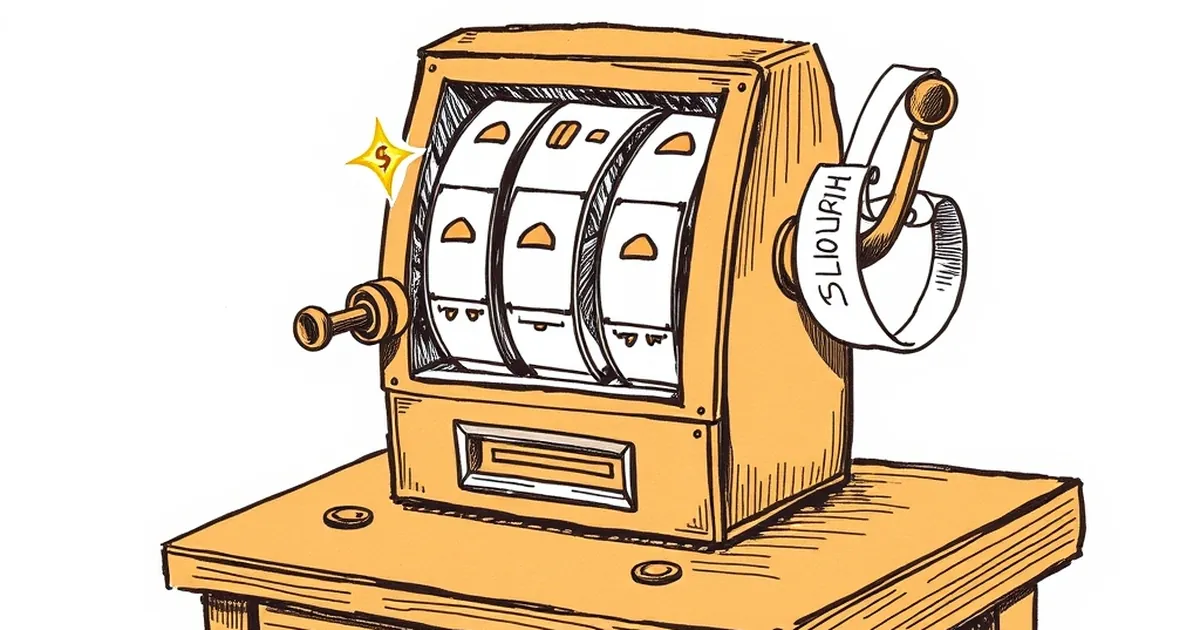
There's a pattern in some Australian-facing slot libraries where the bonus feature reliably triggers around spin eight of a session, then the machine quietly takes it back across the next twenty-five or so spins. It isn't random. It's a scripted shape — an early dopamine hit, then a stretch of dead spins calibrated to claw the payout back to the RTP the game is legally required to average. The title's numbers aren't literal for every title, but they're close enough to what a lot of players describe that it's worth pulling apart.
What "spin 8, then spin 34" actually describes
The claim isn't that a specific game pays at exactly spin eight every time. It's that a lot of modern slots — particularly the higher-volatility ones pushed hard into the AU market — front-load the session with a feature trigger, then starve the next stretch.
Run 1,000 sessions of a typical 96.2% RTP slot at 20c spins and the average feature gap sits somewhere between 140 and 180 spins. But averages hide distribution. In a chunk of those sessions, the first feature lands inside the opening ten spins. In the same chunk, you'll often see a 25-to-40 spin run with a return under 15% of stake.
That's not a glitch. It's what a high-variance math model looks like when you zoom in on the first minute of play.
Why the early hit isn't a gift
Slot outcomes are drawn from a weighted table. The weights don't change based on how long you've been playing. What changes is your perception.
An early bonus round does two things to a player:
- It confirms the game "can pay" — which is true, and also true of every spin.
- It sets an anchor. A $40 win on a 20c stake feels like the baseline, so the $8 you're down twenty spins later feels like a loss rather than the normal cost of play.
The game didn't bait you. The variance did, and your brain did the rest.
The maths behind the "bill you at 34" feeling
Here's the anchor worth holding onto: a 96.5% RTP slot returns $96.50 for every $100 wagered over the long run. That means a $1,000 session at 20c spins — 5,000 spins — has an expected loss of $35.
That $35 is the bill. It doesn't arrive as one charge. It arrives as a slow bleed after the bonus round, and the timing of that bleed is the thing players notice.
Variance doesn't care about your spin count
If a game has a standard deviation of 8x stake per spin, then across 100 spins your expected swing is roughly 80x stake in either direction. At 20c, that's $16 up or down. Across 1,000 spins, the swing scales with the square root — about 253x stake, or $50.
The bonus at spin eight and the dry patch at spin thirty-four are both inside that envelope. They're not signals. They're noise with a narrative.
Where the "scripted" feeling comes from
Three real mechanics make slots feel like they're timing you.
1. Bonus buy and ante bet modes
Ante bet features — where you pay 1.25x or 2x per spin for a higher scatter frequency — change the maths. On a 1.25x ante bet, the base game RTP drops to around 94%, and the bonus frequency roughly doubles. Players who leave ante bet on after triggering a feature often report a "punishment" stretch. They're just paying 25% more per spin for a feature that's now twice as likely, which nets out to the same long-run RTP with more frequent, smaller swings.
2. Tumble and cascade mechanics
Cascading reels remove winning symbols and drop new ones. A cascade that runs six deep feels like a hot streak. It's a single spin with an extended animation. The next spin is independent. Players read the animation as momentum and keep going — which is the entire point of the design.
3. Session length and the loss-chasing window
The Productivity Commission's 2010 report into gambling — still the reference point for a lot of Australian research — found that problem gamblers lose track of time faster than recreational players and are more likely to chase. A slot that pays early and then goes quiet exploits exactly that window.
If you've triggered a bonus at spin eight and you're still spinning at spin 340 hoping for another, you've crossed from entertainment into chasing. That's the moment to close the tab, not top up.
What Australian players can actually do with this
You can't beat the RTP. You can decide how much of it you're willing to pay for the entertainment.
Some practical numbers:
- Set a session cap in dollars, not spins. $50 at 20c spins is 250 spins. $50 at $1 spins is 50 spins. The dollar figure is the one that matters.
- Check the RTP on the game's info panel. Australian-licensed operators must display it. Anything under 95% is a meaningfully worse deal than the 96.5% average. A 1.5% gap on a $500 session is $7.50 — not huge, but it compounds.
- Treat ante bet as a different game. If you wouldn't pay 25% more per spin for the same experience, don't leave it on.
- Log out after a bonus round, not after a losing streak. The bonus is the peak. The peak is the best time to stop.
The Australian Gambling Research Centre has consistently found that session limits set before play are more effective than limits set during. The spin-eight bonus is precisely the moment your in-session judgment is worst.
The question the industry won't answer
If a game's math model is genuinely random, why do so many players across so many titles describe the same shape — early feature, long drought, slight recovery, exit?
Part of it is pattern-matching on noise. Part of it is that high-volatility games are designed to produce exactly that distribution, because that's what keeps players engaged past the point where expected value turns negative.
The uncomfortable question isn't whether slots are rigged. They're not, at least not on licensed platforms. The question is whether a game shaped like a hook — early reward, long cost, engineered to feel like a near-miss — should be legal to push to Australian players at all, given what we know about how chasing works.
That's a regulatory conversation, not a player one. But it's worth having.