Slots tournament blinds drop at level 6 — the leaderboard freezes at 4
Slot tournaments freeze the leaderboard at level 4 while blinds climb to level 6, and that overlooked gap is where most events are quietly decided
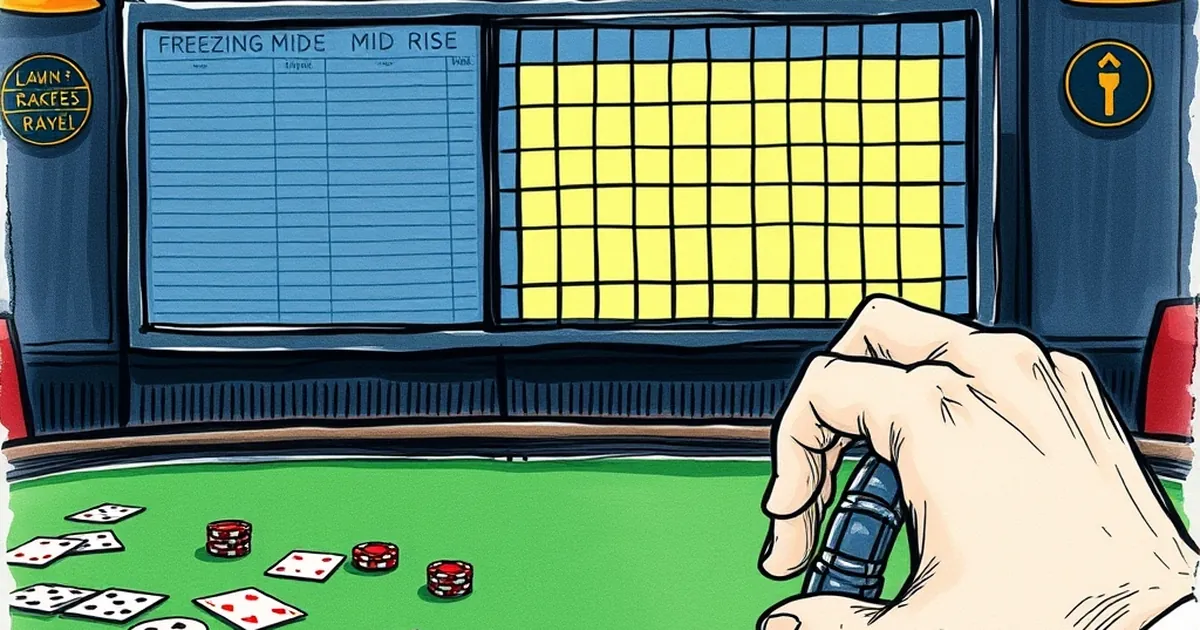
Most slot tournaments on Australian-facing sites run two clocks, not one. The prize clock — the one everyone watches — freezes when late registration closes, which on the standard PokerStars-style structure lands at level 4. The other clock, the blinds, keeps running until level 6. Between those two points you're playing a live tournament with a dead leaderboard, and almost nobody plans for it.
That gap is where tournaments get decided. Not at the final table, not on the last spin. In the 20-odd minutes after the board stops updating and before the blinds stop climbing.
Two clocks, one tournament
The freeze-at-4 rule exists for a reason: it stops a player who's already locked up a top-three spot from late-registering into a fresh stack and farming cheap points. Once registration shuts, the leaderboard becomes final in the sense that no new entrants can appear. It does not become final in the sense that scores stop moving.
Here's the mechanic most players miss. In a slots tournament, your score is usually derived from a single multiplier — best win of the session, or a cumulative points total, depending on the format. The leaderboard pulls that score at a fixed interval. On most platforms that's every 60 seconds, occasionally every 30 on turbo structures. When the board "freezes" at level 4, what's actually happening is that the eligibility window closes. The score feed keeps running until the tournament ends.
So a player sitting 14th at level 4 with 2,400 points can finish 3rd with 9,100 if they hit a 380x multiplier in the last four levels. The board just doesn't show it until the final reconciliation, which typically happens 90 seconds after the last spin.
Why level 6 specifically
Blind levels in these structures are usually six minutes. Level 4 to level 6 is therefore 12 minutes of "blind" play — the pun is unavoidable and the platforms know it. But the number isn't arbitrary. Six levels gives a standard tournament a 36-minute active window, which sits neatly inside the average Australian evening session (7:30pm to 11pm AEST, with the bulk of registrations between 8:15 and 9:00). Push it to level 8 and you're asking for 48 minutes of commitment before the freeze, which measurably reduces late registration. Two extra levels is the compromise.
The practical consequence: the last third of the tournament is played by people who can't see where they stand against the field, only against their own score.
What the freeze actually changes
Three things shift the moment the board stops updating.
Stack discipline goes out the window. In a normal tournament you can see the chip leader and calibrate. Here you can't. You're guessing. And the guess is usually wrong in one direction: players overestimate how much they need. A 200x hit feels like it should move you up six places. Often it moves you up one, because the players above you are also spinning.
The mid-pack collapses. This is the most reliable pattern in freeze-format tournaments. Players sitting between 8th and 20th at level 4 tend to either punt (chasing a big multiplier they don't need) or coast (protecting a score that won't hold). Both are wrong. The correct play is to keep spinning at the same stake and volatility you used to get there, because your score is a function of volume, not of a single heroic hit.
Late registration becomes a trap. If you register at level 3, you've got one level of visible play and five of blind play. Your effective tournament is 30 minutes long and you have no information for 20 of them. The players who do well in these formats register at level 1 or not at all.
The maths of a blind final third
Assume a 500-player field, $22 buy-in, $8,000 prize pool, top 60 paid. At level 4, the leaderboard shows a leader on roughly 6,200 points. The 60th place sits around 1,100. Median is about 1,800.
Now assume the standard score distribution: 70% of players never exceed 2x their entry multiplier, 25% land between 2x and 20x, and 5% hit something above 20x. In the final two levels, that 5% tail is still live. Statistically, in a 500-player field, you'd expect 12 to 15 players to hit a 100x-or-better multiplier across the whole tournament. Roughly a third of those hits land in the final third of the clock — because that's when the most spins are happening per player, as people chase.
That means four to five players will leapfrog the visible top 10 after the board has frozen. If you're sitting 6th at level 4, your realistic finish range is 3rd to 14th. If you're sitting 1st, it's 1st to 6th. The freeze compresses your certainty, not your position.
How to play the blind stretch
The strategy is counterintuitive and almost nobody follows it.
Don't increase stake. The instinct when you can't see the board is to bet bigger to "make something happen." This is backwards. Your score is already locked into the leaderboard's scoring formula. Increasing stake increases variance without increasing expected points, unless you're specifically chasing a top-3 multiplier — and you can't know whether you need one.
Don't decrease stake either. Players who drop to minimum stake to "protect" a score are protecting nothing. The score doesn't decay. There's no downside to spinning.
Watch the clock, not the board. The only real decision in the blind stretch is whether to keep playing at all. If you're 40th with 800 points and the payout starts at 60th, you're already in. If you're 65th, you need a hit, and you need it in the next 12 minutes. That's a coin-flip decision, not a skill decision — and recognising it as such is worth more than any multiplier.
The one number that matters
Track your points-per-minute across the first four levels. If you're averaging 220 points per minute at level 4, you need to maintain that rate to hold position. Most players' rate drops 30-40% in the blind stretch because they change their behaviour. The ones who finish well are the ones whose rate stays flat.
Where this leaves the format
The freeze-at-4, blinds-to-6 structure is a compromise between two incompatible goals: giving players a visible target to chase, and giving the platform a long enough window to collect rake. It does neither particularly well. The visible target is a lie after level 4. The window is short enough that late registrants get a raw deal.
What's interesting is that the format persists despite this. Players like the illusion of a frozen board — it makes the tournament feel decided, which is less stressful than a live-updating leaderboard where you can watch yourself slide from 3rd to 19th in four minutes. The blind stretch is the price of that comfort.
Whether that's a fair trade depends on something the platforms don't publish: what percentage of prize money in these tournaments goes to players who were outside the visible top 10 at the freeze. If it's under 15%, the format is basically a lock-in. If it's over 30%, the freeze is cosmetic and the real tournament starts at level 4. Anyone got the data?