Split pot equity shows 2 outs — the chop needs 6
Six outs to a chop only buy the equity of about two clean outs, a factor-of-three error that quietly inflates your hand in every split-pot game
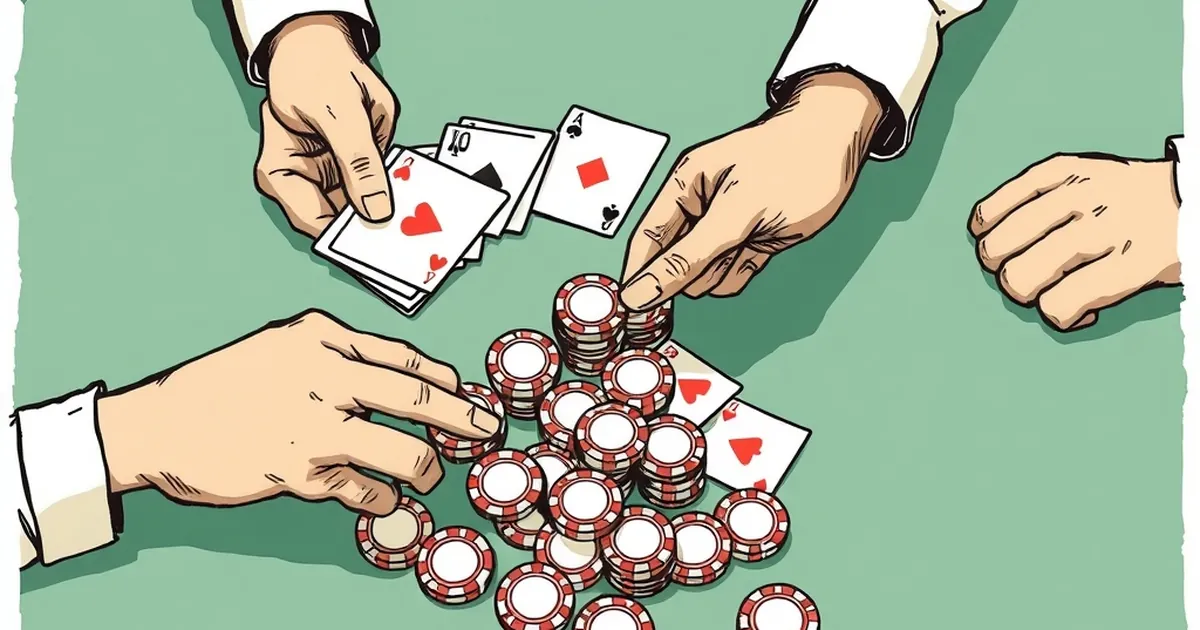
Most players count outs once and move on. In a split-pot game, that habit is expensive: two clean outs to a scoop are worth roughly what six outs to a chop are worth, and the reverse is also true — six outs to a chop only buy you the equity of about two clean outs. If you've been treating "I have six outs to half the pot" as a six-out draw, you've been overestimating your hand by a factor of three.
That factor-of-three relationship is the whole article. It holds across Omaha hi-lo, stud hi-lo, and any game where the pot gets divided, and it explains a lot of the weird, sticky calls you see at Australian cash tables where someone with a low draw and a gutshot talks themselves into a price that isn't there.
The arithmetic behind the 3:1 ratio
A clean out wins you the entire pot. A chop out wins you half of it. So a chop out is worth half a clean out, before you account for the fact that you might get quartered or scooped on the river.
Wait — if a chop out is worth half, shouldn't the ratio be 2:1, not 3:1?
That's the trap. The naive 2:1 ignores two things. First, when you're drawing to a chop, you're usually also drawing to lose: the card that makes your low might make someone else's better low, and the card that fills your straight might fill a higher straight. Second, half the pot isn't half the profit — you still pay the same amount to get there, and getting half of a pot you've contributed half of means you break even at best on that portion of the money. The dead money from earlier streets is what you're actually chasing, and it's smaller than it looks.
Run the numbers on a typical scenario. Say the pot is $100 on the turn, you're facing a $50 bet, and you have six outs to a chop with no outs to a scoop. Your equity from those six outs is six out of 44 unseen cards, or about 13.6%, and you only capture half the pot when you hit. That's roughly $6.80 of expected value from the chop, against $50 you have to put in. You need implied odds on the river of about seven times the bet just to break even, which is not a price you're getting in a limit game and rarely in pot-limit either.
Now compare: two clean outs to a scoop, same pot, same bet. Two out of 44 is 4.5%, and you capture the whole pot. That's $4.50 of immediate equity — less than the chop's $6.80, but the clean out doesn't get quartered, doesn't get counterfeited on the river, and doesn't leave you calling a raise you can't fold to. Once you adjust for the frequency of getting quartered, which in a typical four-way Omaha hi-lo pot runs somewhere around 20–25% of the time you make a low, the six-out chop collapses to roughly the value of two clean outs.
That's the 3:1. It's not a clean mathematical identity; it's the practical conversion after quartering and reverse-implied odds are priced in.
Why the ratio breaks down at the edges
The 3:1 conversion is a rule of thumb, and like all of them it has a shape. It's most accurate in multiway pots with a lot of dead money, and it gets worse the shorter-handed you are.
Heads-up, a chop out is closer to the naive 2:1, because there's no third player to quarter you. Three-handed, you're somewhere in between. Four or more, the 3:1 holds up well and can even understate the penalty if the other players are the type to jam a made low on the turn.
The quartering problem
Quartering is the specific mechanic that kills chop equity. You make your low, someone else makes the same low, and now you're splitting half the pot between two players — a quarter each. In a $200 pot, that's $50 back on a $50 turn call, before you count the river bet you're probably going to have to call. You've spent two streets of action to get your own money back.
The players who get quartered most are the ones who chase the nut low draw with no high prospects. If your hand can only win half the pot, and it can only win that half when the board doesn't pair and no one else has the same low, your equity is narrower than the out count suggests. Six outs to a chop that gets quartered 25% of the time is really four and a half outs to a chop, which is worth about one and a half clean outs — not two, and nowhere near six.
Scooping changes the maths entirely
The flip side is that any hand with both a high and a low draw gets a multiplier the pure chop draw never sees. Two clean outs to a scoop plus six outs to a chop is not the same as eight outs to half the pot. The two scoop outs are worth six chop outs on their own, and the six chop outs are worth two clean outs, so the combined draw is worth about four clean outs. That's the number you should be comparing to the pot odds, not the raw eight.
This is why the good hi-lo players at the $2/$5 pot-limit tables in Sydney and Melbourne play so many hands that look marginal on the surface. They're not counting outs. They're counting scoop-equivalent outs, and the hands with two-way potential clear the bar that the one-way hands don't.
Putting a number on it
Here's the anchor worth memorising: six outs to a chop are worth two clean outs, and the breakeven threshold for a chop draw on the turn is a pot odds price of about 4:1, not the 7:1 the raw out count implies.
That 4:1 figure comes from the adjusted equity: six chop outs, quartered 25% of the time, gives you roughly 4.5 effective outs, which is about 10.2% equity on 44 unseen cards. To call a $50 bet into a $100 pot, you need 33% equity from the pot odds alone — and you're not getting it. You need the pot to be closer to $400 before a $50 call on a six-out chop becomes correct, and that only happens when there's been heavy multiway action on earlier streets.
Which is the practical takeaway: chop draws are only worth chasing in big, multiway pots with lots of dead money, and even then only when you have some high equity to go with them. In a heads-up pot on the turn, a pure chop draw is almost always a fold, no matter how many outs you think you have.
What this means for how you count
The instinct to count outs is fine, but it's a starting point, not an answer. The players who do this well aren't doing complicated maths at the table — they've internalised the conversion and they apply it as a gut check. Six outs to a chop feels like a draw. It isn't. It's a third of a draw, and the pot has to be three times as big to justify the same call.
The interesting question is whether the 3:1 ratio holds in the games Australians actually play. Pot-limit Omaha hi-lo is less common here than in the US, and the games that dominate — hold'em, and the various tournament formats — don't split pots at all. Where split-pot games do run, they tend to be smaller and more recreational, which means more quartering and more multiway pots, which pushes the effective ratio above 3:1 rather than below it. If you're playing a $1/$2 hi-lo game on a Friday night with five players seeing every flop, treat six chop outs as worth less than two clean outs, not more. The maths gets worse, not better, the softer the game gets — and that's a sentence you don't hear often enough.