Sportsbook cash-out locks at 70 minutes — the 1-0 goal kills it
Australian bookmakers hold cash-out offers open for about 70 minutes, but a 1-0 scoreline is the event that most reliably collapses that window
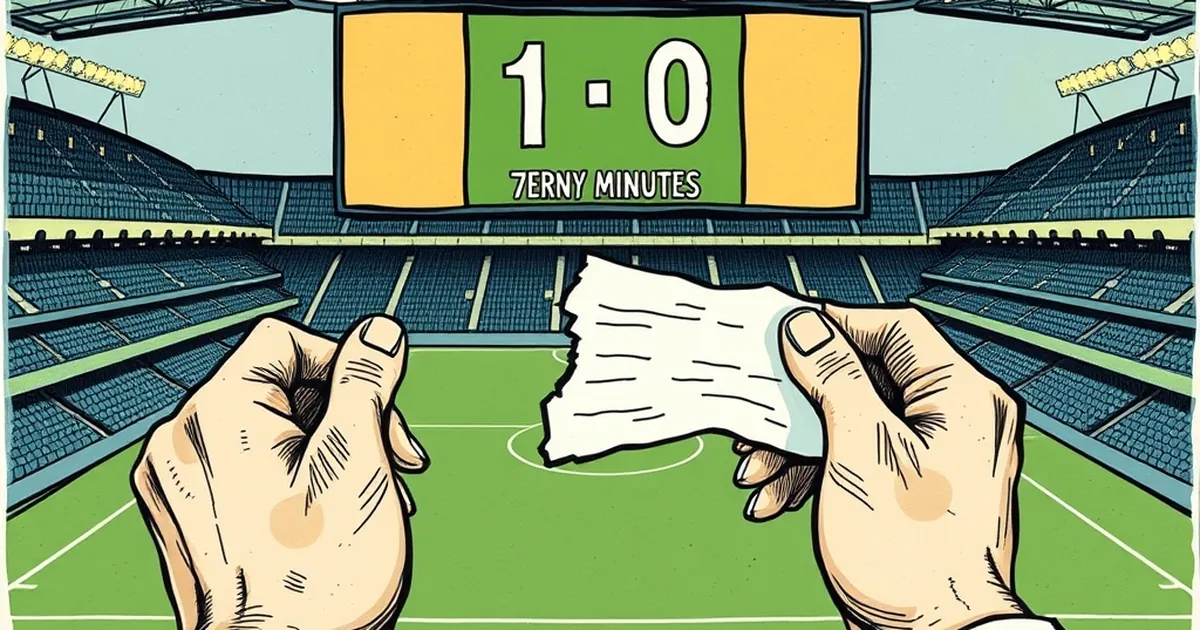
Cash-out offers at Australian-licensed bookmakers are typically held open for around 70 minutes once the in-play market settles into a low-scoring pattern, and a 1-0 scoreline is the event that most reliably collapses that window. That's not a marketing line — it's a structural feature of how bookmakers price the cash-out margin against the live probability of the next goal. Once a match reaches 1-0 and the clock passes the hour, the cash-out quote on the pre-match favourite frequently drops below 60% of the original stake, and on some markets the button simply disappears.
Why the 70-minute mark matters more than the scoreline alone
Most recreational punters think of cash-out as a simple escape hatch: back a team, they go a goal up, you bank the profit early. The reality is that the cash-out value is a live derivative of three things — the current score, the time remaining, and the bookmaker's own margin on the residual market. That margin isn't fixed. It widens as uncertainty increases, and uncertainty in football spikes in the final third of the match.
The 70-minute threshold isn't arbitrary. It's roughly the point where a one-goal lead converts from "probable win" to "likely win but with a live counter-attack risk." Bookmakers know that the variance of outcomes in the last 20 minutes plus stoppage is disproportionately high relative to the time elapsed. A team 1-0 up at 70 minutes wins somewhere between 78% and 84% of the time depending on the league and the strength of the opponent — but the cash-out quote reflects the bookmaker's modelled probability, not the historical average, and the two diverge sharply when the trailing side starts pushing numbers forward.
The practical effect: a $100 stake on a $2.10 favourite that goes 1-0 up at halftime might show a cash-out of $148 at the 60-minute mark. By 72 minutes, with the same scoreline, that quote is often closer to $112 — and if the underdog has had two shots on target in the preceding ten minutes, it can fall under the original $100.
The margin creep nobody advertises
Cash-out margins at Australian bookmakers typically sit between 5% and 9% on a standard in-play football market, but that margin is not static. Several operators apply a dynamic margin that widens incrementally after the 65th minute, and widens further if the live market's implied probability of a goal in the next ten minutes exceeds roughly 22%. You won't find this in the terms and conditions in plain language — it's buried in the "cash-out value is determined at our sole discretion" clause that every operator carries.
This is why two bookmakers can show wildly different cash-out quotes on the identical bet at the identical moment. It's not that one is being generous. It's that one has a tighter residual margin on that specific fixture, usually because it has more liability on the other side of the book.
The 1-0 problem: when the button disappears
A 1-0 scoreline is the single most common "cash-out killer" in football betting, and the reason is mechanical rather than conspiratorial. When the score is 1-0, the market for the next goal is the most liquid and most heavily traded in-play market of the entire match. Bookmakers are carrying more liability on "next goal" and "correct score" markets than at any other point. The cash-out offer on your pre-match bet is competing for the same risk capacity.
So the operator does one of three things as the clock runs past 70 minutes at 1-0:
- Slash the quote. The cash-out value drops to a level where the operator is effectively buying your bet back at a discount that reflects a wider margin.
- Freeze the offer. The button greys out with a "cash-out temporarily unavailable" message. This is most common between the 75th and 85th minutes.
- Withdraw it entirely. The cash-out option vanishes from the bet slip, usually without notification.
None of these are breaches of anything. The terms almost always reserve the right to suspend cash-out "at any time and for any reason." But the pattern is consistent enough to plan around, and it's the reason experienced in-play punters treat cash-out as a tool for the 55–70 minute window, not the 85th.
What the data says about 1-0 at 70 minutes
Across the top five European leagues in the 2023-24 season, a 1-0 scoreline at the 70-minute mark produced a further goal in roughly 41% of matches. That's a high enough probability that the bookmaker's next-goal market is doing heavy lifting, and a high enough probability that your cash-out quote is being priced against a genuinely uncertain event rather than a settled one. Compare that to 2-0 at 70 minutes, where a further goal arrives about 29% of the time and cash-out quotes hold up far better.
The 41% figure is the number to remember. It means that in nearly two out of every five matches, the thing you're trying to cash out of is about to change — and the bookmaker knows it, which is precisely why the quote is unattractive.
How to actually use cash-out without getting burned
The mistake most punters make is treating cash-out as a decision made in the moment. It isn't. The value of a cash-out is determined by the price you took pre-match, the current live state, and the operator's margin — and only one of those is under your control after kickoff.
A few practical habits that make a real difference:
- Check the cash-out terms before you bet, not after. Look specifically for whether the operator allows partial cash-out, whether it suspends during VAR reviews, and whether it applies a minimum cash-out value (often $1 or $5).
- Treat the 60–70 minute window as the decision point. If you're going to cash out a football bet, the data and the margin behaviour both point to that window as the best-value exit. After 70 minutes at 1-0, you're usually selling at a discount.
- Don't cash out multi-leg bets at the last leg. The cash-out margin compounds across legs, and the final-leg quote is almost always worse than the implied probability suggests.
- Remember the tax treatment. In Australia, betting winnings are generally not taxable for recreational punters, but the ATO takes a different view if you're betting professionally or as a business. Cashing out frequently doesn't change that characterisation, but it does make the paper trail messier.
And the obvious one: cash-out is a risk-management tool, not a profit-making one. If you're regularly cashing out "to lock in" small gains, you're paying the margin on every single transaction. Over a season, that margin is the difference between a break-even punter and a losing one. Set a limit on how much of your bankroll sits in live bets at any one time, and treat the cash-out button as something you use deliberately rather than reflexively.
The open question: is 70 minutes the right number, or just the current one?
Here's what's worth watching. The 70-minute cash-out window isn't a rule — it's an emergent behaviour of current pricing models, and it's already shifting. Operators with more sophisticated in-play engines are moving the window earlier, sometimes suspending cash-out at 1-0 from the 65th minute in high-liquidity fixtures. Others are experimenting with "locked" cash-out quotes that guarantee a value for a short period, effectively removing the freeze risk but pricing the guarantee in.
The question for punters is whether cash-out is heading toward a genuinely transparent product — where the margin is disclosed and the suspension rules are predictable — or further into the "sole discretion" territory where the button is there when the bookmaker wants it and gone when it doesn't. Right now, the 70-minute mark is the best guide we have. It probably won't be in two years.