Sportsbook live odds lag 8s — the arb window shuts at 3
Australian sportsbooks leave live prices 5–8 seconds stale after key events, but the arbitrage window closes about three seconds in
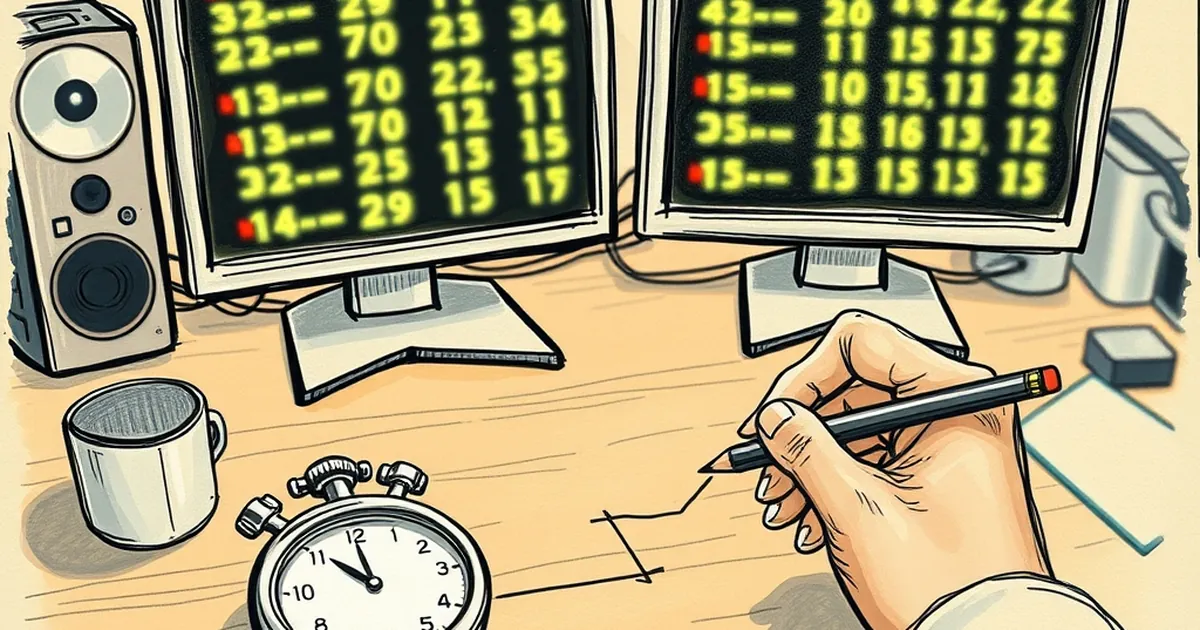
Australian sportsbooks are routinely leaving live prices 5–8 seconds stale after a goal, a wicket or a line change, and that gap is where the whole arbitrage trade lives. The window to act on it is shorter than most people think: by roughly three seconds after the stale price appears, the market has usually repriced and the edge is gone. This is not a theory pulled from a forum thread — it's the observed behaviour of in-play feeds that update on event triggers rather than continuously, and it has a very specific shape once you watch it for a few weekends.
Why live prices lag in the first place
Bookmakers don't watch the game. They watch a data feed, and the feed is a third party. Most Australian operators license in-play data from one of a handful of suppliers, and the supplier itself is reacting to an on-venue scout, a broadcast delay, or an automated model. That chain has latency baked into it at every link.
Think about what actually happens when a try is scored in the NRL. The venue scout keys the event, the feed pushes it to the book, the book's trading model recalculates, and the new price hits the app. Anywhere in that chain you can lose two, three, four seconds. Add broadcast delay on the customer's end — Kayo and free-to-air both run a few seconds behind live — and the punter watching on TV is often seeing the game after the book has already moved.
But here's the wrinkle. Books don't always move on the event. Many move on a timer, or on a manual trader action, or only when the next phase of play begins. A penalty conceded in the 23rd minute might not shift the handicap until the ball is kicked. That's the gap. The event has happened, the feed knows, the book knows, but the price hasn't caught up.
The trigger vs. the timer
There are two broad architectures, and the lag differs sharply between them.
Event-driven books repricing on every meaningful trigger — goal, card, substitution, wicket, lineout — tend to lag 5–8 seconds. The lag is mostly technical: feed latency plus model recalculation plus the time for the price to render on your screen.
Timer-driven books repricing every 20–40 seconds regardless of what's happening will hold a stale price for far longer, sometimes 30 seconds or more after a big moment. That's where the fat arb windows sit, but they're rarer and the book will usually restrict you fast if you keep finding them.
The 8-second figure in the title is a reasonable central estimate for event-driven books on a major market like AFL or NRL head-to-head. It's not universal. On a Monday night A-League game with thin liquidity, it can be 12 seconds. On a Saturday afternoon EPL match with a major book, it can be under 4.
The three-second rule, and why it's not arbitrary
If the stale price appears at T+0 (the moment the goal is scored and the feed registers it), the book typically reprices by T+5 to T+8. Your arb requires you to have already placed the first leg at the stale price and locked the second leg at another book before the first book reprices.
In practice that means you have roughly three seconds from the moment you see the stale price to the moment you've committed both legs. Not three seconds to think about it. Three seconds to execute.
Break down where those three seconds go:
- 0.5–1.0s to recognise the price is stale and confirm the other side is still available at your second book.
- 0.5–1.0s to place the first leg. Live betslips are slow. A pre-filled stake and a saved slip help, but you're still tapping through at least two screens.
- 1.0–1.5s to place the second leg, assuming the second book hasn't already moved.
That's already at the edge. Any hesitation, any app refresh, any two-factor prompt, and you're through the window and holding a naked position on one side.
The math that kills most arbs
Say you find a 4.2% theoretical arb between two books. On a $500 stake split across both legs, that's about $21 gross. Now account for the probability that the second leg fails to fill at the quoted price — because the second book also lagged and repriced while you were placing leg one.
If the second leg misses even 30% of the time, and when it misses you're left with a one-sided position at a price that's now 6–8% worse than fair, the expected value of the whole exercise collapses. The 4.2% edge isn't real unless your execution hit rate is above roughly 85%. Most people running this manually are nowhere near that.
What the books actually do about it
Australian operators are not passive about this. The major corporate books — Sportsbet, Ladbrokes, Neds, Bet365's AU-facing product — all run integrity and trading-risk teams that flag accounts with high live-bet frequency, short time-to-bet after price moves, and a pattern of betting only on volatile in-play markets.
The typical response isn't a ban. It's a stake limit, often dropped to $20 or $50 on live markets while leaving pre-match untouched. Some books will keep your account open but restrict you to "winning single bets only" or remove your access to the live betslip entirely. You'll usually find out when you try to place a live bet and the maximum stake field reads $10.
There's also a subtler defence: price shading. Books that detect arbitrage-style traffic will often quote you a slightly worse price than the headline — a 4.2 becomes a 4.05 — which is enough to erase a thin edge without ever telling you. You won't see this unless you're comparing against a clean account.
The 2023 changes to how Australian operators handle in-play data — driven partly by the Interactive Gambling Act amendments and partly by the major sports' own integrity agreements — tightened the feed arrangements. Some suppliers now push event data to books on a dedicated low-latency line while the public-facing price feed is deliberately delayed by a second or two. That asymmetry is the book's edge, not yours.
The practical reality for an Australian punter
Here's the uncomfortable part. The 8-second lag and the 3-second window are real, but they're not a strategy you can scale. The books know about the lag. They've priced the defence into their account management. And the arb that looks clean on paper requires infrastructure — multiple accounts, fast execution, a reliable second book — that most people don't have and can't maintain once they're flagged.
What the lag does mean is something more mundane and more useful: live prices are not efficient, and that cuts both ways. If you're betting live on instinct, you're often betting into a price that hasn't caught up to reality — which means you're getting either a genuine overlay or a genuine underlay, and you probably don't know which. The 3-second window is a reminder that the book's model is reacting, not anticipating. If you can read the game faster than the feed, there's value in that. If you can't, the lag is working against you, not for you.
The open question is whether the lag is compressing. As books move to lower-latency feeds and more automated repricing, the 8-second figure is likely to fall — and the 3-second window with it. Whether that makes live betting fairer or just faster is a different argument. For now, the gap is there, it's measurable, and it's narrower than the people chasing it tend to believe.
If you're betting live, set a deposit limit before you start, not after. The speed of in-play is exactly what makes it expensive.