The roulette wheel's 2.7% edge hides in the 37th pocket
European roulette's 2.7% house edge comes from a single pocket, not a rigged wheel, and the payout arithmetic that hides it in plain sight
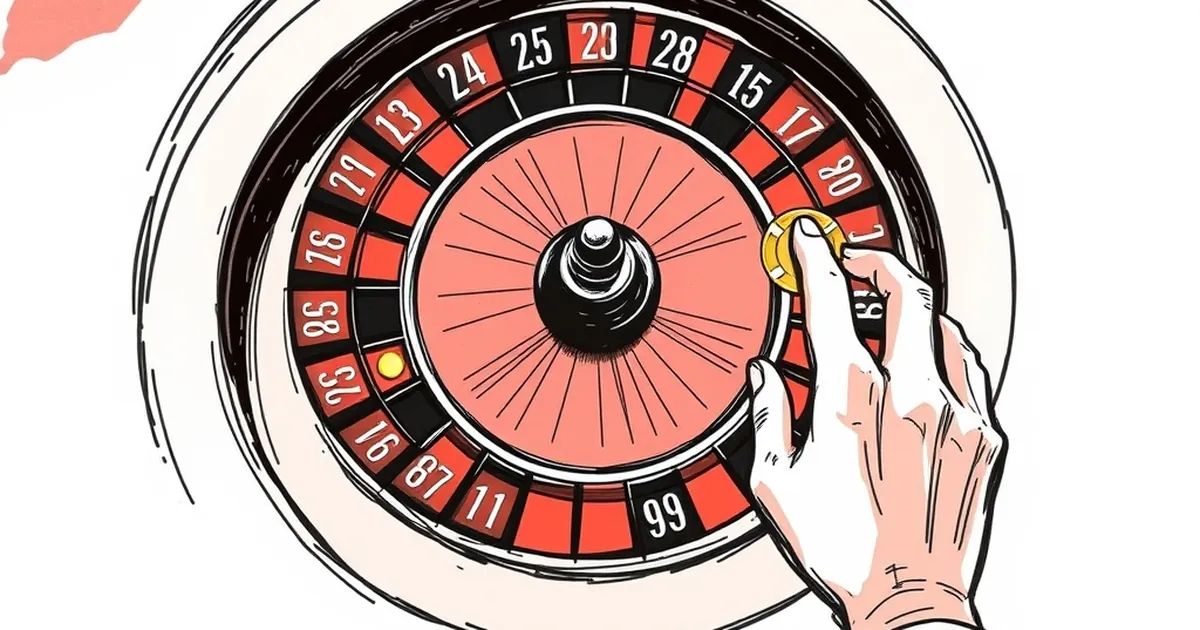
European roulette's house edge is 2.7%, and it comes entirely from a pocket that isn't red or black, odd or even, high or low. Every even-money bet on a single-zero wheel loses exactly that slice over time, not because the wheel is rigged but because the payouts are priced as if 36 pockets exist when 37 do.
That's the whole trick, and it's worth sitting with for a moment. The edge isn't skimmed off each spin like a card game's rake. It's baked into the arithmetic of the payout table, and the 37th pocket is the physical object that makes it real.
The arithmetic nobody sees at the table
A European wheel has 36 numbers plus a single green zero. If you bet $10 on red and the ball lands red, you're paid $10 profit. If it lands black, you lose the $10. Fair odds on that bet, given 18 red and 18 black pockets, would be a straight coin flip — even money on an 18-in-36 proposition.
But the wheel has 37 pockets. Your $10 on red wins 18 times out of 37 and loses 18 times out of 37, with the zero sitting there unclaimed by either side. Expected value per $10 bet is:
(18/37 × $10) − (19/37 × $10) = $4.865 − $5.135 = −$0.27
That's 2.7 cents per $10 wagered, or 2.7%. Run it forward: $1,000 through the wheel in $10 spins and the expected loss is $27.03. The number is boring and relentless, and it's the same for red/black, odd/even, and high/low. All three even-money bets carry the identical 2.70% edge because all three are priced on 36 pockets while the wheel spins on 37.
Where people get confused is the assumption that "safer" bets have a lower edge. Inside bets — a straight-up number at 35-to-1, a split at 17-to-1, a corner at 8-to-1 — all carry exactly the same 2.70% house edge on a single-zero wheel. The variance is wildly different. The edge is not. A $10 straight-up bet on 17 pays $350 when it hits, but it hits 1 time in 37, and the expected loss is still $0.27. The wheel doesn't care how you slice it.
The only bet that breaks the pattern on a European wheel is the basket-style bet some casinos offer on zero, 1, 2, 3 — and most Australian-facing tables don't offer it at all, which is just as well, because it carries a 7.89% edge. Skip it if you see it.
Why the 37th pocket matters more than the payout
Strip the zero out and the wheel becomes a fair game. Every bet pays true odds. The casino makes nothing on the spin itself and relies entirely on the fact that people keep playing and eventually hit a losing streak they can't fund.
The zero is the casino's entire business model on roulette. It's not a tax on bad play — it's a tax on all play, applied evenly. A player who bets red every spin for an hour and a player who bets a different straight-up number every spin for an hour lose the same percentage of their turnover, on average. The difference is only in how bumpy the ride gets.
This is why the American double-zero wheel is a materially worse game and not just a cosmetic variation. Two zeros on a 38-pocket wheel push the even-money edge to 5.26% — nearly double. The straight-up bet pays 35-to-1 on a 1-in-38 shot instead of 1-in-37, and the edge climbs to the same 5.26%. If you're choosing between a single-zero European table and an American wheel, the choice isn't close. Australian online casinos lean heavily European for exactly this reason, and the ones that offer both usually bury the American wheel in a "classic" or "Vegas" tab.
There's a third variant worth knowing about: French roulette, which uses the same single-zero wheel but adds la partage (half your even-money bet returned when zero hits) or en prison (your bet is imprisoned for the next spin rather than lost). La partage cuts the even-money edge from 2.70% to 1.35%. En prison does the same in expectation. Neither changes the edge on inside bets. If a table advertises French rules, the even-money bets are genuinely half as expensive — and that's the only common roulette configuration where the 2.7% figure doesn't apply to red/black.
What 2.7% actually costs you
The edge is small enough that it feels abstract. Make it concrete with a realistic session.
Say you play 40 spins an hour at $25 a spin. That's $1,000 of turnover per hour. At 2.70%, your expected loss is $27 an hour. Over a four-hour session, $108. That's the average across thousands of players — your actual result will swing wildly either side of it, because roulette variance at $25 a spin is substantial. You could be up $400 after four hours. You could be down $600. The edge describes the long run, not your Tuesday night.
The number that matters more for a session is the standard deviation, not the edge. On even-money bets, the standard deviation per spin is roughly 0.998 × your stake — essentially your stake. Over 160 spins at $25, the standard deviation of your total result is about $25 × √160 × 0.998 ≈ $316. So a four-hour session at $25 a spin has an expected loss of $108 and a standard deviation of roughly $316. Two-thirds of sessions land within one standard deviation of expectation — between roughly −$424 and +$208. The edge is real, but it's small relative to the noise, which is precisely why it's easy to ignore and hard to beat.
Compare that to a 5.26% double-zero wheel: same 160 spins, expected loss of $210, standard deviation of about $320. The swing is similar; the drain is double. Over a year of weekly sessions, that's the difference between losing about $5,600 and losing about $10,900 in expectation. Neither is a strategy. One is just cheaper.
The strategies that don't touch the edge
Martingale, Fibonacci, D'Alembert, the "wait for five reds then bet black" system — none of them change the 2.70%. They change the shape of your bankroll curve and the probability of ruin, sometimes dramatically, but the expected loss per dollar wagered is fixed by the wheel's geometry. A martingale doubling sequence on a $10 base with a $1,000 bankroll survives seven consecutive losses and blows up on the eighth; the edge on every one of those bets is still 2.70%, and the sequence just concentrates the loss into a single catastrophic event instead of spreading it out.
The only lever a player actually controls is turnover. Fewer spins, smaller stakes, or a French table with la partage are the three real ways to reduce what the 2.7% costs you. Everything else is theatre.
So the question worth asking isn't how to beat the 37th pocket — you can't, not legally and not over time. It's whether the entertainment value of the spin is worth 2.7 cents on the dollar to you, and whether you'd rather pay that on a European wheel, half of it on a French table, or double on an American one. Set a loss limit before you sit down, treat the edge as the price of admission rather than an obstacle, and the arithmetic stops being something the house does to you and becomes something you walked in knowing.