Variable rewards fire at 3 taps—habits form at 40
Why engineered delight fades after three taps and the unglamorous repetition near tap forty that actually builds lasting user habits
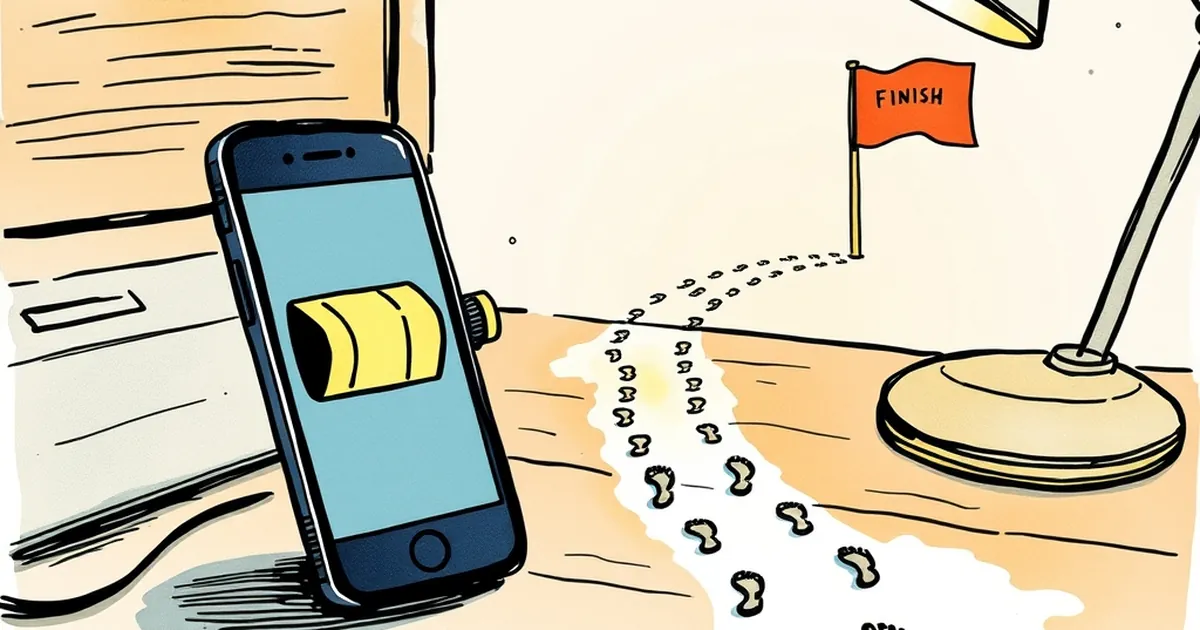
Most product teams can name the exact moment their app delivers a hit of delight: the third tap, the pull-to-refresh, the little animation that says someone liked you. Almost none of them can tell you what happens on tap forty, or tap four hundred, when the novelty has worn off and the user is still there. That gap—between the engineered thrill and the unglamorous repetition that actually builds a habit—is where a lot of Australian product and web work quietly goes wrong. So the question worth sitting with is this: if you can trigger a reward in three taps, why does it take roughly forty repetitions before the behaviour starts to feel automatic, and what should you build in the space between?
The three-tap reward is real, and it's cheap
Variable-ratio reinforcement is one of the most reliably reproduced findings in behavioural psychology. B.F. Skinner's work in the 1950s showed that delivering a reward after an unpredictable number of responses produces steadier, more persistent behaviour than rewarding every single time. Slot machines are the famous example, but so is the refresh gesture on a social feed, the randomised "you've earned a badge" toast, or the notification that sometimes contains something worth reading and sometimes doesn't.
The reason this matters for web and product design is that variable rewards are almost too easy to implement. A randomiser, a bit of copy variation, a confetti animation—you can wire that up in an afternoon. And it works, in the short term, in the narrow sense that people tap again. Nir Eyal's Hooked popularised this as the "variable reward" phase of a habit loop, and a generation of product teams took it as gospel.
But there's a catch that gets glossed over. The three-tap reward fires the anticipation system. It's dopamine doing what dopamine does—signalling that something might be about to happen. It is not the same as learning. It doesn't build the mental model that says "this is just what I do on a Tuesday."
Forty reps is where the behaviour moves house
The number forty isn't arbitrary, though it's also not a law of nature. It comes from Phillippa Lally and colleagues at University College London, whose 2009 study tracked 96 people forming a new daily habit over twelve weeks. The widely cited finding was that automaticity took a median of 66 days—but the more useful detail for designers is that the range was enormous, from 18 to 254 days, and that missing a single day didn't derail the process. Forty is a reasonable working proxy for "enough repetitions that the behaviour starts to feel like yours rather than the app's."
What Lally's work implies is that habit formation is a slow consolidation process, not a trigger. The reward gets you the first few reps. The reps are what build the habit. If you optimise only for the trigger, you get a product that people open, tap three times, and abandon—because you've trained them to chase the reward, not to integrate the behaviour into their day.
This is the distinction between engagement and retention, and it's the one that separates a website that converts on first visit from one that becomes part of someone's routine. The first is a psychology problem. The second is a product design problem, and it's much less glamorous.
A concrete example worth sitting with
Consider the humble weekly email digest. A lot of Australian SaaS and e-commerce teams treat it as a re-engagement lever—a nudge to bring people back. But the ones that actually build habits treat it as a ritual: same day, same time, same structure, same length. No variable rewards, no urgency, no countdown timers. The predictability is the point. After a few months, subscribers report opening it out of routine, not curiosity. That's forty reps doing its quiet work. The variable-reward version—random send times, varying subject lines, occasional "big news"—gets higher open rates in week one and higher unsubscribe rates by week twelve.
Loss aversion is doing more work than you think
Here's a thread that runs underneath all of this. Daniel Kahneman and Amos Tversky's prospect theory established that losses loom roughly twice as large as equivalent gains. In product terms, that means the fear of losing a streak, a saved state, a completed profile, or an accumulated history is often a stronger behavioural force than the promise of gaining something new.
This is where a lot of teams get uneasy, and rightly so. Loss aversion is powerful, and the line between "reminding someone of value they've built" and "holding it hostage" is thin. Duolingo's streak is the classic example—genuinely habit-forming for many users, and genuinely stressful for others. The design question isn't whether to use loss aversion. It's whether the thing being lost is real. If a user has built something over forty sessions, protecting it is a service. If you've manufactured a number purely to threaten them with its disappearance, you're just running a variable-ratio machine with extra steps.
For Australian businesses, where trust and word-of-mouth still carry disproportionate weight in a relatively small market, the reputational cost of the second approach is higher than it looks on a dashboard.
Decision-making under uncertainty is the user's real experience
One more layer worth naming. When someone lands on your site for the first time, they're making a decision under uncertainty—they don't know if you're legitimate, if the product works, if the pricing is fair, if the support is any good. Behavioural research on risk-taking (Kahneman and Tversky again, plus the later work on ambiguity aversion) suggests people are more willing to take a chance when the downside is bounded and the information is concrete.
That has a direct design implication. The first three taps should reduce uncertainty, not manufacture excitement. Clear pricing. A real address. A named human. A cancellation policy in plain English. These are boring, and they're what actually moves someone from "curious" to "willing to try." The variable reward can come later—once the user has enough context to interpret it. Firing a confetti cannon at someone who doesn't yet know what you sell is just noise.
Where this leaves your roadmap
The forward-looking move is to stop treating the reward loop and the habit loop as the same thing, and start designing for both on different timelines. The reward loop is a week-one problem: it gets attention, it earns the second visit, it's cheap and it's fast. The habit loop is a month-three problem: it's about predictability, accumulated value, and fitting into an existing routine rather than competing with it.
Practically, that means instrumenting for reps, not just sessions. Track how many times a user completes the core action in their first forty interactions, not how many times they open the app. Look for the point where they stop needing the nudge—where the behaviour has moved from "triggered" to "default"—and design the experience around that moment rather than the dopamine hit that got them in the door.
And keep asking the uncomfortable question. Your three-tap reward is working. Is it working for the person on the other side of the screen, forty taps from now? If the answer is yes, you've built something that lasts. If it's no, you've built a very efficient way to lose someone slowly—and in a market this small, they'll tell people about it.