What a 3% payment fee does to a $200 cash-out
A 3% fee on a $200 cash-out costs $6, but applied to regular withdrawals it can quietly add up to $150 a year in fees most players never notice
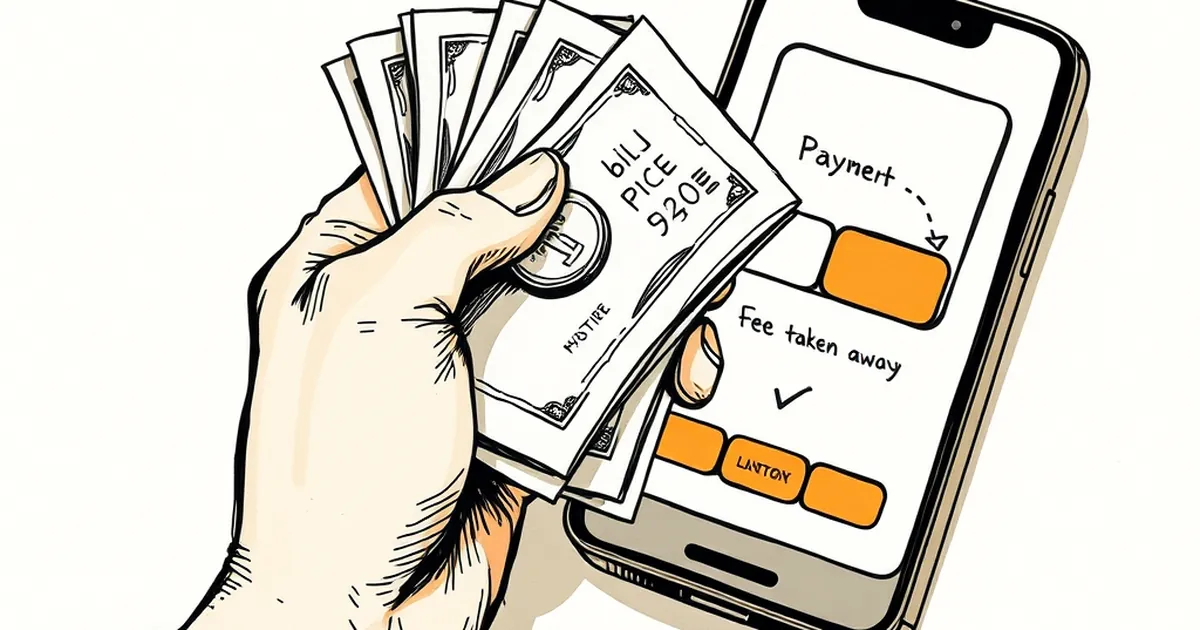
A 3% payment fee on a $200 cash-out costs you $6, which leaves $194 in your pocket. That's less than a schooner at most Sydney pubs, so it's tempting to wave off. But that same 3% applies whether you withdraw $200 or $2,000, and it stacks against a withdrawal limit that many Australian-facing casinos set at $5,000 a week — meaning a regular player can hand back $150 a year in fees without noticing a single one.
The fee itself isn't the interesting part. What matters is where it sits in the chain: after the house edge, after the wagering, after the currency conversion that some operators bury in the same line item. By the time a 3% charge hits your withdrawal, you've already paid for the privilege of cashing out several times over. Let's break down what that actually looks like.
The maths on a $200 withdrawal
Start with the obvious. A $200 cash-out at 3% nets $194. If the casino advertises "no fees" but routes the payment through an AUD-to-USD-to-AUD conversion, you can lose 2–4% on the spread instead, and that's before any flat "processing" charge. Some operators charge a flat $5 on withdrawals under $500, which on a $200 cash-out is a 2.5% effective fee — close enough to the 3% example that the distinction barely matters.
Where it gets thorny is repeat withdrawals. Say you cash out $200 a week rather than letting it build to $800 a month. At 3% a pop you pay $6 four times — $24 — versus $24 on the single $800 withdrawal. Same total, right? Not quite. The weekly withdrawer also hits minimum withdrawal thresholds more often, and those thresholds (commonly $20–$50) are where flat fees bite hardest. A $5 fee on a $50 minimum withdrawal is 10%.
The compounding you don't see
If you're redepositing after each cash-out — a habit the bonus terms often encourage — the fee isn't a one-off cost. It's a tax on every cycle. Ten $200 withdrawals over a year means $60 gone in fees. That's a full buy-in at a $60 tournament or roughly 300 spins on a 20c-per-spin slot at 96.2% RTP. The fee is small; the opportunity cost of the fee is not.
What 3% actually buys you
Payment fees aren't pure profit for the operator — card processors and payment gateways charge them too, and the margin on a $200 transaction is thin. But the fee structure is rarely transparent. Three things typically hide inside a "3% fee":
- Processor cost, passed straight through. Fair enough.
- Currency conversion, sometimes marked up 1–2% above the interbank rate.
- A flat handling charge disguised as a percentage, which punishes small withdrawals disproportionately.
The Australian context matters here. Under the Interactive Gambling Act 2001, licensed offshore operators can accept Australian players but can't offer credit, and the AusTRAC and AUSTRAC reporting requirements mean KYC checks are mandatory before any withdrawal clears. That verification step is free to you but adds friction the operator sometimes recoups through fees. If a casino charges for the KYC step itself, that's a red flag — verification is a legal obligation, not a service.
The comparison that stings
A domestic bank transfer in Australia typically costs nothing for a standard withdrawal, and PayID transfers settle in seconds. Crypto withdrawals on some platforms carry network fees of a few dollars regardless of amount, which means a 3% charge on a $200 crypto withdrawal is worse than the network fee itself. The point isn't that all fees are predatory — it's that the same $200 can cost you $0 or $6 depending entirely on which rail you choose, and most players never check.
The threshold problem
Here's where the percentage fee interacts badly with withdrawal limits. Many Australian-facing casinos cap withdrawals at $5,000 per week and $20,000 per month, with minimums around $20–$50. A 3% fee on a $5,000 withdrawal is $150. On a $50 minimum it's $1.50, but the flat component usually kicks in and turns it into $5 or more.
The practical effect: small, frequent withdrawals get punished, and large withdrawals expose you to the full percentage. The sweet spot — if there is one — is withdrawing in chunks just above the minimum but below the cap, and only when the fee structure is percentage-only with no flat component. Most players don't have that granularity in front of them when they hit "withdraw."
Worse, some operators apply the fee to the gross withdrawal before any pending bonus is deducted, or reverse it if you cancel the withdrawal and keep playing — a nudge dressed as a courtesy. If cancelling a withdrawal refunds the fee, ask why the fee existed in the first place.
How to read a fee schedule before you deposit
The fee schedule is usually buried in the banking page, not the terms. Look for four things:
- Percentage versus flat. A flat fee on small withdrawals is worse than a percentage; a percentage is worse on large ones.
- Which methods attract fees. Bank transfer is often free; cards and e-wallets often aren't.
- Whether the fee applies to the requested amount or the net. It should be the net, but check.
- Whether fees are refunded on cancellation. If they are, the fee is a retention tool, not a cost recovery.
If a casino won't publish its withdrawal fees in plain language on the banking page, treat that as the fee being higher than advertised. The $6 on a $200 cash-out is trivial in isolation; the opacity around it is the real cost, because you can't budget for a number you can't see.
Responsible gambling note: fees are a reason to withdraw less often, not a reason to chase losses to "make back" the $6. If a fee is influencing your play decisions, that's a signal to step back — Gambling Help Online is free on 1800 858 858.
The open question is whether payment fees should be regulated the way wagering requirements are. Australia has moved on bonus terms and credit betting, but withdrawal fees — which hit every player, not just bonus hunters — remain largely unregulated for offshore operators. If a 3% fee is small enough to ignore, it's also small enough to disclose clearly. The operators that do will probably keep more players than the ones that don't.