What a $5 minimum does to your average stake at table 12
A $5 table minimum quietly pushes your average stake to $7–$9 a hand, letting the house edge work harder on every dollar you drift upward
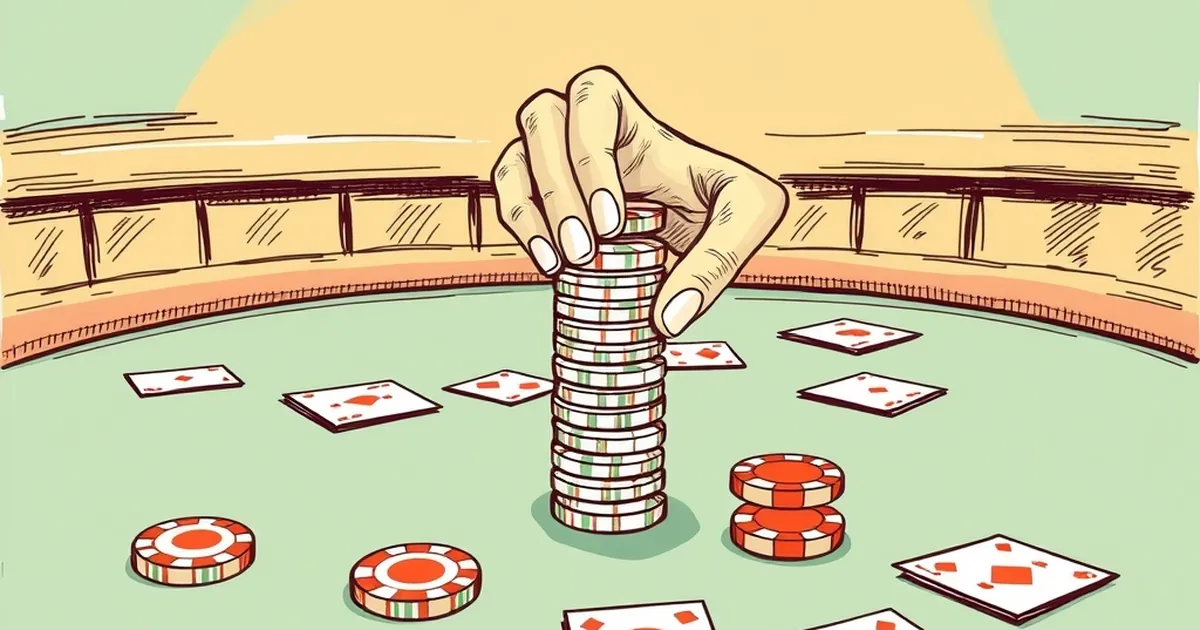
A $5 table minimum doesn't just set the floor on what you can bet at table 12 — it quietly drags your average stake upward. Most players who sit down intending to flat-bet the minimum end up somewhere between $7 and $9 a hand within 40 minutes, and the house edge gets to work on every dollar of that drift. The minimum is a psychological anchor, not a spending plan, and treating it like one is where the maths starts working against you.
The anchor problem: why your brain rounds up from $5
Casino floors have known this for decades. The minimum exists to get you seated; the real revenue comes from what you actually put on the felt once you're comfortable. Table 12 at your local — the $5 blackjack table tucked near the bar, not the $25 table with the velvet rope — is designed around exactly this behaviour.
Here's the mechanism. When you sit at a $5 table, $5 feels like the entry price, not the playing price. You bet $5, you win, you're up $5. That feels like nothing. So you bet $10. You lose. Now you're down $5 and $5 feels insultingly small to bet, so you bet $10 again to "get it back properly." Within twenty hands you've forgotten the minimum entirely and you're operating at $10–$15, which is a 100–200% increase on your stated plan.
Research on gambling stake escalation puts the drift at roughly 40–60% above the opening bet within the first hour for casual players. That's not a moral failing — it's how anchoring works on everyone, including people who know better.
The table minimum is a price signal, not a limit
A $5 minimum tells your brain two things: this is the cheap table, and $5 is the smallest meaningful unit here. Neither is quite true. The first is marketing. The second is arbitrary — the casino could run a $2 table, and some do during quiet weekday mornings. But $5 has become the standard entry point in most Australian venues and online equivalents, which means it's the number your brain calibrates against.
What the drift actually costs you over a session
Let's put numbers on it. Say you sit at table 12 with $200 and a plan to flat-bet $5 for two hours. At a typical 60 hands per hour, that's 120 hands. If you hold the line at $5, your total wagered is $600, and at a 0.5% house edge on basic-strategy blackjack, your expected loss is $3. Comfortable.
Now apply the realistic drift. If your average stake creeps to $7.50 across the session — a modest 50% increase — your total wagered becomes $900. Same house edge, same time, expected loss of $4.50. That's still small, but you've increased your exposure by 50% without consciously deciding to.
Push the drift to $10 average and you're at $1,200 wagered and $6 expected loss. Triple the original. And that's the good version, where you're playing a low-edge game with correct strategy. Swap blackjack for a 2.7% RTP house-edge game like American roulette and the same drift takes your expected loss from $16.20 to $32.40 over the session.
The variance tax nobody mentions
Expected loss is only half the story. Higher average stakes also mean higher variance, which means your bankroll swings harder in both directions. A $200 bankroll flat-betting $5 on blackjack has a reasonable chance of surviving a two-hour session even on a bad run. The same bankroll drifting to a $10 average has a materially higher risk of ruin — often two to three times higher over the same number of hands, depending on the game.
This is the part players feel but rarely quantify. You don't notice the drift hand by hand. You notice it when you're suddenly down $80 and can't remember when the bets got bigger.
Does the minimum change which game you should play?
The $5 floor does something subtler than inflate your bets: it constrains your game selection. At a $5 minimum, the games with the best player odds — certain video poker variants, low-limit baccarat with favourable commission structures — often aren't available at that price point. You're pushed toward whatever the floor offers at $5, and that's usually blackjack with mediocre rules (6:5 payouts on naturals, dealer hits soft 17) or a slot machine with an RTP you can't verify.
If you're serious about the maths, the $5 minimum can actually be a reason to skip the table and play online, where the same $5 gets you access to 99.5% RTP blackjack variants and 0.5% commission baccarat. The trade-off is speed — online hands run faster, which means more hands per hour and more total wagered even at the same stake. A 60-hand-per-hour live table becomes 300+ hands per hour online. Your $5 average stake now processes five times the volume.
The break-even illusion
Players often justify the drift by pointing at a winning session. "I was up $60, so the bigger bets were working." This is survivorship bias in real time. The bigger bets did work that session. Over 100 sessions, the house edge doesn't care about your narrative — it cares about total handle. A 50% average stake increase means 50% more expected loss, full stop. Winning sessions feel like vindication; losing sessions feel like bad luck. The drift operates identically in both.
The number that should be on the table card
Here's the anchor worth remembering: for every $1 your average stake rises above the minimum, your expected loss over a two-hour session rises by roughly $1.20 at 60 hands per hour with a 1% house edge. That's the real exchange rate. A $5 table where you average $8 isn't a $5 table — it's an $8 table with a $5 sign on it.
If you want to actually hold the line, the trick isn't discipline in the abstract. It's concrete: decide your session stake before you sit down, count your hands, and leave when you hit the number. Or set your unit at $5 and refuse to deviate even after a loss streak, because loss-chasing is where the drift accelerates fastest. Most players who "always bet the minimum" are actually betting $7–$9 without knowing it.
So the question isn't whether the $5 minimum is good value. It's whether you're actually playing at it — and if you're not, whether the game you've drifted into is one you'd have chosen at the price you're really paying. Gamble responsibly; the minimum is the floor, not the plan, and the difference between the two is where your bankroll quietly disappears.