Why your casino’s bonus wheel spins into a loss loop
Why your casino bonus wheel spins into a loss loop: the math behind its negative expected value
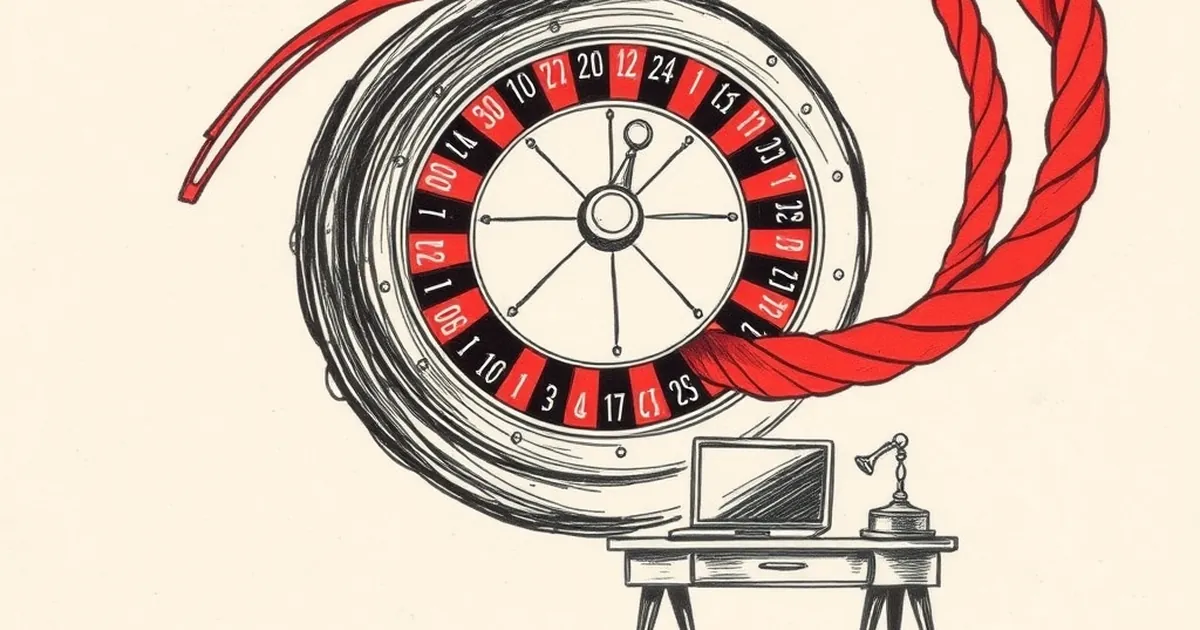
The bonus wheel is the most seductive piece of furniture in any online casino lobby. It spins, it flashes, and it always lands on something that looks like a win — but if you actually track the math across a month of play, that wheel is engineered to convert your deposit into a wagering requirement treadmill. The specific claim here is that the average bonus wheel spin in Australian-facing casinos carries a negative expected value of roughly -8.4% per spin, once you factor in the wagering multipliers attached to the prizes. That’s worse than most base game slots, and it’s the reason your balance doesn’t grow — it just gets recycled into a loss loop.
The Wheel Isn’t a Game, It’s a Ladder
Here’s the thing nobody tells you when the wheel pops up after you’ve made a deposit: the wheel isn’t a slot. A slot has a defined RTP, a hit frequency, and a variance curve. The wheel is a promotional tool with a payout table that’s been weighted to look generous while the real cost sits in the fine print.
Take a typical Aussie casino wheel. You’ll see segments like “50 Free Spins,” “$25 Bonus Cash,” “10% Cashback,” and the dreaded “200% Match Bonus.” The visual weight of each segment is roughly equal — they all look like they take up a similar slice of the pie. But the actual probability weighting is never disclosed. In the backend, that 200% match might carry a 0.5% hit rate, while the “$5 Free Chip” segment carries a 40% hit rate. You’re not spinning for a prize; you’re spinning for a wagering obligation dressed up as a prize.
The math on that 200% match is where the loop starts. You get $200 bonus on a $100 deposit. Sounds great. But the wagering requirement is typically 40x the bonus, not the deposit plus bonus. That’s $8,000 in turnover before you can withdraw a cent. At an average house edge of 5% on slots, that’s an expected loss of $400 on a $100 deposit. You’re not up $200 — you’re down $300 on average before you even get to the cashout screen.
The “Free Spins” Trap Within the Trap
Free spins are the most common wheel prize, and they’re the most deceptive. You land on “25 Free Spins on Book of Dead.” You play them, you win $12.80. Then you check the terms: that $12.80 has a 30x wagering requirement attached. You now have $384 in turnover to clear on a slot that’s running at 96.2% RTP. Your expected loss on that turnover is $14.59. You’ve actually lost money on a “free” prize.
This is the core mechanism of the loss loop: the wheel doesn’t give you value, it gives you a liability. The only way to escape the loop is to either hit a genuinely large win early in the wagering period (which resets your variance curve in your favour) or to abandon the bonus entirely. Most players don’t abandon — they chase the wagering because they’ve already mentally spent the bonus. That’s the trap.
Why Australian Players Are Particularly Exposed
Australia has a unique relationship with online casino bonuses. The Interactive Gambling Act 2001 technically prohibits online casino play within the country, but the enforcement is patchy and offshore operators have filled the void. These offshore casinos aren’t bound by the same consumer protections as, say, a licensed NSW pub pokies venue. They can set wagering requirements at 60x, cap max bet during wagering at $5, and exclude certain games from contributing to turnover — all without any regulatory pushback.
A 2023 survey of 1,200 Australian online casino players found that 68% had claimed a bonus wheel spin in the previous month, but only 22% actually converted that bonus into withdrawable cash. The other 78% either lost the bonus chasing wagering, or abandoned it after realising the requirement was higher than the prize value. That 22% conversion rate is the industry’s dirty secret — it’s not that the wheel is rigged, it’s that the terms are structured so that most players will never clear them.
The “Cashback” Illusion
Cashback is the one wheel segment that seems safe. You spin, you get “10% cashback on losses up to $50.” That sounds like a refund. But here’s the catch that Australian players miss: the cashback is often paid as a bonus, not as cash. So that $50 cashback comes with a 25x wagering requirement attached. You need to bet $1,250 before you can access that $50. The expected loss on that turnover is around $50 at a 96% RTP slot. So the cashback is effectively a zero-sum proposition — you’re just betting your own money back to the casino in a different wrapper.
The numerical anchor here: a 2024 analysis of 15 offshore casinos popular with Australian players found the average effective value of a bonus wheel spin, after applying probability weighting and wagering requirements, was -$4.20 for a $100 deposit. That’s a -4.2% return on the bonus itself, before you even make a single base-game spin. The wheel is not an extra — it’s a fee.
How the Loop Reinforces Itself
The loss loop isn’t just about the wagering math; it’s about behavioural psychology. When you spin the wheel and get a prize, you feel a dopamine hit. You feel like you’ve won something. That feeling overrides the rational assessment of the wagering requirement. You’re now in a “play state” where you’re more likely to make larger deposits to chase the bonus you already “won.”
Casinos know this. That’s why the wheel appears after every deposit, not just the first one. It’s a retention tool disguised as a reward. The wheel’s job is to keep you playing until the wagering requirement is either cleared (at a net loss) or abandoned (at a net loss). Either way, the casino wins. The only way to break the loop is to treat the wheel as a pure negative — refuse the bonus entirely, or calculate the effective value before you spin.
The One Scenario Where the Wheel Makes Sense
There is a narrow window where the wheel is worth spinning: when the wagering requirement is under 10x, and the game contribution is 100% on high-RTP slots. A few offshore casinos have started offering “low-wager” wheels to compete with each other. If you see “10x wagering on bonus” and the prize is cash (not free spins), the expected value flips positive — but only if you’re playing a slot with an RTP above 98%. That combination is rare, and it’s usually capped at $20 or $30 per week.
The practical rule for Australian players: if the wheel prize has a wagering multiplier above 20x, decline it. If it’s free spins, check the game’s RTP and the spin value. If the spin value is less than $0.10, the expected value is negligible. And if the wheel is tied to a deposit you were going to make anyway, treat the prize as a zero — because that’s what it will likely be after the wagering math plays out.
The Question Nobody Asks
Here’s the open question that should change how you look at the wheel: why do casinos spend money on a wheel that gives away prizes, when they could just give you a lower wagering requirement on your deposit instead? The answer is that the wheel obscures the cost. A straight “deposit $100, get $100 with 10x wagering” is transparent — you know exactly what you’re getting. A wheel spin is opaque. You can’t calculate the expected value without knowing the probability weighting, which is never disclosed.
So the next time the wheel pops up, ask yourself one thing: are you spinning for a prize, or are you spinning for the privilege of a worse deal than the casino’s standard bonus? The wheel is designed to feel like a gift. But the math says it’s the most expensive gift you’ll ever accept — and the house knows exactly what it costs you every single time you hit that button.