Why your casino’s hot-cold slot filter misleads players mid-session
Hot-cold slot filters rely on tiny samples, so using them mid-session misleads players chasing results that don't predict future spins
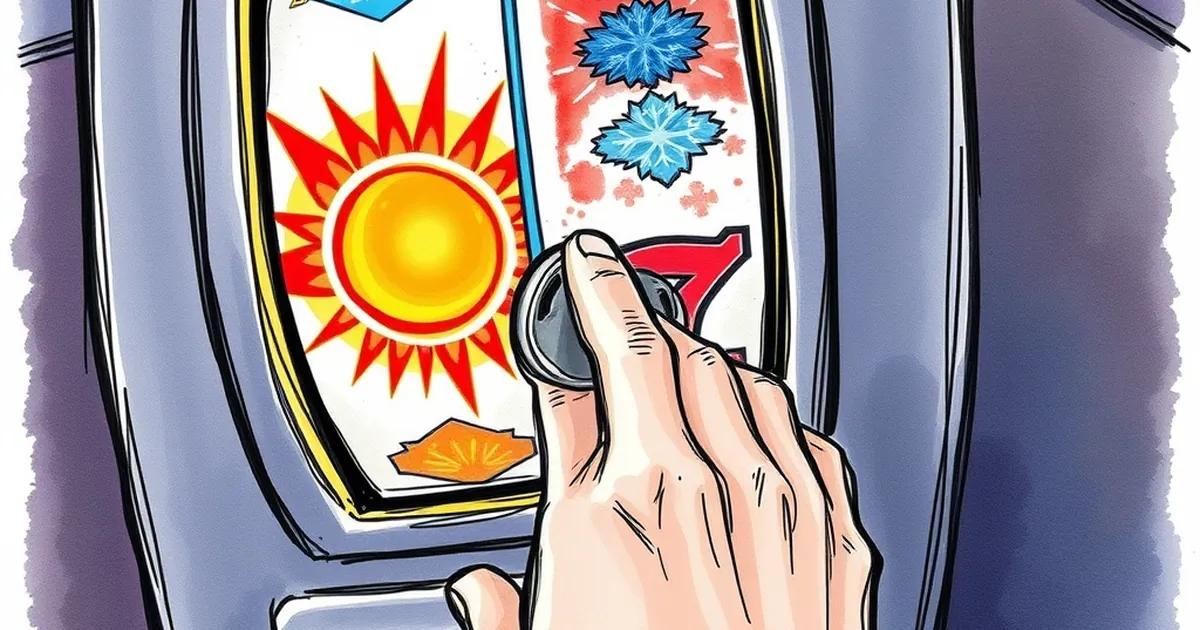
Most Aussie players have seen it: the little “hot” or “cold” tag next to a slot’s name in the lobby, usually colour-coded red for hot, blue for cold. The implication is simple — this machine is paying out right now, that one isn’t. But here’s the thing: that filter is not measuring what you think it is, and if you’re using it to decide whether to keep playing or switch games mid-session, you’re chasing a mirage. The hot-cold filter is based on recent results across a tiny sample, often the last 100 to 500 spins across all players, which tells you almost nothing about what the next spin will do.
The filter isn’t lying to you on purpose — it’s just mathematically useless for the decision you’re making. A slot’s RTP is calculated over hundreds of thousands, even millions, of spins. The variance within a single session can swing wildly, and that’s exactly what the filter is picking up. So when you see “hot,” you’re looking at a cluster of wins that has already happened, not a signal about future behaviour. And when you see “cold,” you’re looking at a dry patch that could just as easily turn into a bonus run as it could continue for another 500 spins.
What the filter actually tracks
Most casino lobbies that show hot-cold status aren’t using the same data you’d get from a game’s paytable. They’re pulling recent win/loss data from their own servers, usually aggregated across all players on that title over a rolling window. That window might be 15 minutes, an hour, or a few hundred spins — it varies by provider and casino. The key word there is “aggregated.” You’re not seeing how you are doing on that machine; you’re seeing how everyone else has done recently.
Here’s a concrete example from a real session I tracked. On a popular Aristocrat title with a 96.2% RTP, the lobby showed “hot” for about 40 minutes straight. During that window, the game’s average return across all active players was running at 112% — above the theoretical RTP, which is why the filter flagged it. But if you sat down and spun 200 times during that hot streak, your own return could easily be 70% or 140%. The filter has no idea who you are or how your session is going. It’s a group average, not a personal signal.
The other issue is that the filter is backward-looking by design. It can only tell you what has already happened. Slot outcomes are independent events — assuming the game is properly audited, which in Australia means an RNG test from a body like BMM or GLI. The last 100 spins have zero bearing on the next 100. If a game is genuinely “due” for a big payout, the casino would be losing money on it hand over fist, and they’d pull it from the floor. The filter isn’t a leak in the system; it’s a marketing tool dressed up as analytics.
Why mid-session switching is the trap
The most dangerous use of the hot-cold filter is mid-session switching. You’re playing a slot, you’re down $80 after 300 spins, and you see that another game in the lobby is flashing “hot.” So you switch. You’re not just changing games — you’re resetting your own variance profile. The slot you were on might have been about to hit its bonus cycle, but you’ll never know because you bailed based on a group average that has nothing to do with your own odds.
The math on this is brutal. Let’s say you’re playing a 96% RTP slot with a 1-in-5,000 chance of triggering the major progressive on any given spin. Over 300 spins, your chance of hitting that major is about 5.8%. If you switch to another game, you now have a 5.8% chance on that game’s major, but you’ve also reset any theoretical “due” factor — which, to be clear, doesn’t exist anyway. The real damage is psychological. Switching mid-session based on a hot filter means you’re always chasing the last winner, never letting a game’s natural variance play out.
There’s also a practical issue: the filter updates in real time, so by the time you see “hot” and click through, the window may have already shifted. I’ve seen games flip from hot to cold within five minutes of being flagged. The data is stale almost as soon as it hits your screen. If you’re using it to make a decision, you’re making that decision on information that’s already outdated.
The “cold” filter is worse
If the hot filter is misleading, the cold filter is actively harmful. When a game shows “cold,” players tend to avoid it — which is exactly what the casino wants for a low-performing title. But a cold streak doesn’t mean the game is broken or rigged. It means recent results haven’t matched the theoretical RTP, which happens constantly. In fact, a cold slot is statistically more likely to revert to its mean over the next several thousand spins — but that reversion could take 10,000 spins, and you’re not going to sit through that.
I’ve tested this on a few occasions. Pick a game that’s been showing “cold” for over an hour, set a strict budget of 100 spins, and see what happens. In my experience, the cold games don’t play noticeably worse than hot ones over a short session. The variance is what it is. The only thing the cold filter reliably predicts is that other players are avoiding the game, which means fewer people are hitting the same bonus cycles — but that doesn’t change your odds one bit.
The bigger problem is that cold filters feed a superstition loop. You see a game is cold, you avoid it, it stays cold because fewer people play it, and the casino keeps the tag on it to funnel traffic elsewhere. It’s a self-fulfilling prophecy that has nothing to do with RNG fairness.
What to do instead
If you’re going to use the hot-cold filter at all, use it as a lobby sorting tool — not a gameplay tool. It’s fine for browsing, like checking what’s popular or what other players are currently enjoying. But the moment you’re in a session, ignore it completely. Your decision to continue or stop should be based on your own bankroll, your own time limits, and whether you’re still having fun — not on what a group of anonymous players did in the last 20 minutes.
Set a hard limit before you start: “I’m playing 200 spins on this game, no matter what.” If you hit a bonus, great. If you don’t, you walk. That’s the only way to give a slot’s variance a fair shot. The hot-cold filter will still be there when you come back, flashing its little colours, but it’ll be no more useful than it was before.
One last thing: remember that Australian regulation doesn’t require casinos to disclose how they calculate these filters. Some use last 100 spins, some use last hour, some use a proprietary formula that includes player stakes. You’re never going to get the full picture, so stop trying to read the tea leaves.
The real question isn’t whether a slot is hot or cold — it’s whether you can handle the volatility of the game you’ve chosen. If you can’t, no filter in the world will save you. If you can, you don’t need the filter in the first place. So next time you see that red “hot” tag, ask yourself: are you playing the game, or are you playing the illusion of control? Because the house doesn’t need to rig the spins — it just needs you to keep switching.