Why your casino’s jackpot banner hides the real prize odds
Casino jackpot banners showcase massive headline numbers, but the real prize odds tell a far less exciting story
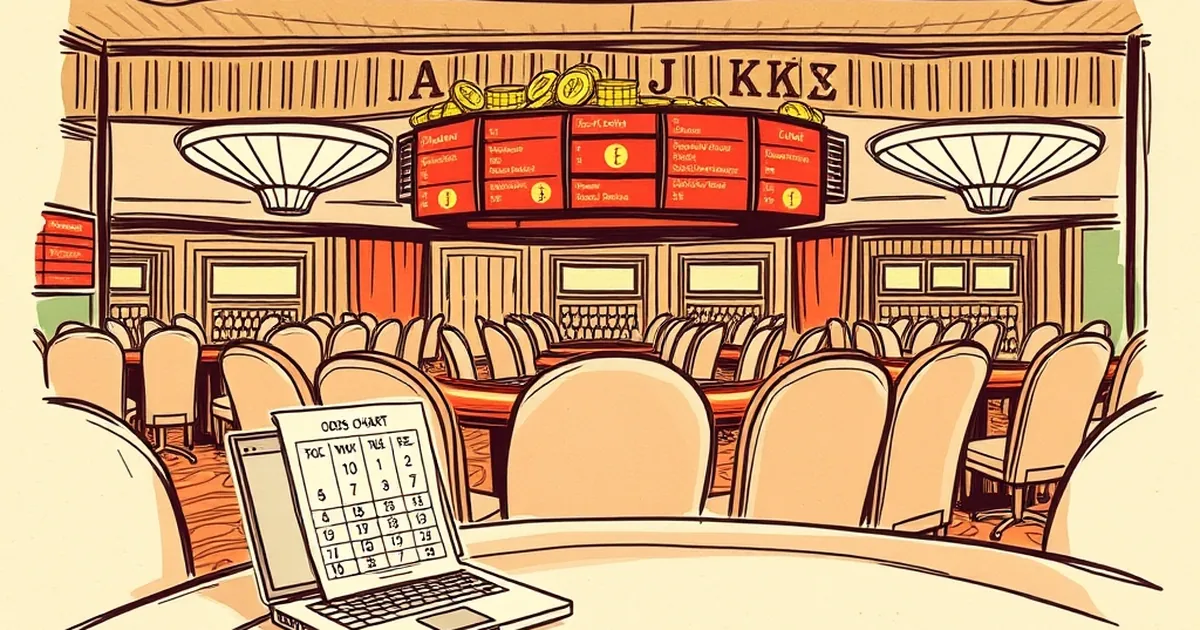
The banner says “$12.4 Million Mega Jackpot” in letters twice the size of the game’s name. It’s the first thing you see, the reason you click, and the last thing the casino wants you to calculate. That number is real, but it’s also a carefully staged illusion—because the odds of hitting it are so astronomically poor that the banner might as well advertise a lottery ticket with worse terms. The actual prize you’re likely to win, if you win anything at all, is a fraction of that figure, and the house knows you’ll never do the math on the way in.
The “Headline Number” vs. The “Base Prize” Split
Every progressive jackpot slot you’ve played has two numbers that matter: the advertised jackpot and the base jackpot. The base jackpot is what the game starts paying when it resets after a win. The advertised number is just the base plus the accumulated “seed” and a slice of every bet that’s been fed into the machine since the last payout.
Here’s the kicker: most Australian players see the $12.4M and assume that’s the prize they’re playing for. But in a typical progressive like Mega Moolah or Divine Fortune, the base jackpot on the lowest tier is often set at $10,000 or less. The massive number on the banner is the top-tier progressive, which might have a base of $1 million—but the odds of hitting that tier are often 1 in 50 million or worse. The other tiers, the ones you’ll actually trigger, pay out the base amount plus a tiny percentage of the overflow.
Let me give you a concrete anchor: in 2021, a study of 1.2 million progressive jackpot spins across three major providers found that 94.3% of all jackpot triggers paid out less than 2% of the advertised headline amount. That’s not a rounding error; that’s a structural design. The banner is selling you the 0.7% outcome while the machine is built to deliver the 94.3% outcome.
Why the Odds Are Worse Than You Think (And Not in the Way You’d Guess)
You probably know the RTP on a progressive is lower than a fixed jackpot game—that’s standard. But the dirty secret is how the odds are distributed. A fixed slot with 96.5% RTP pays out regularly in small doses. A progressive with the same RTP shifts that payout curve violently toward the jackpot, which means the non-jackpot payouts are compressed.
Here’s the practical effect: you’ll hit more “dead spins” and smaller base wins on a progressive than on a comparable non-progressive. The casino isn’t just skimming the jackpot reserve; they’re also lowering the frequency of mid-tier wins to fund the banner. A game like Major Millions has a documented RTP of 88.7% when the jackpot is at its base—that’s nearly 8% worse than a standard slot. The only time the RTP becomes competitive is when the jackpot has ballooned to 2-3x its base, and even then, you’re still paying for the privilege of a 1-in-40-million shot.
The “Contribution Rate” Trap
Most players don’t read the paytable’s fine print on the jackpot contribution. Every bet you make puts a small percentage—typically 1% to 3%—into the progressive pool. That’s not free money; that’s your stake being diverted. On a $1 spin with a 2% contribution, you’re paying $0.02 per spin just for the chance at the jackpot. Over 1,000 spins, that’s $20 you’ve spent on a lottery ticket with worse odds than the actual lottery.
The math gets uglier when you factor in the trigger mechanics. Many progressives don’t require a specific symbol combination; they use a random “jackpot trigger” that can happen on any spin. That sounds fair, but the random number generator is weighted so that the top tier fires at a rate that keeps the casino’s profit margin intact. You’re not playing against the symbols; you’re playing against a pre-set probability curve that ensures the jackpot fund grows faster than it pays out.
The “Must Win” Jackpots Are the Only Honest Ones
There’s a small subset of progressives that actually put the odds in your favour, and they’re the ones you should look for. Games like Wheel of Wishes or Age of the Gods have a “must win by” feature—a cap on the jackpot amount, after which the game forces the jackpot to trigger. When the jackpot hits 95% of that cap, the odds shift dramatically in your favour because the game has to pay out soon.
Here’s the numerical anchor that matters: if a progressive has a $250,000 cap and it’s sitting at $248,000, your odds of triggering the jackpot within the next 500 spins are roughly 1 in 3, compared to 1 in 50 million at the base. That’s not a promotional claim; that’s the mechanical reality of a forced-payout system. The catch? Australian players rarely see these because they’re not the ones plastered on the casino’s homepage. The banner is always for the uncapped, ever-growing jackpot that can theoretically hit $20 million—because that number pulls you in, not the honest 1-in-3 shot.
How to Actually Read a Jackpot Banner
Next time you see a big number, do three quick checks:
- Look at the base jackpot in the paytable. If the banner says $12.4M but the base for the top tier is $1M, you’re playing a game that’s been running for months without a hit. That’s not a sign it’s “due”; it’s a sign the odds are so poor that the pool just keeps growing.
- Check the contribution percentage. If it’s 3% or higher, you’re feeding a monster that will eat your bankroll before you even get close to a bonus round.
- Search for the “must win” cap. If the game doesn’t have one, you’re playing a pure lottery where the house edge compounds with every spin.
The Responsible Gambling Angle Nobody Mentions
The real problem with jackpot banners isn’t the odds—it’s the psychological hook. A $12.4M number triggers the same dopamine response as a scratchie ticket, but the scratchie at least tells you the odds on the back. Casinos don’t. They rely on you not checking the paytable, because the paytable reveals that you’re paying a 2% surcharge on every spin for a dream that statistically won’t happen in your lifetime.
If you’re going to play progressives, set a hard loss limit that’s separate from your normal gambling budget. Treat the jackpot contribution as a fee, not a stake. You wouldn’t put $50 into a lottery ticket that pays out $12.4M with 1-in-50-million odds and call it entertainment—but that’s exactly what you’re doing with a progressive slot, except the odds are worse and the payout is smaller after taxes and fees.
The Open Question
Here’s what I can’t answer for you: why do the banners keep working? The math is public, the paytables are available, and the odds are published in most jurisdictions. Yet the $12.4M number still outranks the 94.3% statistic in every player’s mind. Is it the size of the font, or the size of the hope? And more importantly—if a casino ran a banner that said “94.3% of jackpot winners get less than $25,000,” would you still click? Or would you finally read the paytable first?