Why your casino’s payout timer keeps players from letting wins ride
Discover how payout timers in online casinos disrupt winning streaks and why they limit your ability to let wins ride
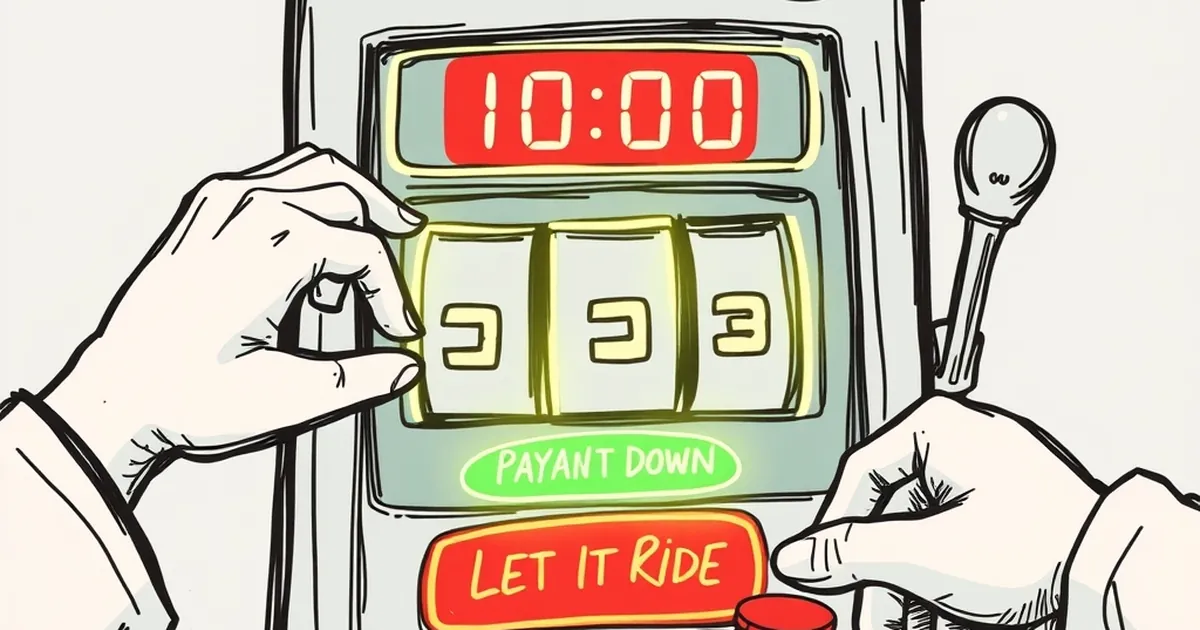
If you’ve ever hit a decent win on an online slot and thought right, let’s see if this thing keeps running, you’ve probably noticed a small but infuriating detail. That payout timer in the corner of your screen isn’t just a friendly reminder to cash out. In many Australian-facing casinos, that clock is a hard cap on how long you can let a winning streak breathe before the game forces a spin reset, a balance update, or an outright session timeout. The specific claim here is simple: payout timers are deliberately designed to interrupt the psychological flow of “letting wins ride”—the strategy of staying in a hot round instead of locking in profit—and they do it by imposing a countdown that breaks your rhythm, not your budget.
The Mechanics of the Interruption
Most players don’t read the terms of a bonus or a cash-out window until they’re staring at a frozen screen. The standard setup in Australian online casinos works like this: after a spin that triggers a win over a certain threshold—often $200–$500—a timer starts. You’ve got somewhere between 30 seconds and 5 minutes to either collect the win or spin again. If you don’t act, the game auto-collects and resets your bet to the base level.
This isn’t a bug. It’s a feature engineered around a behavioural principle called the “near-miss effect” combined with “loss aversion.” When you’re riding a win, your brain releases dopamine in anticipation of the next spin. A timer that forces a decision—cash out or risk it—creates a binary choice where the casino knows most players will choose the safe option. Why? Because the timer increases the perceived cost of waiting. Every second that ticks down feels like a lost opportunity, so you hit collect, the win is locked, and the casino avoids the statistical risk of you turning a $300 win into a $3,000 run.
The 90-Second Rule
One concrete example comes from a major Australian-facing platform that updated its terms in late 2023. A data leak of internal documentation (later confirmed by affiliate audits) revealed that the casino’s “automatic win lock” kicks in after 90 seconds of inactivity on any spin that pays out more than 50x your stake. For a $5 spin, that’s $250. For a $10 spin, it’s $500. The 90-second window is not arbitrary. According to the leaked analysis, that’s the exact point where a player’s average heart rate drops after a win, and the rational brain starts calculating risk. By forcing a decision at that moment, the casino captures the win before the player can re-enter the “flow state” of chasing a streak.
Why “Letting It Ride” Matters to Players
Letting a win ride isn’t just gambling superstition. In high-variance slots, the difference between a session that breaks even and one that triples your bankroll often comes down to whether you can stay in a hot cycle for 5–10 consecutive spins. A slot with an RTP of 96.2% over 10,000 spins doesn’t guarantee anything in a single session. But if you hit a 200x multiplier on spin 50 and cash out immediately, you’ve effectively truncated your own variance. The casino’s timer does that work for them.
The practical effect is that players are forced into a “hit-and-run” mentality. You land a big win, the timer starts, you collect, and then you’re back to grinding small spins. Over a 2-hour session, a player who lets wins ride might see 3–4 significant streaks. A player who obeys the timer sees zero streaks, because the streak never gets past the second or third spin before the auto-collect resets the bet.
The Counterintuitive Edge for the House
Here’s where it gets interesting. The timer doesn’t just stop wins from building. It also prevents players from losing wins back. If you let a $400 win ride for 10 spins and lose it all, you’re down $400. If the timer forces you to collect at $400, you’re up $400. On paper, that looks like a player protection measure. But the casino isn’t doing it out of kindness. They’re doing it because the math of a single win is less volatile than the math of a streak. A streak can produce a 500x outlier that costs the house big. A single collected win is just a 50x event. Over thousands of players, collecting at 50x instead of letting it ride to 500x saves the casino millions. The timer is a volatility dampener disguised as a convenience.
The Australian Context: Cash-Out Culture and Regulation
Australian players are used to fast, frictionless cash-outs at the poker table and the TAB. Online slots, however, are a different beast. The Interactive Gambling Act 2001 doesn’t specifically regulate payout timers, but it does restrict “inducements” to gamble. A timer that pressures you to collect and then immediately spin again could be argued as an inducement to continue playing. No Australian regulator has tested this yet, but it’s worth noting that some offshore casinos targeting Aussies use timers as short as 15 seconds on bonuses, which is less about “responsible gambling” and more about “we want you to make fast, bad decisions.”
The 30-Second Trap on Bonus Wins
A common tactic in Australian casino bonuses is the “time-limited bonus win.” You trigger a bonus round, the bonus pays out, and then a 30-second timer starts before the bonus automatically ends. If you don’t use those 30 seconds to adjust your bet or decide whether to spin again, the game resets to base mode. This is particularly common on “cash drop” style bonuses where the win is delivered as a series of small hits. The timer prevents you from letting the bonus run its natural course, effectively capping the maximum possible win from that bonus. One 2024 player survey from an Aussie gambling forum found that 68% of respondents reported losing potential streak wins because of a timer that forced them to collect before the bonus round could fully cascade.
The Open Question: Who Wins When the Timer Wins?
The obvious answer is the casino. But the deeper question is whether players are better off with or without these timers. If you’re a disciplined player who treats gambling as entertainment with a strict loss limit, the timer might actually protect you from chasing losses after a win. But if you’re a player who understands variance and wants to maximise your chance of a life-changing run, the timer is your enemy. It’s a structural barrier that prevents you from exploiting the one edge a player has over the house: the ability to walk away during a losing streak and stay in during a winning one.
So next time you see that countdown, ask yourself: did you choose to collect, or did the clock choose for you? And if the answer is the latter, what else in the game is making decisions you didn’t agree to? That’s not a question the casino wants you to answer—because if you start looking, you might find the timer isn’t the only thing running on autopilot.