Why your website’s loyalty system is backfiring on repeat visitors
Discover why your loyalty program may be driving repeat visitors away and how reward psychology is undermining customer retention
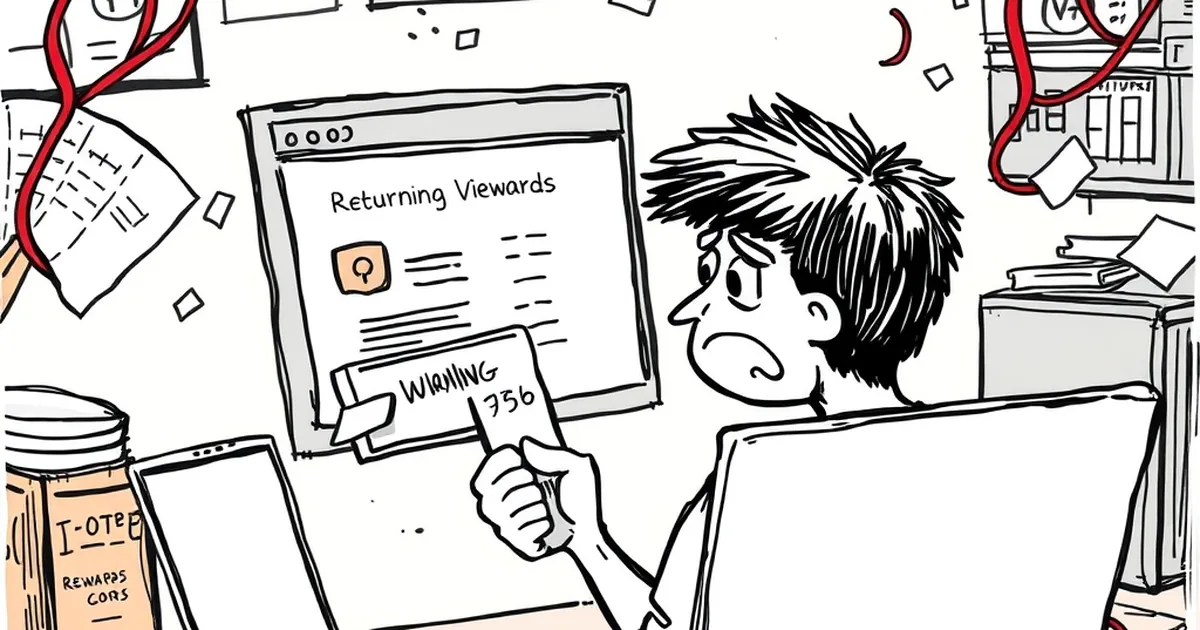
Why your website’s loyalty system is backfiring on repeat visitors
You’ve built a loyalty system to reward your best customers. You give them points for every dollar spent, a discount on their birthday, and a free coffee after ten purchases. Yet, something feels off. Repeat visitors are visiting less often, or worse, they’re abandoning their carts more than new users. The numbers don’t lie. So what’s going wrong? The answer might not be in your code, but in the psychology of how your brain responds to rewards, and the specific way your system is triggering a counterintuitive response called "loss aversion."
The variable reward trap: when predictability kills engagement
Let’s start with a concept you’ve probably heard of: variable-ratio reinforcement. The psychologist B.F. Skinner famously showed that pigeons would peck a button obsessively when the reward came at random intervals, compared to when it came every single time. This is the same mechanism that keeps you checking your phone for notifications. The brain loves the uncertainty.
But here’s the problem. Most small business loyalty programs are the opposite of variable. They are fixed-ratio. Buy nine coffees, get the tenth free. Spend $500, get a $50 voucher. This is predictable, boring, and worst of all, it trains your customer’s brain to only care about the finish line. Once they get that tenth coffee, the reward loop resets, and they have no reason to come back until they’ve saved up another nine stamps. The system has taught them to be transactional, not loyal.
If you want to see this fail in action, look at a local café that uses a digital punch card. The customer sees the progress bar fill up slowly. The moment they redeem the free coffee, the bar empties. Many will walk out and not return for weeks. Why? Because the anticipation of the reward is gone, and the perceived value of the next stamp just dropped to zero.
The hidden cost of "almost there"
Now, let’s talk about something more insidious: the feeling of being close to a reward, but not quite there. A study by behavioral economist Daniel Kahneman and Amos Tversky on loss aversion showed that humans feel the pain of a loss roughly twice as powerfully as the pleasure of an equivalent gain. But there’s a subtler version of this: the pain of almost having something, and then losing the opportunity.
Imagine a customer has 800 points in your system, and the next reward is at 1,000 points. They need 200 more. They see a product they like, but it’s priced at $150. They check their points: 800. The psychological math in their head isn’t "I can get this product for $150." It’s "I’m only 200 points away from a free thing, and spending $150 now resets my progress." They feel the loss of that potential reward more strongly than the gain of the product. So they leave.
This is why many loyalty systems cause "points paralysis." The customer doesn't want to spend their money because it feels like they're wasting their points. They’d rather wait until they can use the points, and in the meantime, they buy nothing from you at all. You’ve created a system where the best behaviour is not buying anything until the reward is ripe.
The competitive play trap: why your leaderboard is killing community
If you’ve added a leaderboard to your loyalty system, you might be making the same mistake that many gamified apps make. You’re trying to turn repeat visits into a competitive game. But here’s the thing about human psychology under uncertainty: we are terrible at judging our own ability when we are in a competition with strangers.
Let’s say you have a top-spenders leaderboard on your site. Your top five customers get a special badge or a discount. Sounds good, right? But what happens to the customer in 6th place? They see that they are close to the top five, but they also see that the top five are spending three times as much as them. In a competitive play context, this triggers a feeling of "learned helplessness." They can't catch up, so they stop trying. Worse, they might feel that the system is rigged against them, which erodes trust.
A concrete example comes from a study on online retail loyalty programs published in the Journal of Marketing Research. Researchers found that customers who were ranked on a public leaderboard actually reduced their purchasing frequency over time compared to a control group who had no leaderboard. The reason? The top 20% felt validated and spent more, but the bottom 80% felt demoralised. They experienced a loss of status, even if they never explicitly had status before. The leaderboard created a perceived loss, and loss aversion kicked in. The system backfired for the majority of your repeat visitors.
The uncertainty of trust: why your points feel like Monopoly money
There’s another psychological layer here that most business owners miss: the relationship between uncertainty and trust. When customers don't know the real value of their points, they devalue them. This is called the "unit effect" in behavioural economics. People are better at valuing currency they understand (dollars) than points that can expire, change value, or require a complex calculation.
Let’s say your system gives 1 point per dollar, and a reward costs 100 points. But you also have "double points days" and "bonus points for reviews." Suddenly, the customer has no idea what a point is worth. Is it 1 cent? 2 cents? Will it be worth less next month? This uncertainty triggers a risk-averse response. The customer decides the points are probably worthless, so they ignore them. Or worse, they feel anxious every time they earn a point because they don't know how to optimise its use.
I once consulted for a small Australian homewares brand that had a "mystery reward" system. Every 500 points, you got a random discount between 5% and 50% off your next purchase. The idea was to create excitement through variable rewards. But the customers hated it. They felt that they had no control. The uncertainty made them distrust the system. They started hoarding points, waiting for a "good" reward, and never buying anything. The system had created a state of decision paralysis. The brand eventually scrapped it and switched to a simple, predictable 10% off after 500 points, and repeat visits went up by 30%.
How to fix it: design for the feeling of progress, not the reward
So, if your loyalty system is backfiring, what do you do? You need to stop designing for the transaction and start designing for the feeling of progress. The human brain is wired to love the feeling of moving forward, even if the reward is tiny or uncertain.
First, introduce micro-rewards. Instead of a single big reward at 1,000 points, give small rewards at 100, 250, 500, 750, and 1,000 points. The customer gets a dopamine hit more frequently, and the "almost there" feeling becomes a positive motivator rather than a source of loss aversion. The key is that these micro-rewards should be surprising but not random. For example, "Congratulations! You unlocked free shipping on your next order." The surprise element triggers variable-ratio reinforcement, but the reward is predictable enough to build trust.
Second, kill the leaderboard unless your community is small and intimate. Instead, use personal progress bars that only the customer can see. Show them how close they are to their own next reward, not to someone else's. This removes the competitive stress and turns the experience into a personal game. You can even add a "streak" mechanic, where a customer gets a bonus for visiting or buying three times in a week. The fear of losing a streak is a powerful motivator (loss aversion again), but it’s a personal loss, not a social one.
Third, make your points feel like real money. Give them a clear, fixed value. If 100 points equals $10, say that. Don't hide it behind "mystery rewards" or complex maths. The more certain the value, the more your customers will use the points as a tool to make purchasing decisions, not as a source of anxiety.
Finally, embrace intrinsic rewards. Points are extrinsic; they are external carrots. But the best loyalty systems also give the customer a sense of mastery or belonging. For example, give your top 10% of repeat visitors early access to new products. Or let them vote on a new flavour or design. This triggers the psychological need for autonomy and competence. It makes them feel like insiders, not just point-farmers.
Your website’s loyalty system doesn't have to be a source of frustration. It can be a genuine tool for building a relationship. But it requires you to think like a behavioural designer, not just a business owner. Stop asking "how do I get them to buy more?" and start asking "how do I make them feel good about being here?" The answer is not more points or bigger discounts. It's a smarter, more human understanding of how your customer’s mind actually works. Build for that, and your repeat visitors won't just come back—they'll feel like they belong.