Why your website’s skill meter kills curiosity at level 3
Discover why gamified skill meters on websites often stifle user curiosity instead of boosting engagement
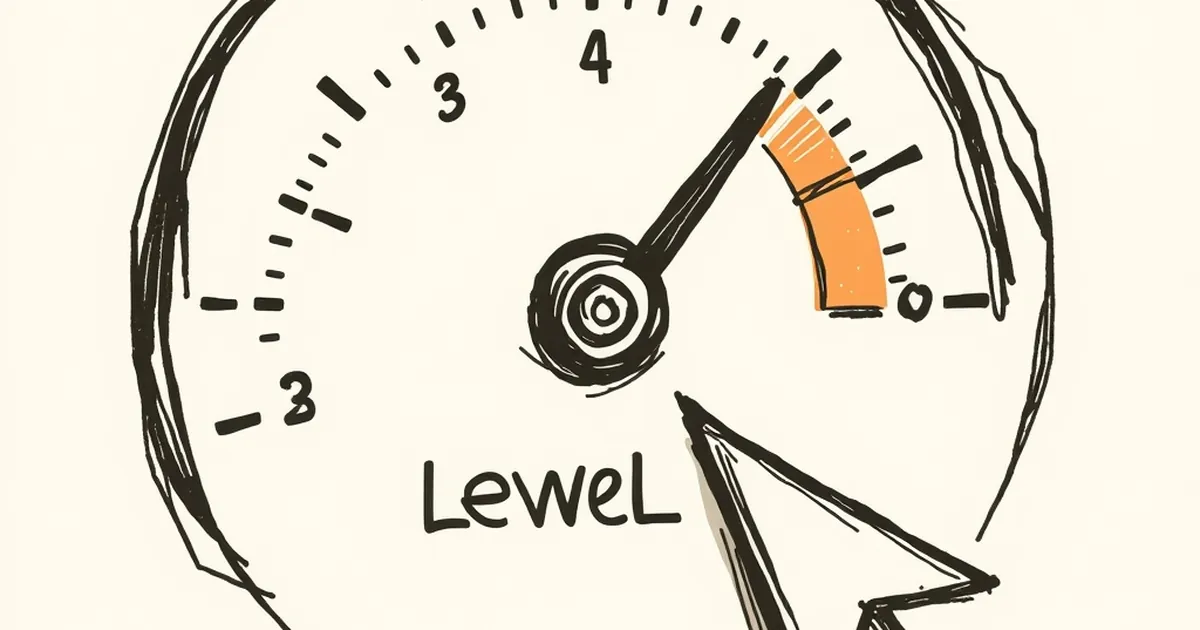
So, you’ve built a website with a progress bar, a points system, or a “skill level” badge that goes from Novice to Expert. You thought it would gamify the experience, keep people coming back. And it worked... for about three clicks. Now the engagement has flatlined, and nobody seems to care about reaching Level 4. Why does a system designed to motivate feel like a dead end?
Here’s the uncomfortable truth: most skill meters don’t reward behaviour; they punish curiosity. They create a closed loop where the only goal is the next arbitrary milestone, which kills the very exploration that keeps a website interesting. Let’s pull back the curtain on the behavioural science behind this, and look at how to design a system that doesn’t treat your visitors like lab rats chasing a pellet.
The problem with predictable progression
Let’s talk about variable-ratio reinforcement. It’s the psychological principle that made slot machines (and, less nefariously, Twitter notifications) so addictive. The reward is unpredictable. You don’t know when the next “ding” will come, so you keep pulling the lever. It’s the uncertainty that hooks us.
Your skill meter is the opposite. It’s fixed-ratio reinforcement. “Do this action five times, get a badge. Do it ten times, get a star.” B.F. Skinner himself showed us that predictable rewards lead to predictable boredom. Once a user figures out the cost-benefit ratio—"I have to write three more reviews to reach Level 4, and for what?"—the system collapses. The curiosity evaporates because the outcome is known.
A 2018 study from the University of Chicago Booth School of Business backs this up. Researchers found that when people were given a clear, linear path to a reward (like a progress bar), their motivation actually decreased after the halfway point, especially if the reward felt trivial. This is the “middle problem.” The novelty of Level 1 and 2 is fun. Level 3 is the grind. And Level 4? That requires an emotional investment that a badge can’t justify.
Why Level 3 is the kiss of death
Level 3 is where the user has had enough time to realise the system is a treadmill. They’ve seen the pattern. They know that Level 4 requires ten more of the same action. The curiosity that drove them to explore your site initially is now replaced by a cold calculation: “Is this worth my time?” For most, the answer is no.
This is a classic case of loss aversion, but in reverse. Kahneman and Tversky showed us we hate losing more than we love winning. A skill meter that requires effort to gain a level feels like a potential loss of time. The user asks, “What if I put in the work and the reward is disappointing?” The perceived risk of wasted effort outweighs the potential reward of the next badge. So they stop.
The hidden cost of “mastery” badges
We often design these meters with the best intentions. We want to guide a new user toward “mastery” of our platform. But here’s where it gets messy: labelling someone a “Novice” or “Intermediate” can trigger a fixed mindset. Carol Dweck’s work on mindset is directly relevant here. A fixed mindset says, “I am a Level 3. That’s my identity.” A growth mindset says, “I am learning.”
Your skill meter accidentally tells the user, “You are now a Level 3. Be satisfied with that.” It creates a ceiling on curiosity. Once a user hits that label, they stop exploring new, unmeasured features because those features don’t feed the meter. They only do the things that get them points. You’ve inadvertently trained them to ignore 80% of your website’s value.
The competitive play trap
Some sites try to fix this by adding leaderboards or competitive elements. This is a high-risk move for most Australian small businesses. Competitive play works beautifully in a closed environment like a gaming platform. But on a website for a local tradie or an accounting firm? It often backfires.
Why? Because it introduces social comparison, which can trigger shame or anxiety. A user who was happily exploring your content now feels like they’re losing a race they didn’t sign up for. Instead of fostering curiosity, you’ve created a fear of being seen as “low skill.” The result? They stop engaging publicly, or worse, they leave entirely. The reward loop becomes a punishment loop.
A better way: reward the unknown, not the known
So, how do we design a system that sustains curiosity instead of killing it? We need to borrow from the best parts of behavioural psychology without the manipulative baggage. The goal isn't to create addiction; it's to create genuine exploration. Here’s the practical shift:
Ditch the linear skill meter. Replace it with a “curiosity trail.”
Instead of a bar that fills up predictably, design a system that surfaces hidden content. For example, let’s say you run a website for a gardening business. Instead of a “Level 3 Gardener” badge, what if the user’s third action unlocks a secret seasonal planting guide? They didn’t know it existed. The reward is a surprise. This is variable-ratio reinforcement applied ethically.
Use “streaks” with a twist. A streak (like Duolingo’s) is a powerful motivator because it leverages loss aversion—you don’t want to break the chain. But a simple streak can feel like a chore. The twist: make the reward for a streak unrelated to the skill you’re measuring. If a user visits your site for five days in a row, don’t give them a “Loyalty Level 2” badge. Give them early access to a new feature or a piece of industry news that isn’t public yet. The reward is novelty, not status.
Create “exploration achievements,” not “mastery levels.” Reward users for doing things that are not the primary action. Did they click on three different product categories? Achievement unlocked: “Curious Cat.” Did they read a blog post and then watch a video? Achievement: “Multi-Modal Explorer.” This encourages breadth of discovery, not depth of grinding. It’s a subtle shift, but it changes the entire emotional tone. The user feels smart for being curious, not for being obedient.
The forward-looking close
Here’s the takeaway: your website isn’t a game, and your users aren’t players trying to “win.” They’re people trying to solve a problem or satisfy a curiosity. The moment your reward system makes the path feel like a predetermined grind, you’ve lost the very thing that brought them there: the joy of not knowing what’s next.
Look at your current site analytics. Find the drop-off point. I’ll bet it’s right after that third milestone. Now, instead of adding another badge, ask yourself: What hidden piece of value can I surprise them with? That’s the only reward that keeps curiosity alive past Level 3. Build for the unexpected, and the engagement will follow.