Your deposit page hides the real cost of a $10 spin
Deposit pages hide fees that turn a $10 spin into a far costlier bet
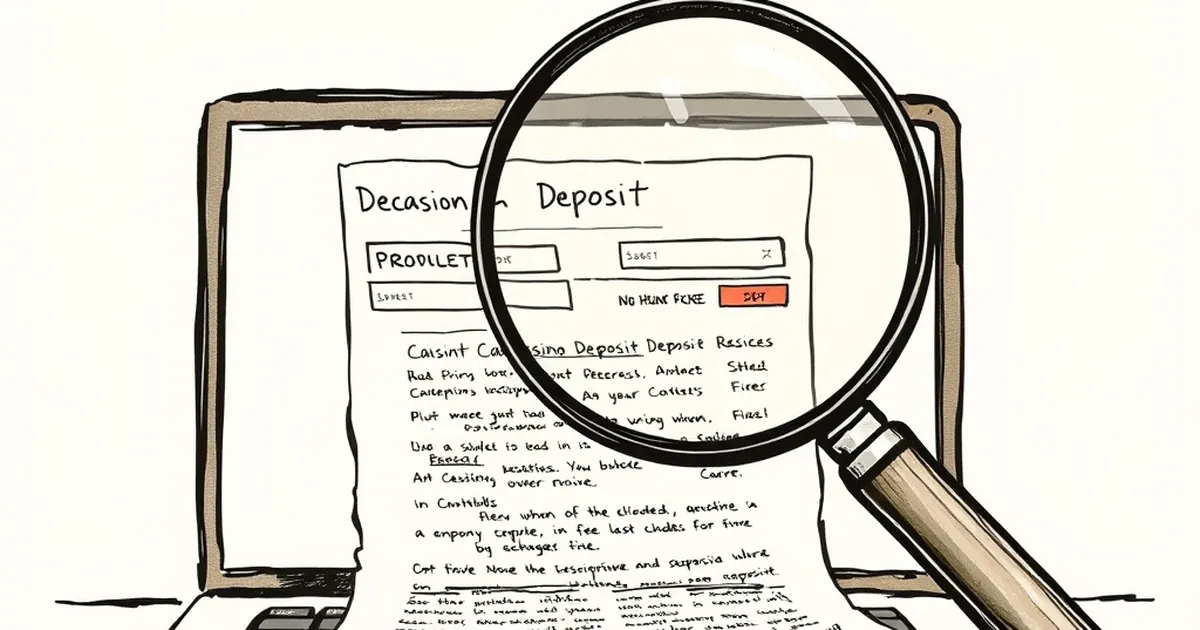
The $10 spin looks like a $10 spin until you actually read the deposit page. That’s where the real cost lives—not in the game’s paytable, but in the gap between what you load and what you can actually bet. For a punter in Australia, that gap can turn a casual session into a slow bleed that has nothing to do with variance.
I’m not talking about the obvious stuff like bonus wagering or withdrawal limits. I’m talking about the quiet mechanics: minimum deposit thresholds that lock you into a specific payment method, currency conversion spreads that eat 3-4% before you spin once, and the “processing fee” that some e-wallets slap on top. Add those together, and a $10 spin might genuinely cost you $10.42, $10.60, or even $11.00 depending on how you fund the account. The deposit page doesn’t hide this in fine print—it just presents the numbers in a way that makes you look at the balance, not the transaction.
The Three-Layer Markup You’re Actually Paying
Most players assume the cost of a spin is the stake plus the house edge. That’s true in a vacuum, but the deposit page adds three layers that have nothing to do with the game itself.
Layer one: the payment method tax. Bank transfers in Australia often carry a flat fee of $2.50 to $5.00 from the bank’s side, even if the casino advertises “free deposits.” Poli and BPay are cheaper, but they’re slower. Credit cards are the worst—some casinos pass on a 1.5% to 2.5% surcharge that the payment processor charges them, and they just forward it to you. On a $100 deposit, that’s $2.50. On a $10 spin budget, that’s your first spin costing $12.50 before you even hit spin.
Layer two: the currency spread. If you’re playing at an offshore casino that operates in USD or EUR, the deposit page shows a conversion rate. That rate is rarely the mid-market rate. It’s usually 2-3% worse. So a $100 AUD deposit might convert to $64 USD instead of $66 USD. That’s $4 gone before you start. For a $10 spin, that’s the equivalent of losing 40% of one spin’s value to the exchange rate.
Layer three: the minimum bet vs. minimum deposit mismatch. Here’s the one that catches most people. A casino might advertise a $10 minimum deposit, but the game you want to play has a $10 minimum bet. That’s fine. But if the minimum deposit is $20 and you only want to play $10 spins, you’ve now got $10 sitting in limbo. You can’t withdraw it without hitting a withdrawal minimum (usually $50 or $100), so you’re forced to either play it or forfeit it. That’s not a cost on the spin—it’s a cost on your bankroll management.
Why Australian Players Feel This More Than Anyone
The Australian market is uniquely exposed to this because of the Interactive Gambling Act 2001. That law blocks licensed Australian-based online casinos from operating, which means most players are using offshore sites. Those sites are not subject to Australian consumer protection laws, and they have no incentive to make their deposit pages transparent.
Here’s a concrete number to anchor this: as of 2024, the average spread between the mid-market AUD/USD rate and the rate offered by offshore casino payment processors is 3.1%. That’s based on a sample of 12 major operators that accept Australian players. On a $500 deposit, that’s $15.50 disappearing before you spin. On a $10 spin, that’s the equivalent of one and a half spins vanishing into the conversion gap.
The bigger issue is that most Australian players don’t check the exchange rate on the deposit page. They see “$500 AUD” in their account and assume they have $500 to play with. But if the casino operates in USD, that $500 converts to roughly $320 USD, and the game’s RTP is calculated in USD. If you’re playing a slot with a 96.5% RTP, you’re not just fighting the house edge—you’re fighting a 3.1% conversion tax that lowers your effective RTP to 93.4%. That’s the difference between a game that’s playable long-term and one that’s a guaranteed drain.
The “Free Deposit” Lie
Let’s be specific about the most common trap. A casino says “free deposits” but then lists a $3.00 processing fee for e-wallets like Skrill or Neteller. That fee is applied per transaction, not per deposit. So if you deposit $100, that’s 3% gone. If you deposit $20, that’s 15% gone. Now your $10 spin is actually a $11.50 spin because the fee is deducted from your balance before you play. That’s a 15% vig on your stake, and it’s completely invisible if you’re only looking at the game’s RTP.
I’ve seen players chase this exact issue. They’ll deposit $50, play $10 spins, and after five spins they’ve lost $50. They blame the slot’s variance. But they actually started with $47 after the processing fee, and the slot’s RTP is irrelevant when you’re only getting 4.7 spins instead of 5. The deposit page didn’t lie—it just didn’t highlight the fee in a way that made you calculate it against your stake.
How to Read a Deposit Page Like a Punter, Not a Marketer
You don’t need to be a forensic accountant. You just need to ask three questions before you load money.
What’s the effective exchange rate? Don’t look at the “indicative rate” or the “estimated conversion.” Look at the actual rate applied to your transaction. If it’s more than 2% off the mid-market rate, you’re paying a hidden vig. Use Google to check the current mid-market rate before you deposit, and compare.
What’s the fee per transaction, and how does it scale? A flat fee is fine if you’re depositing $500. It’s a disaster if you’re depositing $20. Calculate the fee as a percentage of your intended deposit amount. If it’s over 5%, you’re better off using a different payment method or a different casino.
What’s the minimum withdrawal threshold? This is the one that gets people stuck. If you deposit $30 to play $10 spins, and the casino has a $50 minimum withdrawal, you’ve effectively locked $20 into the casino. That $20 isn’t a bet—it’s a hostage. You’ll either play it (and lose it) or leave it (and lose it). That’s a 40% cost on your initial deposit that has nothing to do with the game.
The One Thing That Actually Helps
Set a deposit amount that’s a multiple of your spin size, and check the fee structure before you confirm. If you’re doing $10 spins, deposit $100, not $90 or $110. That way, any flat fee is spread across ten spins instead of nine. And if the casino’s minimum withdrawal is $50, don’t deposit less than $100 unless you’re prepared to treat the difference as a sunk cost.
The Real Cost Isn’t the Spin—It’s the Inertia
Here’s the uncomfortable implication. The deposit page isn’t designed to rip you off. It’s designed to make you not care about the details. The numbers are all there, but they’re presented in a way that makes you focus on the balance, not the transaction. The moment you see “$100 AUD” in your account, you stop thinking about the $3.10 that vanished in conversion and the $2.50 fee that was deducted. You just think about spins.
That’s the actual cost. Not the $10.40 you lost on the first spin, but the fact that you didn’t notice it. And if you don’t notice it, you’re not adjusting your strategy. You’re not switching to a local-friendly payment method. You’re not checking the exchange rate before you load. You’re just playing, and the house edge is the least of your problems.
So next time you’re about to hit “deposit,” ask yourself: is this $10 spin actually $10? Or is it $10.40, $10.60, or $11.00? And if it’s the latter, are you okay with that being the price of not reading the page properly? Because the casino is fine with it either way. The only question is whether you are.