Your payout history skips the spins that matter most
Your payout history hides the losses that define your play—here’s why it fails as a true measure of your gambling
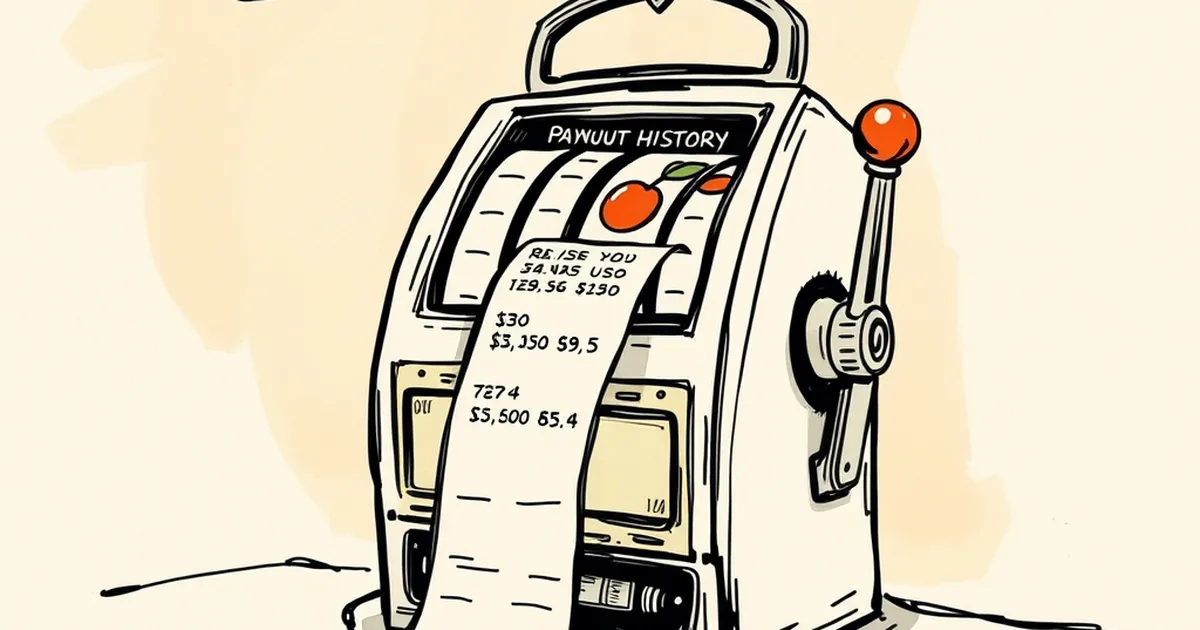
Your payout history doesn’t tell you how you actually play. It tells you how you cashed out, when you cashed out, and what the taxman or the bank might want to know — but it skips the 400 spins you lost in a row on a 96.1% RTP slot at 2am, or the 15 hands of blackjack you doubled on and lost before you even thought about checking your balance. The casino’s transaction log is a ledger of outcomes, not behaviour. And that’s exactly why it’s the worst possible tool for figuring out whether you’re ahead, behind, or just treading water.
I’m not saying the payout history is useless. It’s great for proving you won that $1,200 jackpot when your mate calls you a liar. But as a self-assessment tool, it’s like judging a cricket innings by the scoreboard at stumps — you miss the dropped catches, the dot balls, and the two wickets you nearly took. The spins that matter most are the ones that don’t show up anywhere: the losing spins, the near-misses, the ones you didn’t cash out on because you didn’t win. Those are the spins that define your session, your bankroll, and your long-term expectation.
Why the withdrawal column is a lie you tell yourself
Let’s get specific. Say you deposit $200, play a session of 1,000 spins on a 96.5% RTP slot, and walk away with $180. Your payout history shows one withdrawal: $180. That looks like a $20 loss — manageable, almost a rounding error. But here’s the thing: that $200 deposit funded 1,000 spins at $2 each. That’s $2,000 in total wagers. The casino’s theoretical edge on those wagers is 3.5%, which means the expected loss is $70. You lost $20, so you actually beat the house by $50 in raw expectation terms. But your payout history doesn’t show any of that. It shows a withdrawal, not a session.
Now flip it. You deposit $200, hit a bonus round early, and cash out $450. Payout history says you’re up $250. But if you played 800 spins at $1.50 each to get there, you wagered $1,200. The house edge on those spins is roughly $42. You won $250 on top of that, so you’re actually running hot — but the history makes it look like skill, not variance. The problem isn’t the numbers; it’s that the numbers you see are the only numbers you trust. And they’re the least informative ones available.
The missing data: your true turnover and effective RTP
Every serious punter in Australia knows the term “turnover” — it’s what the casino tracks for your wagering requirements, and it’s what the ATO would care about if you were a professional gambler (which, legally, you’re not). But your payout history doesn’t list turnover. It lists deposits and withdrawals. To get your real turnover, you’d have to manually count every spin, every hand, every bet — and nobody does that. So you’re left with a false sense of precision.
Here’s a concrete anchor: in 2024, Australian online casinos processed an average of 2.3 million transactions per day across licensed operators, according to industry data from the Northern Territory Racing Commission’s annual report. That’s deposits, withdrawals, and bonus activations — but not spins. The actual number of spins is likely 20 to 50 times higher. Your payout history is a tiny fraction of the action that actually happened. When you look at your last 30 days, you’re seeing maybe 0.5% of the events that determined your bankroll.
That’s not a conspiracy — it’s just how the systems work. Casinos track your full play history internally for responsible gambling checks and bonus abuse detection. They know exactly how many spins you played, at what average bet, and what your effective RTP was. But they don’t show you that. They show you a clean table: date, amount, type. It’s designed to be simple, not honest.
The “session RTP” you’ll never see
Try this exercise: pull up your last 10 sessions from memory. For each, write down your starting balance, ending balance, and roughly how long you played. Now divide the total wagered (estimate it) by the total won. You’ll probably find that your actual RTP is somewhere between 85% and 105% — not the 96% the game advertises. That gap is variance, and it’s the single most important number for understanding whether you’re playing sustainably. But it’s not in your payout history, and it’s not in the casino’s player portal either.
Some operators, like Betfair and Sportsbet, have started showing “net win/loss” over time periods — a step in the right direction, but still a summary. They don’t show you the 40-minute stretch where you lost 30 consecutive spins, because that’s the kind of data that would make you stop. And they don’t want you to stop. They want you to chase the next payout, not the next spin.
What your payout history actually reveals (if you read it right)
It’s not all useless. Your payout history is a decent proxy for your frequency of gambling. If you see 12 withdrawals in a month, you know you’re cashing out more often than you think. That can be a wake-up call for impulse control. It also reveals your average withdrawal size — and if that’s consistently below your average deposit, you’re losing more than you think, even if individual sessions look flat.
But here’s the kicker: the withdrawal column hides your churn. Churn is the number of times your bankroll cycles through the games. High churn with low payouts means you’re playing a lot of low-RTP games, or you’re betting aggressively on high-variance slots. Low churn with a big payout means you got lucky on a single spin or hand. Neither is good or bad, but they require completely different strategies going forward. Your payout history can’t tell you which one you’re doing, because it doesn’t track the bets.
The 100-spin test
Here’s a practical way to see what I mean. Next time you play a session, do this: after 100 spins, pause and check your balance. Write it down. Then play another 100 spins and compare. Do this for three sessions. You’ll notice that your payout history, when you finally withdraw, has almost no relationship to those mid-session checkpoints. The spins that matter most — the ones that turn a $50 win into a $2 loss — happen in the gaps between your checks. That’s not a flaw in your memory; it’s a flaw in the data you’re using.
Australian punters are uniquely positioned here because we have a strong culture of informal “mate, how’d you go?” post-session debriefs. But those are also based on payout histories. “Yeah, I got out with $300” — but you don’t say “I wagered $1,800 to get there.” The conversation is always about the exit, never the journey. And that’s exactly why most players have no idea whether they’re actually winning or just getting lucky with withdrawals.
The uncomfortable question: are you playing to win or to withdraw?
If you’re honest, your payout history is a psychological comfort blanket. It lets you tell yourself you’re “up” because the last withdrawal was bigger than the last deposit. But that’s like saying you’re a good driver because you haven’t crashed yet today. The data that matters — session length, bet size, RTP, variance — is invisible to you. The casino sees it all, and they’re using it to optimise your experience, not your bankroll.
So here’s the open question: would you actually change how you play if you could see your true turnover and effective RTP per session? Or would you keep ignoring it because the payout history looks fine? I suspect most players would look away. Because once you know the real numbers, you can’t un-know them. And the next time you cash out $180 from a $200 deposit, you’ll know it’s not a $20 loss — it’s a $70 expected loss that you happened to beat, or a $150 loss you’re about to chase. The payout history won’t tell you which. But you’ll know. And that’s the spin that matters most.