Poker time bank runs 30s — the tank on hand 2 takes 90
A 90-second tank on hand two of a $22 tournament defies the standard 30-second poker time bank, raising questions about how the clock is really enforced
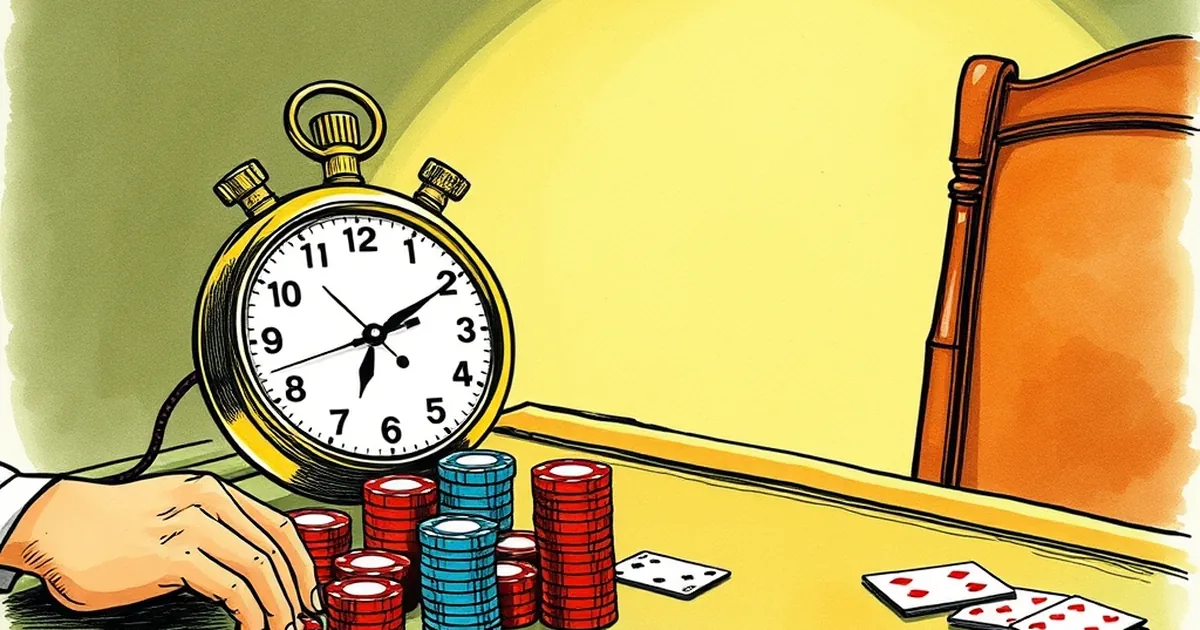
Poker's standard time bank gives you 30 seconds on top of whatever the clock allows. On hand two of a tournament, one player burned 90. That's three banks' worth on a pot with blinds at 100/200 and no real history between anyone at the table. It wasn't a Hollywood act for the cameras either — this was a $22 buy-in on a Tuesday night, the kind of game where a 90-second tank is more likely to get you timed out than paid off.
The maths is simple and that's what makes it interesting. If a site enforces a 30-second bank, the tank on hand two should have been impossible. Either the clock wasn't enforced, the player had stacked banks from earlier, or the "30 seconds" in the client is a suggestion rather than a rule. All three happen, and all three change how you should think about the button.
What a time bank actually is, and what sites don't tell you
Most Australian-facing rooms — the offshore ones that take Aussie players since the Interactive Gambling Act pushed the big licensed operators out — run some version of a time bank. Ignition, for example, gives you a fixed pool per tournament rather than per hand. Others, like the GG network skins, reset a smaller bank each decision. The difference matters more than the number on the marketing page.
A per-hand bank of 30 seconds is a hard cap. You get 30, you use 30, the hand is over. A pooled bank of, say, 60 seconds per blind level is cumulative — you can spend 5 seconds on twenty hands and then dump 55 on one river decision. That's how a 90-second tank becomes legal on a site advertising "30 second time bank." The player didn't cheat. They saved.
The third model, and the one that trips people up, is the soft clock. The client shows a countdown but the server only auto-folds after a longer interval — often 60 to 120 seconds — because the site would rather let a hand finish than kill it mid-action. If you've ever watched a player sit frozen past zero and still get to act, you've met the soft clock.
Why the tank on hand two is different from a tank on the bubble
Early in a tournament, the chips at stake are small and the information is thin. Nobody has reads. A 90-second decision on hand two isn't buying you a better call — it's buying you a look at how five other players react to the delay. Who sighs in chat. Who calls the clock. Who starts playing faster because they're annoyed. That's free scouting, and it costs the tanker nothing but a bit of table image they didn't have yet.
On the bubble, the same 90 seconds carries ICM weight. You're not gathering reads, you're doing the fold-equity maths against a pay jump. Different problem, different solution, and the sites know it — which is why some rooms shorten banks as the field narrows.
The three ways a 30-second bank becomes 90
If you're the one being tanked on, the useful question isn't "why is this allowed." It's "which of these is happening."
Pooled bank. Check the tournament info tab. If it says "time bank: 30s per level" rather than "per hand," the tanker has been saving since the first orbit. Nothing to report.
Soft clock. Watch the next two hands. If players routinely act after the visible timer hits zero, the enforcement is cosmetic. You can either exploit it yourself or accept that the room runs loose.
Stacked banks. Some sites let banks carry across rebuys or accumulate per blind level without a cap. A player who late-registers into level four can arrive with 120 seconds banked. That's your 90 right there.
None of these are bugs in the strict sense. They're design choices, and they favour the patient player over the impatient one.
What 90 seconds actually costs you
Here's the number that matters. In a standard turbo with 5-minute levels, a 90-second tank eats 30% of a blind level. Do that four times and you've effectively played a level and a bit less than everyone else at the table — same blinds, fewer hands, less chance to accumulate. The tanker isn't just annoying you. They're shortening the tournament for both of you, which in a fast structure is a real edge for anyone who's already ahead on chips.
In a slower structure — 10 or 15-minute levels — 90 seconds is noise. That's why the tank on hand two reads as amateurish in a deepstack and tactical in a hyper. Context is the whole story.
There's a second cost that doesn't show up in the maths: attention. Every long tank pulls the table's focus onto one player. If you're multi-tabling four tournaments, a 90-second pause is 90 seconds you're not spending on the other three. Regs who play eight tables at once feel this more than anyone, and it's why you'll see them call the clock faster than casual players will.
Calling the clock in Australia
Most offshore rooms require you to have been in the hand or to have already folded before you can request a clock. The request usually triggers a 10 to 30-second countdown, then an auto-fold if the player doesn't act. On some skins the request is silent — the tanker doesn't know who called it. On others, your name flashes up in the chat. If table image matters to you, that's worth knowing before you click.
Casual rooms tend to police this socially rather than mechanically. Someone types "clock?" in chat, the tanker speeds up, everyone moves on. That works until it doesn't, and then you're stuck watching a soft clock tick past zero for the third time in an orbit.
The read you can actually take from it
A player who tanks 90 seconds on hand two is telling you something, and it's usually not that they're strong. Strong hands early in a tournament want action. They bet, they raise, they build a pot while the blinds are cheap. A long tank on a marginal decision — a bluff-catcher, a thin value bet, a coin-flip call — signals uncertainty, and uncertainty at 100/200 with no reads is a player who hasn't worked out what they're doing yet.
The exception is the player who tanks deliberately to set up a later image. If the same person snap-calls a big bet on hand twenty, the hand-two tank was theatre. That's a level most $22 field players aren't operating on, but it exists, and it's the reason you shouldn't write off a tanker as weak without a second data point.
What the clock is really measuring
If a site advertises 30 seconds and a player takes 90, the site isn't lying — it's defining "time bank" in a way that suits its server load and its tolerance for stalling. Your job as a player is to find out which definition applies before it costs you a level. The open question is whether rooms will ever standardise this, or whether the soft clock stays a quiet feature that only the regulars notice. Given how much of the offshore market runs on the same white-label software, don't hold your breath. Gamble within what you can afford to lose, and if a table's clock is being abused, you can always stand up — the blinds will find someone else.