How slot machine odds and payouts actually work
Slot odds, payout tables and RTP are three separate things, and understanding how each works explains why hot and cold machines are a myth
5 min
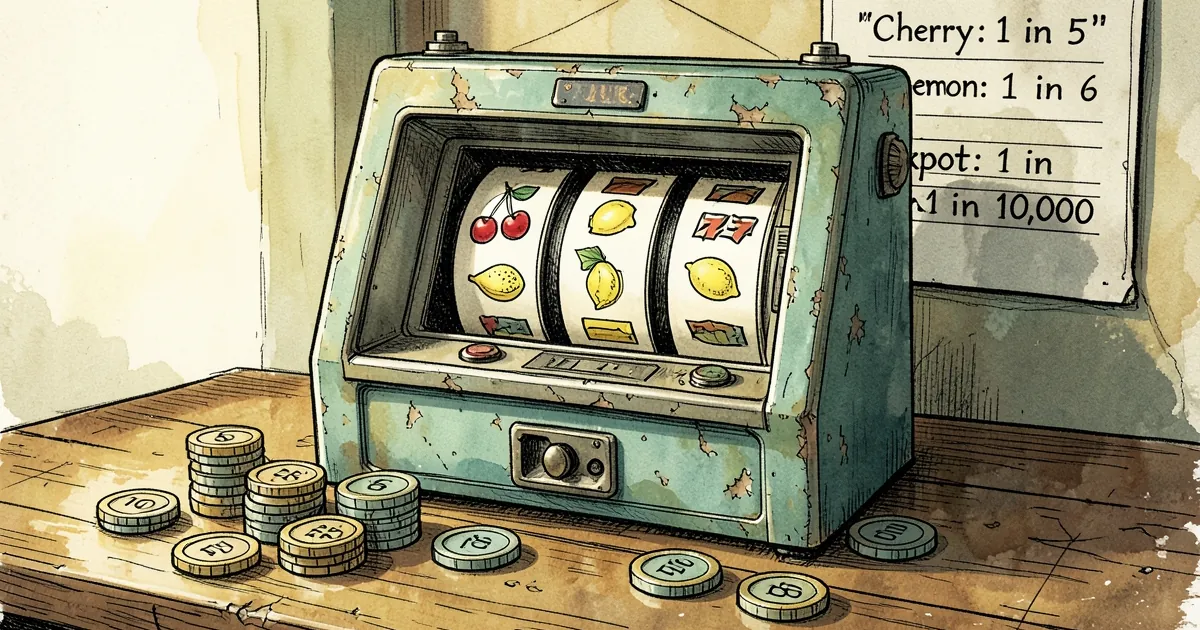
Slot odds aren't a property of your session. They're a property of the machine, calculated over a working life of roughly a million plays, which is why a 90% game can hand you 300% of your stake across an hour and still be a 90% game. The payout table tells you what each combination pays when it lands; the odds decide how often it lands; and the RTP sits above both of them, describing an average nobody is promised. Once you separate those three things, most of the confusion around slots — hot machines, cold machines, "due" machines — falls away.
What RTP actually measures, and over what
Return to player is a long-run average: the share of total turnover a machine returns as winnings over its lifetime. In Queensland, gaming machines are required to return between 85% and 92% over that lifetime, according to the state government's business department. Read that carefully. It's not per session, per player, or per night. It's an average across every bet the machine ever takes.
The Victorian regulator is blunter about it: poker machines in that state must meet a minimum return generally around 85% or higher, calculated over thousands or millions of spins, and it explicitly does not apply to a single player or a single session. The same page notes Victorians lost more than $3 billion on pokies in 2024–25 alone. That's the other side of the same arithmetic — a return rate of 85–92% means a house take of 8–15% of everything staked, compounding quietly across a state.
Queensland's guidance adds a detail most players never hear: machines typically run for three to four years and handle about a million turnovers, and the return is paid out across that whole life, not within your visit. So when a machine pays a jackpot, it hasn't "used up" its goodwill for the evening, and when it's been quiet for an hour, it hasn't stored any up.
The 1-in-7-million number
For a sense of scale on top prizes: Queensland's guidance puts the chance of hitting the top prize at about 1 in 7,000,000 when playing maximum lines, ways or patterns. That's not a number that improves with persistence. It's the same on spin one and spin ten thousand. If you're comparing what a max-win actually costs you in expectation, there's a piece on why slot filters hide the real max win odds that covers the gap between advertised prize and advertised likelihood.
Why the payout table and the odds are different documents
The paytable is the visible half. It lists symbols and combinations and what each pays — three of a kind at 25x, five scatters at 500x, and so on. What it doesn't tell you is how the reels are weighted. Modern slots use virtual reels: the odds of any symbol landing aren't the physical count on the visible strip, they're set by how often that symbol appears in the internal reel mapping. Two games can show identical paytables and have wildly different RTPs because their reel weights differ.
That's before volatility enters. Two machines at 96% can behave nothing alike: a low-variance game dribbles out small wins often, a high-variance one sits dead for 400 spins and then pays 800x. Neither is broken. The RTP is identical; the distribution of outcomes is not. If you've read the argument that slots forgive you at spin 73, not before, that's the same idea from the player's side — the payout pattern is lumpy by design, and patience isn't a strategy so much as a description of variance.
What "hit frequency" adds
Hit frequency is the percentage of spins that return anything at all, including less than your stake. A game with 28% hit frequency and 96% RTP is paying small amounts often; a game with 12% hit frequency and the same RTP is paying bigger amounts rarely. Neither is better. But hit frequency explains why some sessions feel like a slow bleed and others feel like a rollercoaster, even when the maths underneath is identical.
The regulatory floor is not a recommendation
Here's where jurisdictions diverge, and it matters if you play across borders. Australia's state-based floors sit around 85%, which is low by global standards. Many online slots run 94–97%. The gap between an 85% machine and a 96% machine is not 11 percentage points of "fun" — it's roughly a tenth of your turnover versus a twenty-fifth, compounding.
Regulators elsewhere intervene differently. Since 9 April 2025, online slots in Great Britain have carried a maximum stake of £5 per game cycle for players aged 25 and over, with a £2 limit for 18–24s from 21 May 2025, per European Gaming Industry News. That's a stake cap, not a return cap — a different lever aimed at a different problem. The point is that "the odds" you're playing against are partly a product of where the licence was issued, and that's before the operator's own configuration.
Sessions, not machines
Because RTP is a lifetime figure, anything you observe in a session is noise. A machine that's paid well for an hour is not "hot"; it's early in a distribution that will even out somewhere you'll never see. The same logic applies to bonus mechanics: a meter that fills at a fixed rate per spin is a clock, not a mood. There's a useful breakdown of that in what 12 spins per minute costs the bonus meter — speed changes your exposure, not the machine's generosity.
If you're auditing your own play, the honest measure isn't whether you're up. It's turnover multiplied by the house edge, which gives you the expected cost of the session before it starts. A $1 stake at 90% RTP over 600 spins costs $60 in expectation. You might finish up $200. The expectation doesn't care.
Where the money actually goes
Payouts are funded by losses, and losses are structural. An 85% floor means the operator keeps 15 cents of every dollar staked over the machine's life; a 97% online slot keeps three. The difference funds everything from the licence fee to the affiliate programme to the withdrawal queue — and yes, the queue is a real cost centre, as covered in KYC clears in 90 seconds — the withdrawal queue takes 3 days. None of this is hidden; it's just not advertised next to the jackpot figure.
The responsible-gambling angle isn't a footnote here, it's the arithmetic. If you're playing a game with an 85% return and a $1 spin at 500 spins an hour, your expected loss is $75 an hour. That's the number to set against your entertainment budget, not the jackpot. Set a limit before you start, and treat the machine's lifetime RTP as the only figure that's actually true.
The question worth asking
So here's the open question. If RTP is a lifetime average that no individual player will ever experience, and stake caps are the regulatory tool of choice in some markets while return floors are the tool in others, which one actually protects players? A £5 cap limits the damage per spin; an 85% floor limits the damage per dollar. Neither stops a determined player from losing a lot of money slowly. And as machines get more configurable — variable volatility profiles, adjustable hit frequency, operator-side RTP bands — the gap between what the paytable promises and what the maths delivers gets wider, not narrower. The odds are published. Whether anyone reads them before pressing spin is a different problem entirely.