Roulette's house advantage: 2.7% on a single-zero wheel
Roulette's 2.7% house edge on a single-zero wheel comes straight from the wheel's geometry, rising to 5.26% when a second zero is added
5 min
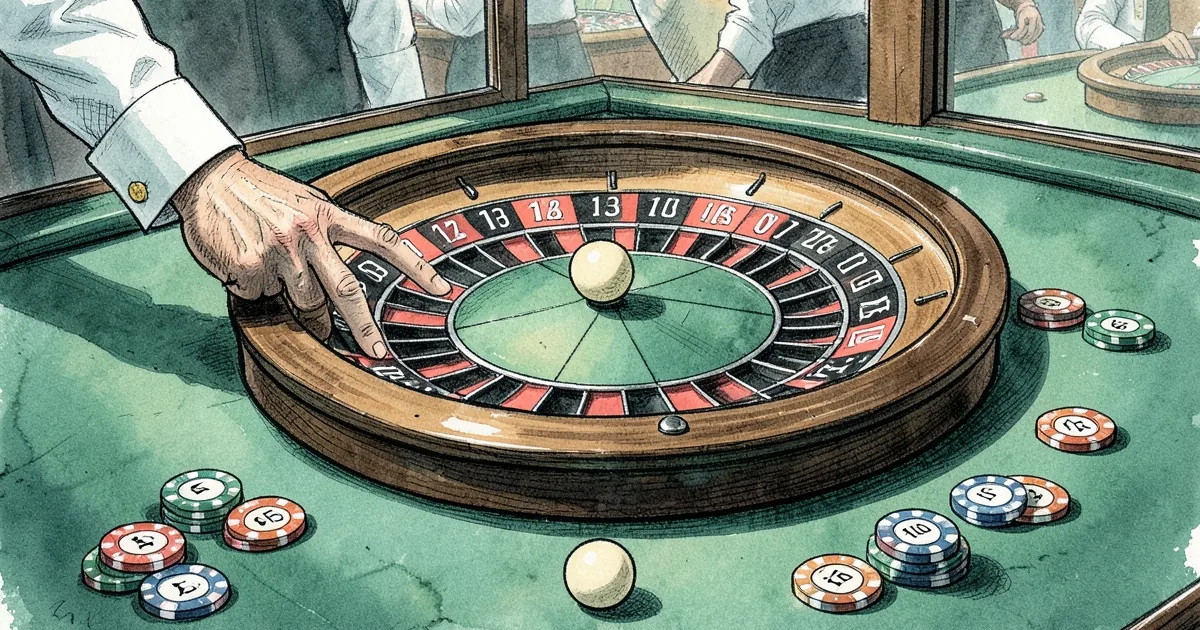
The house advantage in roulette is 2.7% on a single-zero wheel, and that figure is not a marketing estimate — it falls straight out of the wheel's geometry. Thirty-seven pockets, one green zero, and every payout on the layout calculated as though that zero didn't exist. The University of Melbourne puts the double-zero figure at 5.26%, which is the same maths with an extra pocket working against you.
So the short answer to "what is the house advantage in roulette" is: 2.7% on a European wheel, 5.26% on an American one. What follows is why those numbers land where they do, where each wheel turns up, and what the difference is actually worth to you over a session.
Where 2.7% comes from
A single-zero wheel has 37 pockets: the numbers 1 to 36 plus one zero. Any individual number has a 1-in-37 chance of coming up, as OLG PlaySmart spells out. Fair odds on a single number would therefore pay 36 to 1 — you'd win 36 units for every 1 you risk, and across 37 spins your expected return would be exactly zero.
The casino pays 35 to 1 instead. That missing unit is the whole edge. As one patent filing on roulette game design puts it, the expected value of a bet is −1/37 of the stake, which works out to roughly 2.7%.
Run it longhand. Thirty-seven spins at 1 unit on a single number costs you 37 units. You expect to win once, collecting 35 units plus your original stake back — 36 units in total. Net position: down 1 unit on 37 units staked, or 2.7%.
The neat part is that this holds across almost the entire layout. Red or black, odd or even, high or low, dozens, columns, splits, streets, corners, six-lines — all of them converge on the same 2.7% on a single-zero wheel. The zero is a pocket that pays nothing on any of those bets, and the payouts are all calibrated to a 36-pocket wheel. One extra pocket, uniformly skimmed.
The exception is the five-number basket bet (0, 00, 1, 2, 3), which only exists on double-zero layouts and carries a notably worse edge. On a single-zero wheel you can't make it. The 2.7% edge rides on 37 pockets, and the last one pays 35 — that's the whole mechanism in one sentence.
Why 5.26% is the number you want to avoid
Add a second zero and the wheel has 38 pockets. The chance of any number drops to 1 in 38, but the payout stays at 35 to 1. Now 38 spins at 1 unit cost 38, and your single expected win returns 36. Down 2 units on 38 staked — 5.26%.
That's nearly double the edge for an identical-looking game. Same layout, same chips, same spin. The only difference is a green pocket most players never look for.
Double-zero wheels dominate in the United States, Canada, South America and the Caribbean, according to the widely cited geography of the game. Outside those regions the single-zero wheel is the norm. For Australian readers that's good news: the Queensland Office of Liquor and Gaming Regulation notes that most Australian casinos use wheels with only one zero and no double zero. If you're playing in Sydney, Melbourne, Brisbane or the Gold Coast, you're almost certainly on the 2.7% version.
Worth checking anyway. "Most" is not "all", and a venue that quietly runs an American wheel is offering you a game with roughly twice the built-in cost. It takes three seconds to look at the felt.
The 1843 change that stuck
The single-zero wheel wasn't inevitable. François and Louis Blanc introduced it at the Bad Homburg casino in Germany in 1843, and it spread across Europe from there. The double-zero layout persisted in the Americas largely through separate development and, later, regulatory inertia. Nearly two centuries on, the difference between the two traditions is still worth 2.56 percentage points to the house.
What 2.7% costs in practice
Percentages are easy to nod at and hard to feel. Convert it to money.
At 2.7%, every 1,000 AUD cycled through a single-zero roulette table has an expected cost of about 27 AUD. At 5.26%, the same 1,000 AUD costs roughly 53 AUD. That's the entire practical difference between the two wheels, and it scales linearly. Ten thousand through the cage is 270 versus 526.
Two things follow from that, and both are easy to get wrong.
First, the edge is charged on turnover, not on your starting bankroll. If you buy in for 200 and cycle it five times over an evening, you've turned over 1,000 and the expected cost is 27 — not 5.40. Players who track their losses against their deposit rather than their total staked routinely underestimate what the wheel is taking.
Second, 2.7% is an average over a very large number of spins. In a hundred spins the variance swamps it completely. You can be well ahead after 200 spins on a double-zero wheel and well behind after 200 on a single-zero one. Fifty spins in, the house edge stops being theoretical only in the sense that the drift becomes visible; it takes far longer for the number to assert itself reliably.
Where the zero really bites is streaks. A run of reds feels like a pattern until you count how often the green pocket interrupts it. The zero tends to eat your streak before spin 20 more often than intuition suggests — not because the wheel is rigged, but because a 1-in-37 event arrives sooner than most people's mental model allows for.
And if you're covering the table with neighbour bets or call bets to smooth out the swings, check the maths first: those hedge bets can carry vig closer to 9% depending on the layout and the numbers covered. Hedging a 2.7% game with a 9% bet is not risk management.
The number that doesn't move
Every strategy you've read about — martingale, Labouchere, waiting for five reds, tracking hot numbers, switching to a different section of the felt — operates on top of a fixed 2.7%. None of them change it. Progression systems change the shape of your outcomes, not their expected value; they trade many small wins for occasional large losses, and the average stays put.
The only levers that genuinely move the number are structural: play single-zero rather than double-zero, avoid the five-number basket if you ever find yourself on an American layout, and don't wrap a low-edge bet in high-edge side bets. That's it. Everything else is presentation.
Which raises the question worth sitting with. If the difference between 2.7% and 5.26% is a single green pocket, and most players never check which wheel they're on, how much of the money lost at roulette tables worldwide is going to a design flaw rather than to the game itself? The answer is uncomfortable, and it's sitting right there on the felt.